Brunello Cucinelli’s Foray Into Wine
The Italian fashion designer focuses on human dignity and respect for nature with his Castello di Solomeo wines

The small Umbrian medieval hamlet of Solomeo is an unepected place for a fashion empire. The last official census data in 2011 put the population at 456 residents, and it hasn’t ticked upward much since. Looking for dinner? The only restaurant in the area makes it an easy decision.
This sleepy village is where designer Brunello Cucinelli centers his multi-billion-dollar cashmere business. He has spent 25 years and millions of dollars restoring the village, which now includes a theater, a castle-turned-school for crafts, a restored church—and soon, a library. On the valley floor of this hilltop town are where much of Cucinelli’s design and production facilities reside. But the newest addition to Cucinelli’s world has nothing to do with clothing: it’s a winery where Cucinelli’s wine, Castello di Solomeo, is produced.
For celebrities, wine often serves as a vanity project, but Cucinelli sees it as a part of what he calls “humanistic capitalism,” focusing on sustainability that puts people’s well-being central in all work.
Cucinelli holds a deep appreciation for the arts and philosophy, and he weaves concepts of nature, beauty and history into conversation. He grew up poor, but says it gave him an appreciation for balance in the world. “We were really living in keeping in harmony with creation, and that’s exactly what we need to rediscover,” he says.

Wine embodies all these concepts: it’s about agriculture and terroir, it’s a historical beverage, it requires a skilled human touch and, when finished, the best ones can be considered art. It makes sense that wine was his next endeavor.
He hired agronomist Michele Baiocco to establish the vineyard, and vines went into the ground in 2011. For a person whose ethos is all about local, from his nearby factories to a focus on Italian materials, his choice of grapes is surprising. The vineyard is planted with typical Bordeaux varieties: cabernet sauvignon, cabernet franc and merlot. Sangiovese is the only Italian grape with any vineyard real estate. When asked why the focus on French varieties, Cucinelli cited a preference for Super Tuscans, particularly Guado al Tasso, a traditional Bordeaux-style blend from the Tuscan coastal region of Bolgheri. But to him, the end wine is the least important aspect of what’s in the bottle.
“My hope was that our wine could represent a human dignity for the way it was made and the dignity of the earth,” he says. “I can vouch for that. If it’s good, even better. But if it were just an ordinary wine, everybody would still know that it was made whilst respecting human beings along the process. And that’s enough for me.”
We want to try and live always in balance, in harmony with creation. Every kind of work that we perform, whatever the segment, needs to really abide by respect.
Brunello Cucinelli
But this being Cucinelli, ordinary was never in the cards. Elsewhere in the world, burgeoning winemakers may share winemaking facilities — known as custom crushes — or rent out space at a friend’s winery to make wine. Building an entire production center and cellar is not an inexpensive endeavor, but that’s exactly what Cucinelli did.
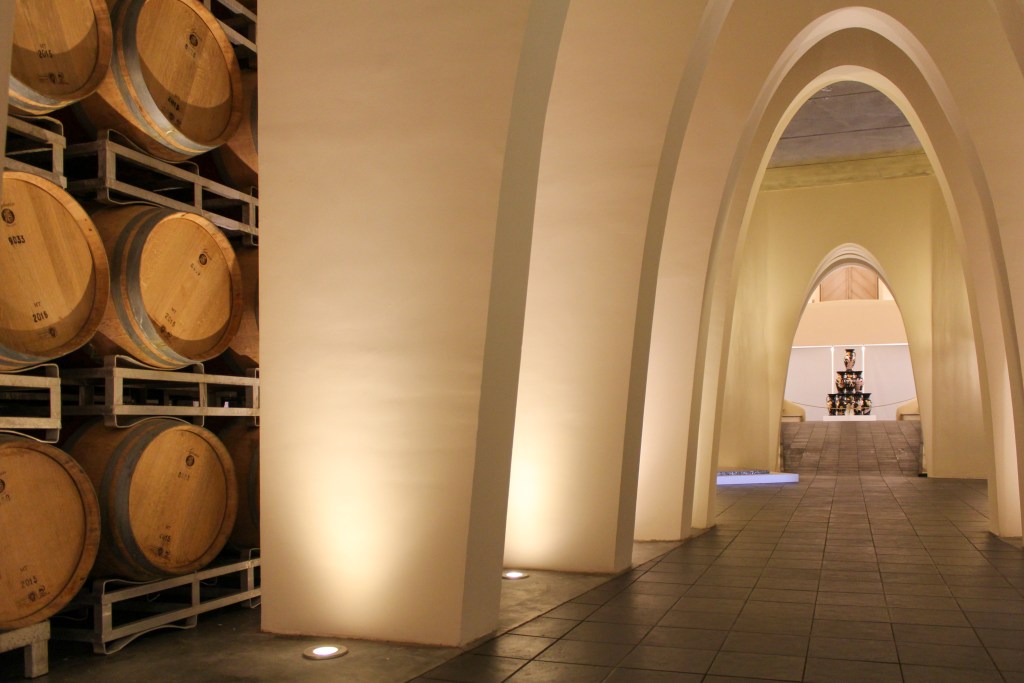
Walking through the winery is like walking through a church. 178,000 bricks, laid out in intricate formation, swoop overhead in the high arched ceilings. We found ourselves talking in hushed tones and cringing at our own loud footsteps on the stone floors. Barrels seemed like an afterthought in the cavernous space. For 9,000 bottles, it was quite an undertaking.
Yes, just 9,000 bottles are made of each vintage. And he intends to keep it that way.
Half of the production is sold exclusively on Fine + Rare, an e-commerce platform for collectible wine. A single bottle of the latest vintage, of which there are only three, sells for £300, but is mostly released as 3-bottle packs, upwards of £1,240. The other 4,500 is reserved for the winery’s collection and special events.
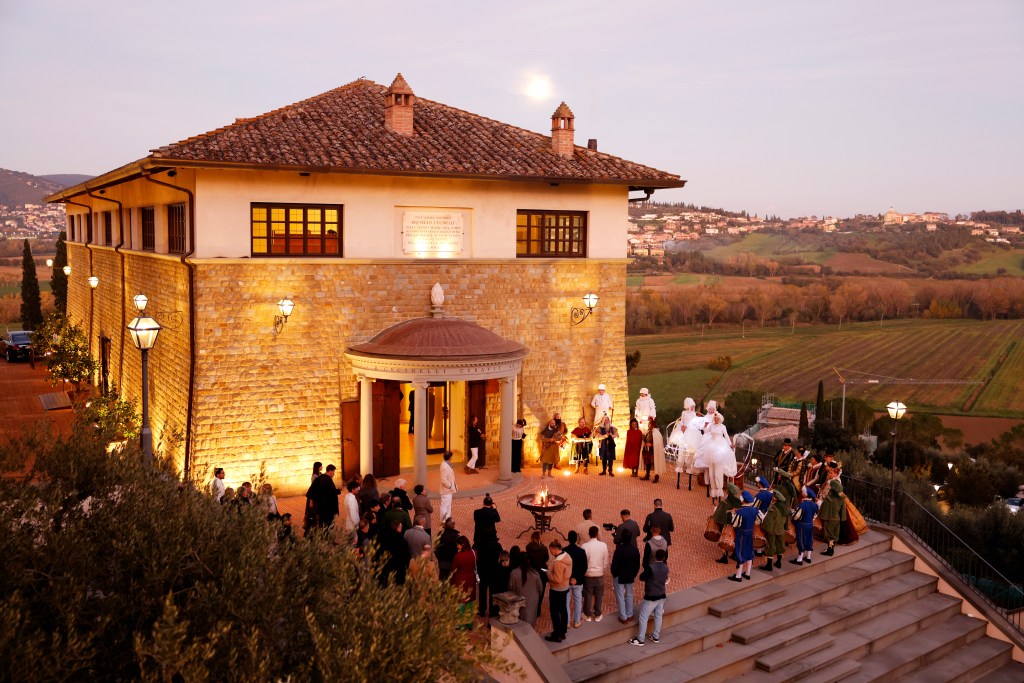
Events may be the next frontier for the winery. Wine is known to express its sense of terroir, and Cucinelli, who takes such pride in Solomeo, wants to convey its uniqueness to customers. Last November, he enlisted Pressoir—an experiential wine company that runs the Burgundy-focused La Paulée, La Fête du Champagne and more high-end wine events in the U.S.—to bring Solomeo to life and express all facets of his vision. The clock was turned back to medieval times: minstrels wandered the streets while basket makers and weavers demonstrated their craft in the narrow cobblestone alleys. Stations scattered throughout the hamlet poured Burgundy, Champagne and Bordeaux, a not-so-subtle indicator of where Castello di Solomeo wants to be positioned in the world of wine.
Luxury aside, producing Castello di Solomeo goes back to human capitalism, with proceeds from the sale of the wines will fund a project to build libraries in nearby villages. Art, commerce and humanity are deeply entwined at Castello Solomeo. “We want to try and live always in balance, in harmony with creation,” Cucinelli says. “Every kind of work that we perform, whatever the segment, needs to really abide by respect.”


What are your thoughts?