The 2026 Milano Cortina Winter Games Cauldron is for Everyone
This year’s Olympic Cauldron, designed by Balich Wonder Studio, symbolizes unity, peace and the continuation of time at Milan’s Peace Arch
The Olympic Games are not just about sport. Naturally, they are also about the values of fair play, respect, friendship, equality and peace. And, as in the current edition of the Winter Olympic Games in the Italian cities of Milan and Cortina, about harmony. Harmony among people from many places around the world. But also between humankind and nature, according to the mastermind of the recent Olympic Inauguration Ceremony, Marco Balich. Milan is a perfect example of a modern metropolitan city, while nearby Cortina, set against the staggering Dolomite Alps, is one of Italy’s most scenic destinations for ski lovers.
The acclaimed creative director and executive producer of worldwide institutional events—credited with a record 16 Olympic Ceremonies—worked specifically on this duality and set out to offer a world of initiatives and content accessible to as many people as possible. In Milan, the City Hall and the International Olympic Committee (IOC) followed this spirit with a rich cultural program for all sorts of minds, spread across the city.
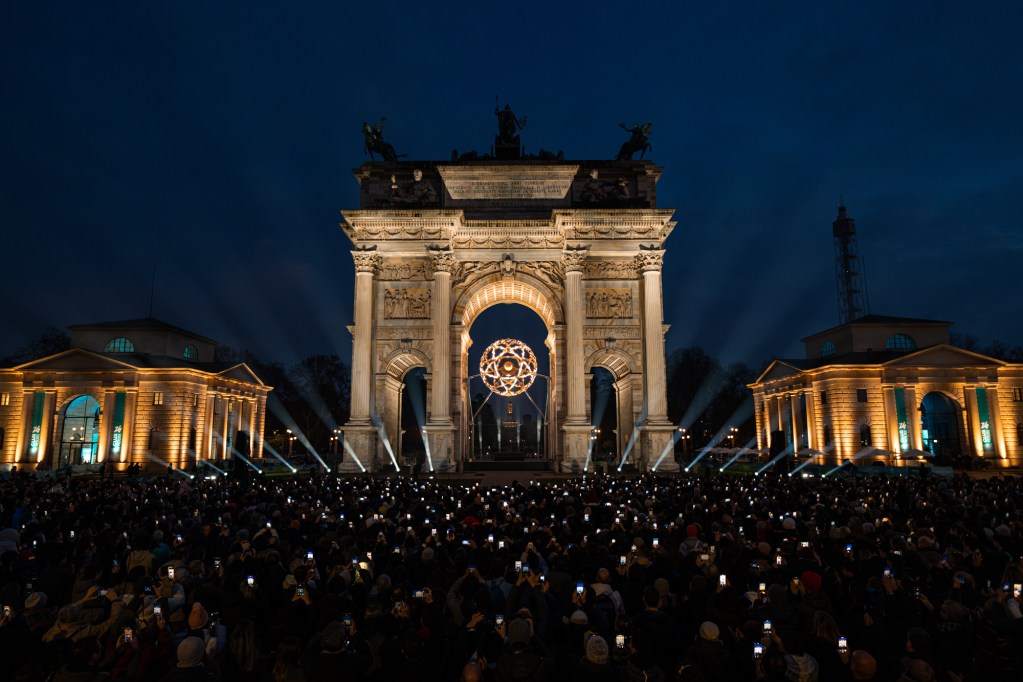
The most important symbol of the Olympic Games is the Cauldron. This edition prides itself with a very design-oriented and captivating cauldron. After an internationally applauded Inaugural Ceremony—the first widespread Olympic inauguration with simultaneous happenings in Milan and the three Games sites near Cortina—Marco Balich hosted a special presentation for a select group of media representatives at Milan’s Peace Arch. In the historic square, the Olympic cauldron has been strategically placed for all to enjoy, not just sports audiences. Similarly, a twin copy stands in the main square of Cortina.
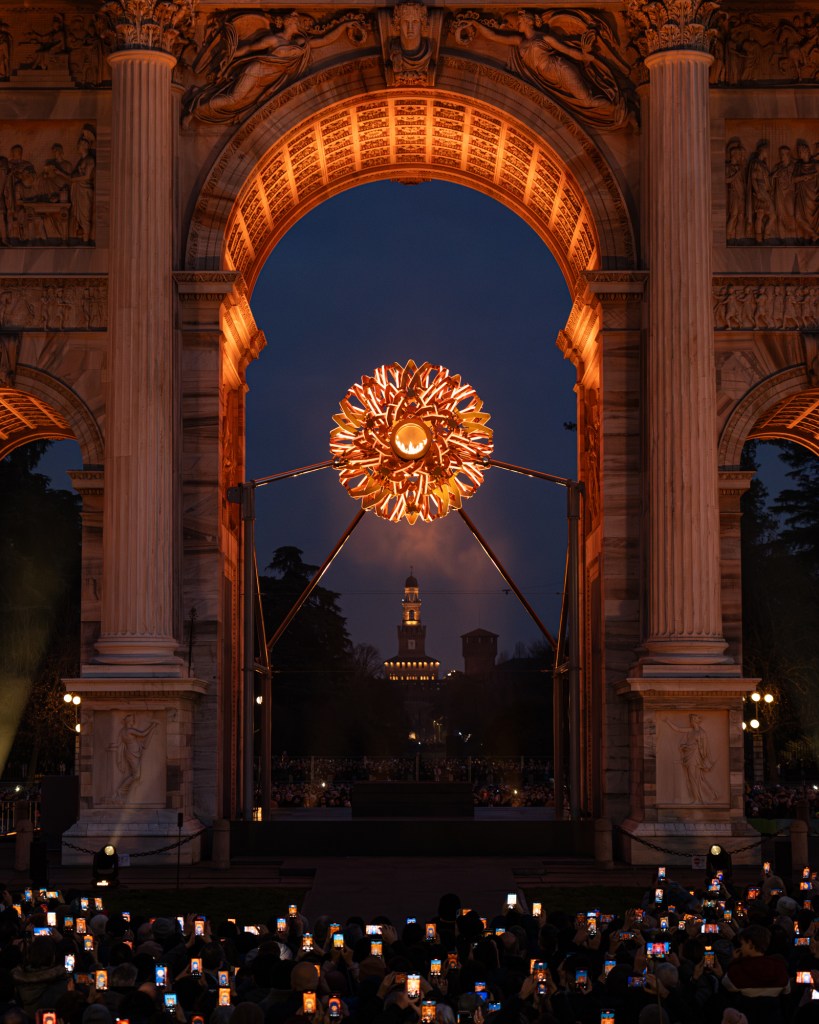
“It was generous of the Milan municipality to have the cauldron placed outside a sports arena so that everyone could come see it, says Balich. “I’m especially fond of the fact that families hang around and get to live a moment of the Olympics.” The installation features an hourly show every night between 6 pm and 11 pm, gathering crowds of hundreds—and sometimes even thousands. Lasting four minutes, it combines impressive lighting, music and movement.
The cauldron was designed by Balich with his long-time creative partner Lida Castelli and set designer Paolo Fantin as a post-contemporary tribute to something eternal, like the sun, as a source of life and power. It also bears a sign of Italian design history, with references to the geometric interlacing of Leonardo da Vinci’s knots. The cauldron was built by Fincantieri, one of the world’s leading shipbuilding groups, with a wholly Italian history dating back to the 1950s. It is made of aeronautical aluminum, an element that combines strength and lightness. The complex mechanical system integrates 244 pivot points and 1,440 components, mounted on pins and bearings.
Being the director of the greatest show on earth is a matter of humility. We chose not to be opulent, but rather elegant, celebratory and inclusive.
Marco Balich, Balich Wonder Studio cReative Director and executive producer
The cauldron is a dynamic structure intended to represent the continuity of time and the natural alternation between day and night. During the hourly show, it shifts in geometry and expands, reaching a diameter of 15 feet when fully open. Light emanates from the cauldron itself but is also projected onto the historic marble arch, using a palette of fire, dawn, sunset and the brightest sunlight. Engineering serves poetry at its best, and as such, it needed the best soundtrack. The cauldron’s epic music was scored specifically by contemporary composer Roberto Cacciapaglia.
At the cauldron’s core, the Olympic flame burns in a glass-and-metal treasure chest with a sustainable scenic effect: no smoke, no ash fallout and total safety for the public. It is a triumph of nature and technology, working more through wonder than haughtiness.
“Being the director of the greatest show on earth is a matter of humility,” continues Balich. “We chose not to be opulent, but rather elegant, celebratory, and inclusive. That was our goal: to invite everyone to enjoy and celebrate, to feel part of the Olympics. Nothing like this cauldron—the main symbol of the Games—speaks more of that.” The success is such that there is already conversation about whether the piece should remain permanently at the Peace Arch after the end of the Olympics.
Till a decision is made, the flame of the cauldron will burn throughout the Olympic Games (ending on 22 February) and again during the Paralympic Games, which takes place from 6 March to 15 March.






What are your thoughts?