Clase Azul México Opens Casa de los Leones in Mexico City
The new cultural space empowers Mexican designers and hosts special events, curated pairings and guided tequila tastings
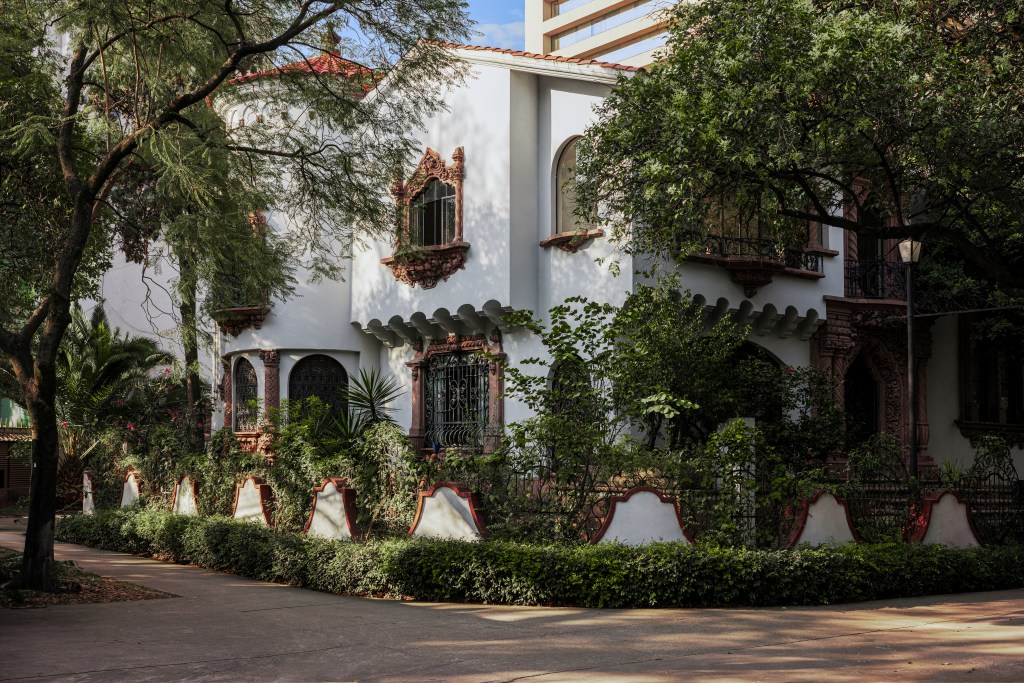
In the heart of Polanco, behind the doors of a restored historic mansion, Clase Azul México has unveiled Casa de los Leones—an immersive brand home that extends the company’s universe beyond the decanter and into the realm of architecture, art and hospitality. The new space marks a significant evolution for the house, translating its commitment to craftsmanship into a permanent cultural address in Mexico City.
Conceived as both gathering place and creative platform, Casa de los Leones occupies a storied residence in Polanco that has been carefully restored and reinterpreted. The project was led by C Cúbica Arquitectos, whose approach balances preservation with contemporary intervention.
Casa de los Leones is a platform to empower Mexican designers
Andrea Cesarman
“Casa de los Leones is a platform to empower Mexican designers,” says Andrea Cesarman, architect and Co-Founder of C Cúbica Arquitectos. Throughout the mansion, that philosophy is tangible. Everything is made in Mexico, from the marble floors to the custom furnishings, foregrounding local materials and expertise.
At Casa de los Leones, design is not decorative—it is structural to the story. C Cúbica Arquitectos developed the architectural project while leading the overall creative direction and curatorship of every bespoke piece conceived for the house. Under the guidance of Cesarman, alongside Emilio Cabrero and Marco Coello, the residence unfolds as a tightly orchestrated collaboration between architects, designers, artists and master artisans across Mexico.
The lobby introduces this philosophy immediately. A ceramic celosía installation, developed with ACOOCOORO, anchors the entrance and reinforces the centrality of clay—material of both soil and spirit. The piece is conceived as a living intervention, expanding over time and deepening the dialogue between architecture and craft.
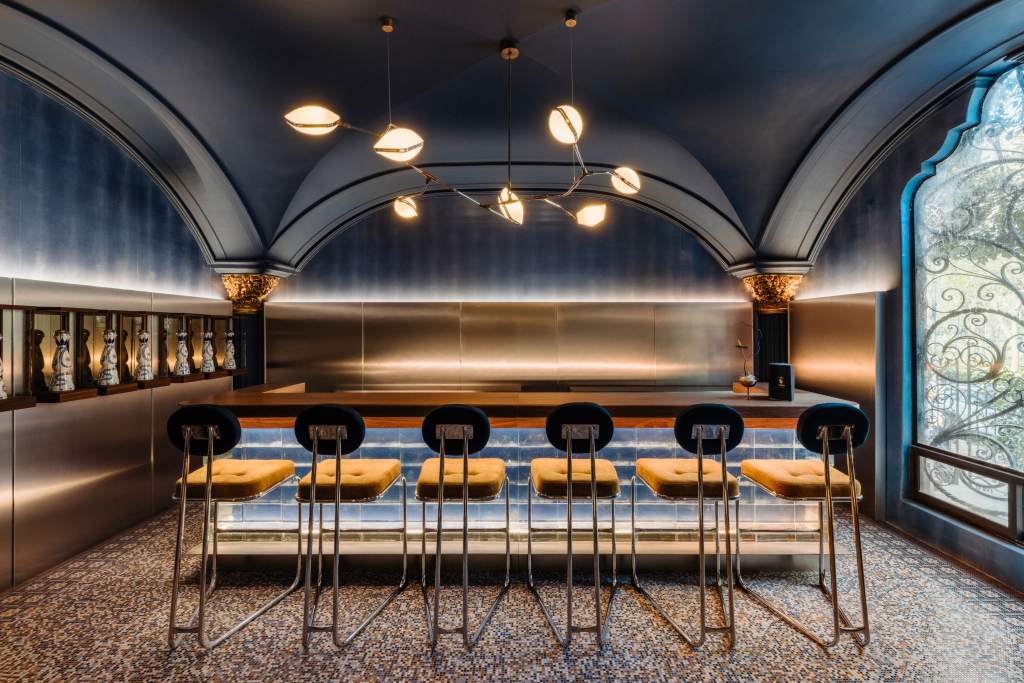
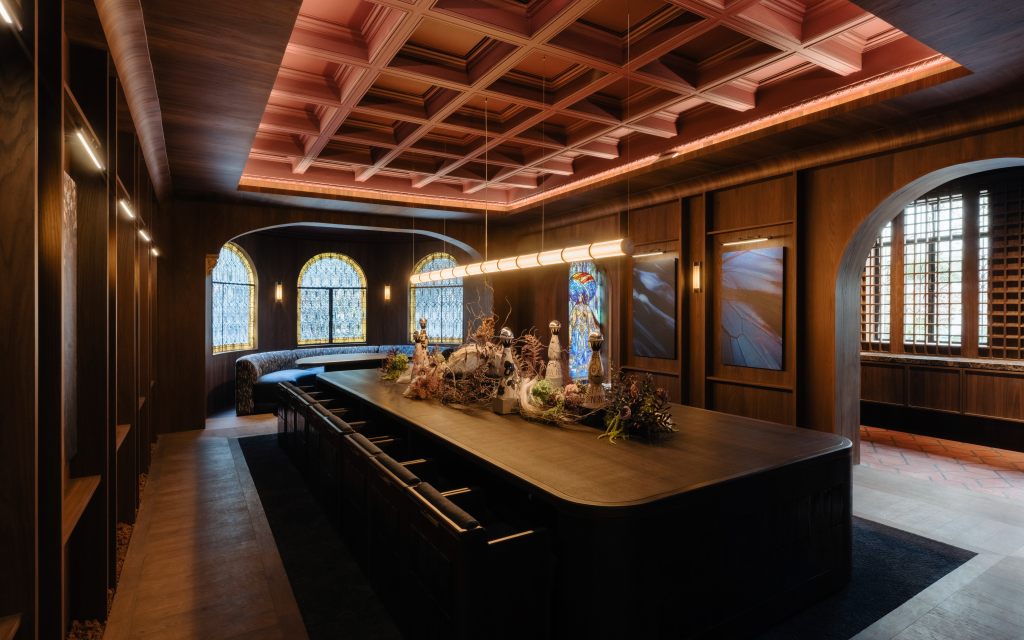
Lighting throughout the mansion functions as sculpture. Designer Thierry Jeannot created chandeliers for both the Lounge and the Cocktail Bar, merging tradition and contemporaneity through refined, tactile forms. In certain spaces, chrome interventions add a subtle industrial counterpoint, heightening the interplay between reflection and shadow. Sustainability and material innovation are also central. Lampshades in the bar and a chandelier in the tasting room are crafted from PET plastic. Room dividers are made using recycled fiber.
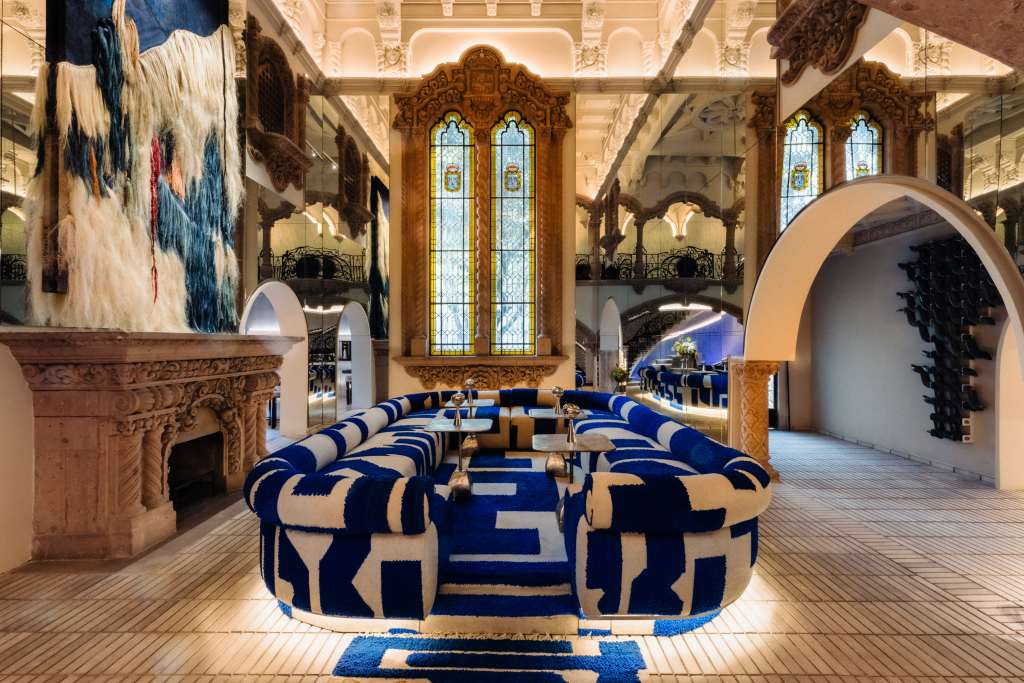
Material exploration continues in the work of Raul de la Cerda, whose contributions span multiple rooms. In the Lounge, his coffee table foregrounds the relationship between form and function, while in the Blue Bar and Cocktail Bar—some developed in collaboration with Nouvelle—his pieces introduce an experimental sensibility grounded in material honesty. A custom sofa that takes up the majority of the Lounge, created in collaboration with Josefina Ruiz and C Cúbica, reflects the layered authorship present throughout the home. The sofa took months and months to complete and of course reflects the pattern on the Clase Azul bottle. Guests are encouraged to remove their shoes before entering the sofa area, reinforcing a sense of intimacy and immersion within the space.
The Silver Room intensifies this material dialogue. Metallic surfaces capture and refract blue light, subtly echoing the chromatic depth of a Clase Azul bottle. The effect is immersive yet restrained, light behaving almost like liquid across the room’s reflective planes.
Stone anchors the house physically and symbolically. Tumbled marble floors sourced from Mexico soften the grandeur of the historic residence, while onyx flooring introduces a luminous quality in more intimate areas. Mosaic applications, custom lavabos and sculptural room dividers crafted from recycled fibers extend the tactile language across architectural details.
Ceramic mastery remains central. Marva Studio collaborated with Raul de la Cerda on custom tables, while master clay artisans from Michoacán contributed pieces rooted in ancestral techniques. Their work preserves traditional processes while producing expressive, singular forms that reflect the cultural richness of the region.
Textile interventions further expand the material spectrum. Beatriz Morales contributes works that merge conceptual rigor with handwoven sensitivity, exploring fiber as both medium and message. In the Lounge, a monumental rug by Morales—the largest she has ever woven—hangs on the wall. The distinctive blue she employs is made entirely from agave fiber. Mirrors are positioned to amplify light and volume, subtly expanding the rooms without disrupting their architectural integrity.
One of the most architecturally striking furniture pieces is the Escamas .002 coffee table, developed by LOFA Ceramics in collaboration with C Cúbica and designed by Oscar Centeno under the curatorship of Andrea Cesarman. With brutalist undertones, the table emulates tiled wall patterns, its surface formed by scale-like ceramic elements that create a protective, armor-like shell. The detailing reveals the soul of the object even as it appears reinforced and transformed into something sculptural.
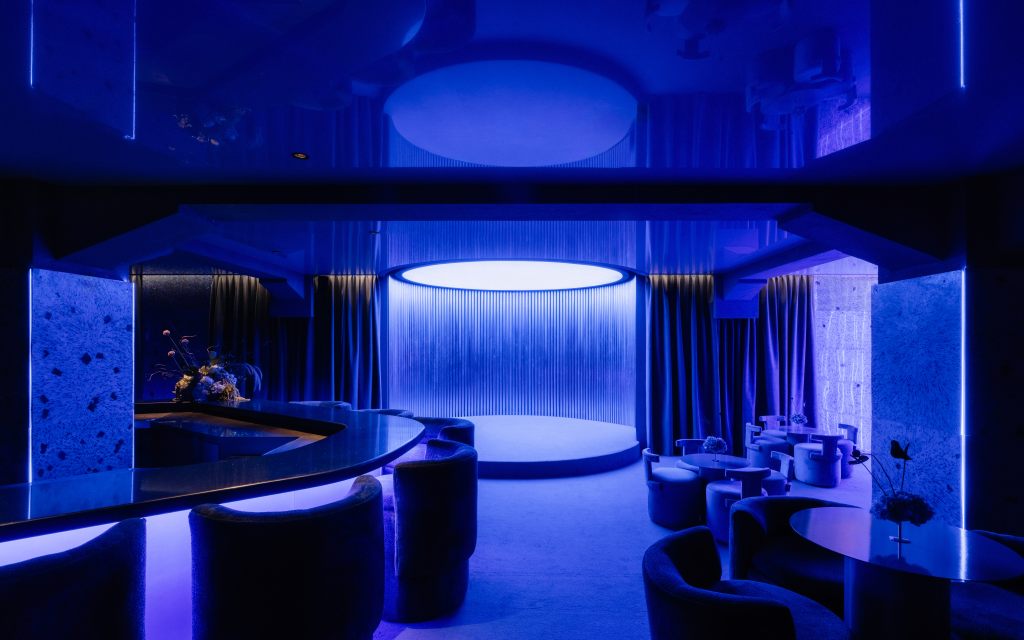
Throughout Casa de los Leones, interiors, furnishings and artworks do not compete for attention. Instead, they operate as extensions of the architecture itself—each material choice reinforcing a larger proposition: that craft, when given space, becomes architecture; and that architecture, when guided by many hands, becomes a living archive of contemporary Mexican design.
Craft is more luxurious than something created by a brand, because it is bespoke and takes time.
Andrea Cesarman
From the outset, the restoration prioritized integrity. In collaboration with México Territorio Creativo, the team ensured the mansion retained its architectural soul while embracing new layers of design. Original features were carefully restored, including a chandelier in the Lounge by artist Thierry Jeannot.
Ceramics remain central to the identity of the house. In partnership with Marva Studio, bespoke ceramic details were developed to reflect the shared origin of soil—where agave matures and where clay is formed into decanters.
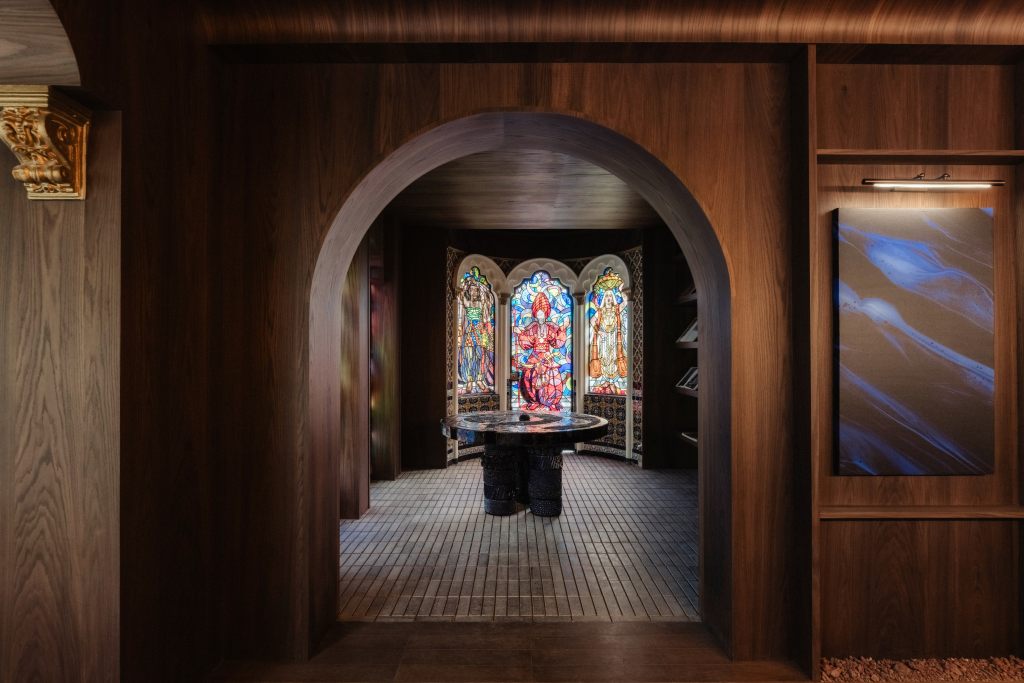
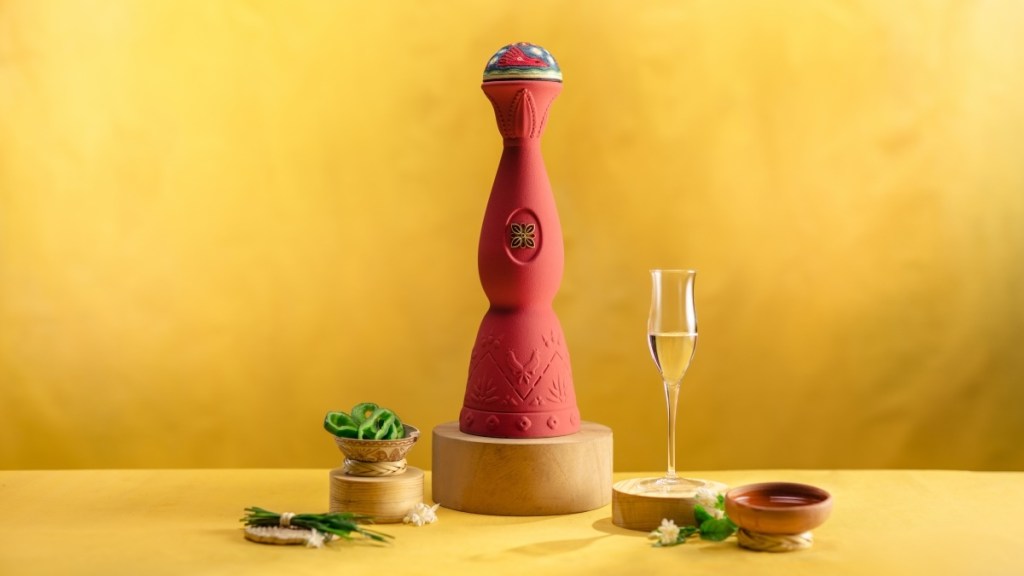
A ceramic-lined tunnel in the Lobby marks the transition from the outside world into the universe of Clase Azul México. The inaugural installation features Oaxacan artist Amador Montes, who recently collaborated on the decanter design for Clase Azul México’s first limited-edition mezcal—the debut release of the brand’s new creative platform, Encuentros. Additional works by Raul de la Cerda including chrome coffee tables, bars and chairs appear throughout the Lounge, Cocktail Bar and Acervo.
Clase Azul’s Master Distiller, Viridiana Tinoco, shared with us the process of creating a limited edition, explaining that she speaks with each artist about what they are drawn to and how to connect that sensibility to the spirit itself.
In the case of Amador Montes, the collaboration felt instinctive. Montes’s father drank mezcal and Oaxacans drink mezcal for every occasion, so the collaboration felt like a natural fit. The mezcal needed to embody presence and strength, according to the artist, leading the master distiller to search for the perfect agave plant for six months. Oaxaca holds 80% of the agaves in Mexico, yet finding the right one required patience. The agave ultimately selected takes 15 years to mature in the soil.
Tinoco describes herself as obsessed with the chemistry of distillation. “In the same way that Monte’s paints in layers, this mezcal has layers in its distillation,” she says. It marks the first time the house has created a limited edition with mezcal rather than tequila. The expression is bottled at a higher proof, reflecting how mezcal is traditionally enjoyed in the region. “I taste different proofs and select where the spirit expresses. The legs of the spirit show the full body,” Tinoco says. “This agave is beautiful because it has aromas never smelled before including wild, flowers, eucalyptus, copal.”
At the center of Casa de los Leones is “Taste of Time,” a guided experience offered to small groups by appointment. Structured as a progression through five tequila expressions, each paired with a chef-crafted bite, the tasting honors the role of time, from agave cultivation to aging and finishing. Guests explore the mansion and its gardens as part of the experience, concluding in the Cocktail Bar for sobremesa—an invitation to linger in conversation.
Founded in 1997 in Guadalajara by Arturo Lomelí, Clase Azul México today reaches more than 100 countries. Casa de los Leones represents a new chapter: not simply a brand home, but a living expression of Mexican artistry, hospitality and collaboration. “Casa de los Leones is our homage to Mexico—a sacred home where our roots, our culture and our future converge,” says Lomelí. “Clase Azul was never meant to live only in a decanter. This house represents a natural evolution of who we are: a place to gather, to share and to honor Mexican culture through meaningful experiences, hospitality and human connection.”
Located at Luis G. Urbina 104 in Polanco, Casa de Los Leones is open exclusively by appointment, welcoming guests into a space where material, memory and spirit converge.





What are your thoughts?