Held Together: Bound at Secteur Privé
A look at the autumn exhibition in Marylebone featuring works by Sonia Navarro, Soojin Choi, Maliha Abidi and Mark Brazier Jones
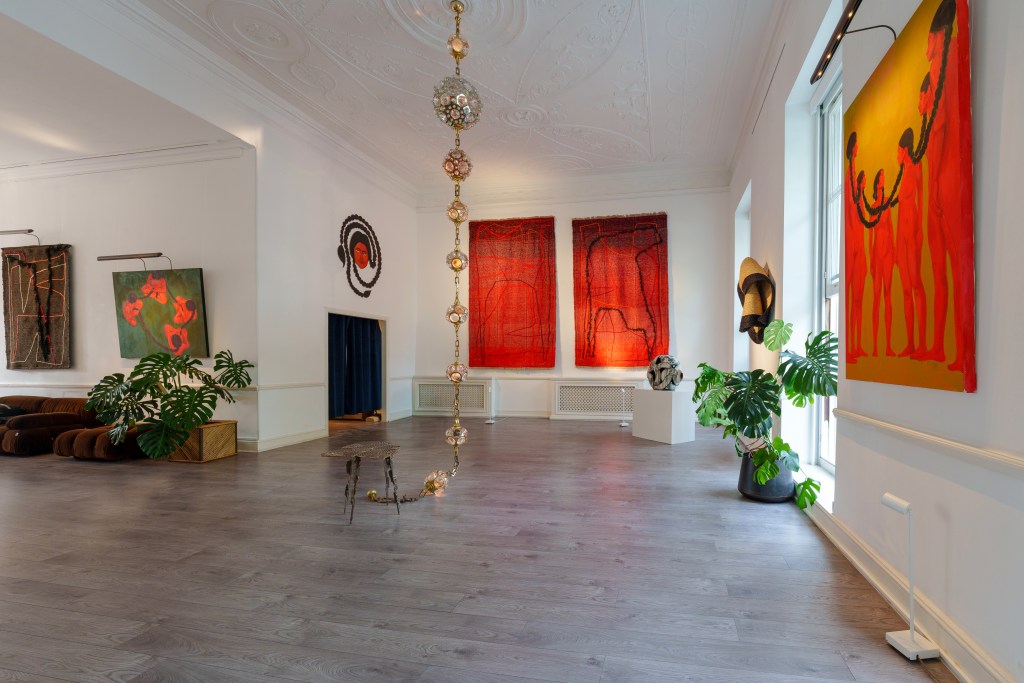
“Bound,” the autumn exhibition at Secteur Privé, gathers Sonia Navarro, Soojin Choi and Maliha Abidi in a Grade II-listed London townhouse at 35 Portland Place, where wool, clay and paint each take up the question of how separate things become one. Thread gathers into cloth, an arm closes around a shoulder and a braid runs from one woman to the next until the people it joins begin to look like a single figure. The single room of the gallery gives these ideas a domestic scale, so a monumental textile settles against a wall like part of the architecture and the clay figures share the floor with the visitor. Mark Brazier-Jones‘s chandeliers of interlocking metal links, long established as residents of the building, hang overhead as a chain of their own and carry the theme into the air above the visitor.
Sonia Navarro: Drawing with Thread
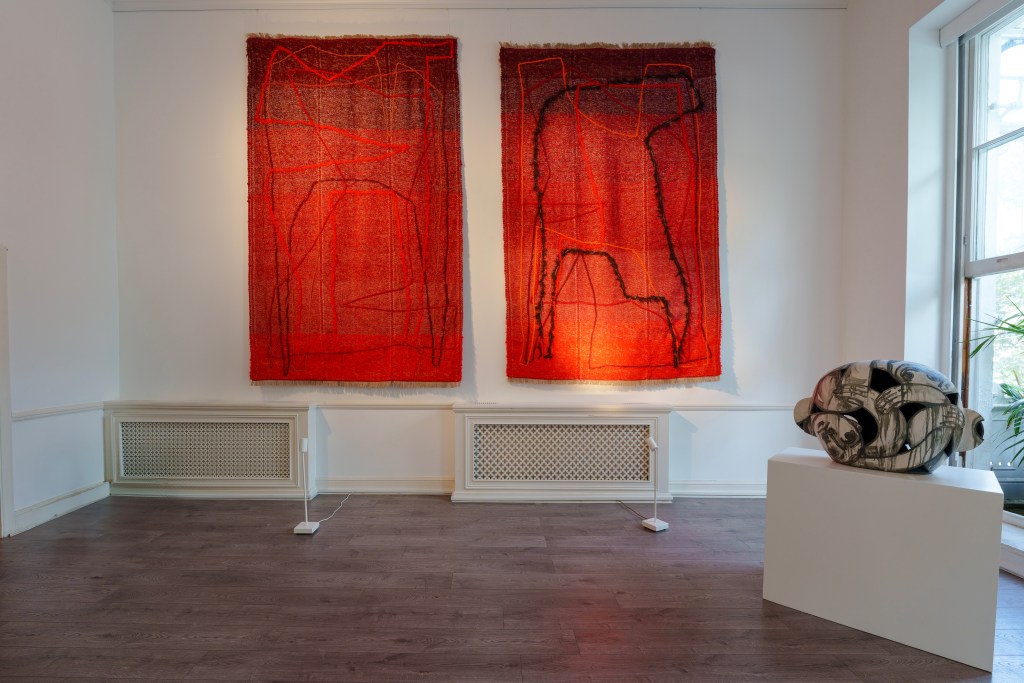
Navarro’s pieces are the largest in the show, and they ask you to step back before you step close. In Piel y memoria I y II (Skin and Memory 1 and 2), two tall hangings of three metres by two, the woven ground shifts from a pale, dusky violet at the top down into a deep, saturated red, like skin flushing or a sky at the end of a hot day. Across that surface, cotton stitching wanders in loose outlines of orange, scarlet and black. The lines suggest doorframes, chairs, rooms, the skeletal plan of a house, but they never settle into a diagram. In one a dark, furred line looks almost like a held breath.
The two works behave like a pair of mirrored memories. Shapes recur but rearrange, as if the same domestic space were being recalled twice by someone whose recollection keeps shifting.
Resguardarse del Sol en Granada 1 (Finding shelter from the sun in Granada) shifts the palette to burnt earth. Its rust-brown, coarsely woven field carries a cage of black and white lines, and a shaggy blue thread that runs along one side like a vein. It is the show’s most direct image of shelter: a rough outline of a room, drawn the way a child might sketch home.
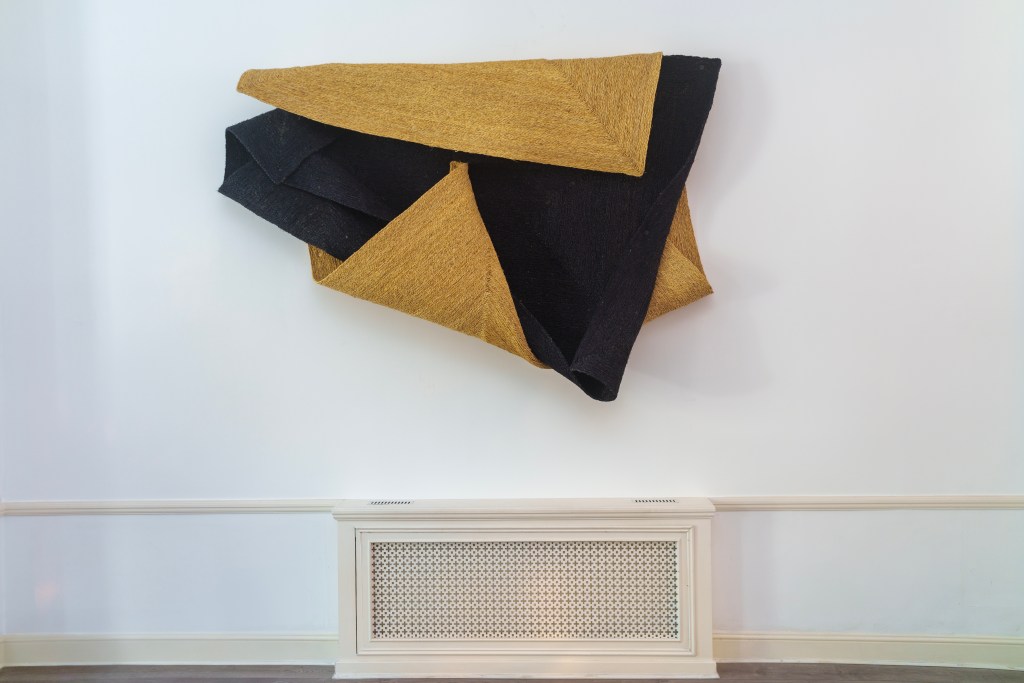
Then there is Spartaria (Sparta), which turns from the wall plane into sculpture. Braided and sewn esparto grass, the humble fibre of Spanish rural labour, is folded over a dark mass like a sheet thrown across furniture. Pale gold against black, it is stiff and soft at once, a rope turned into a cloak. Navarro, who learned these crafts from her grandmothers, treats the material with the respect of a monument and the casualness of laundry. A further work in red esparto is still in progress and is expected to join the group.
Soojin Choi: The Weight of an Embrace
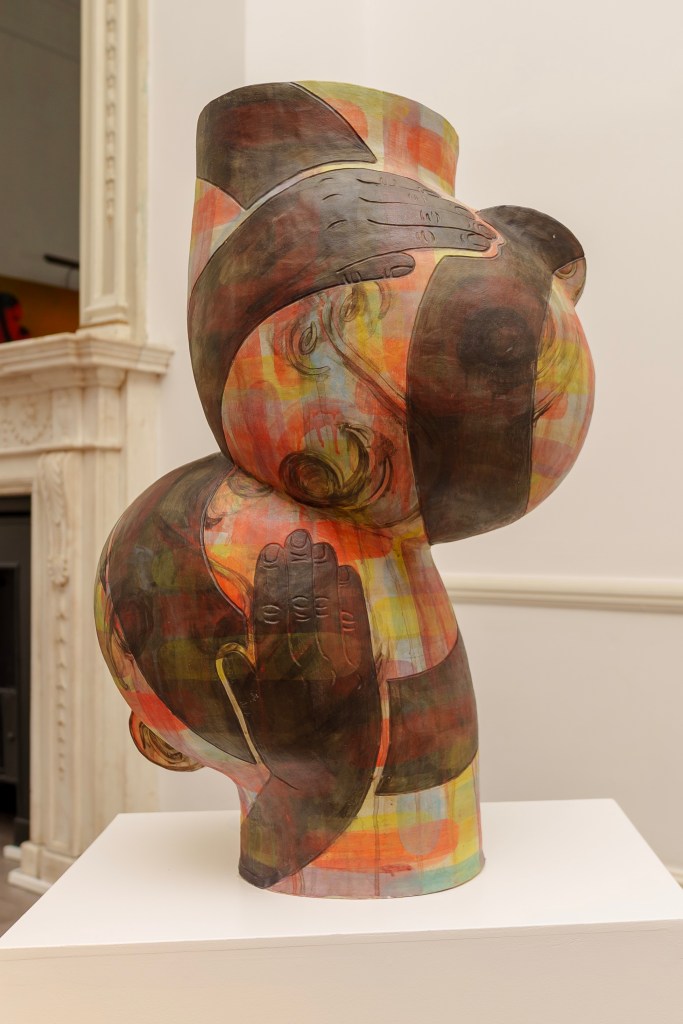
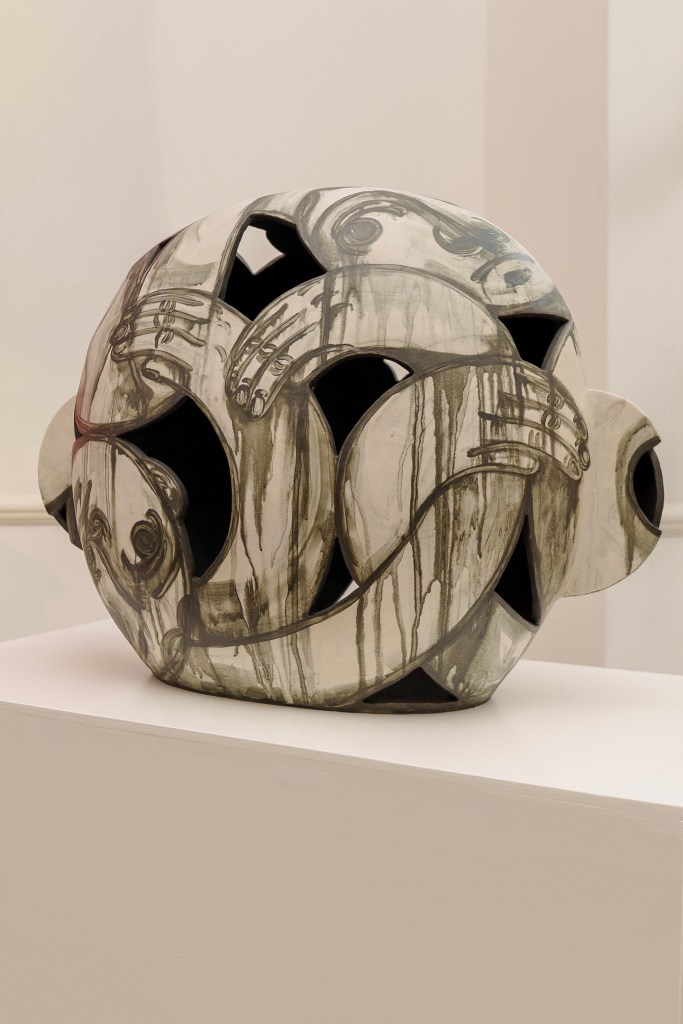
If Navarro’s works are about structures, Choi’s are about the bodies that live inside them. Her three stoneware sculptures are packed with limbs and faces that seem to grow out of one another. Surfaces are covered in slip and underglaze applied with the gestural freedom of a painter, and the drips are left visible, a record of the hand and of gravity.
Rekindling is the most compact: a rounded, almost helmet-like form whose black-and-white surface is crowded with curled figures, hands and eyes, as though a whole family had been folded into a single vessel. Openings cut through its skin let darkness show between the bodies. As It Was (2023) is warmer and more intimate, a wall-mounted knot of figures in fired oranges and blue-grey shadow, one head tucked under another’s arm. It is a study in dependence: you cannot tell where support ends and burden begins.
You Never Knew is the tallest, a twisting column of tangled figures in smoky black over flushes of orange, yellow and blue. Its vertical stack of embraces lends it a totem-like presence, and its hands, gripping and cradling, are the emotional centre of the piece. Choi’s figures hold on tightly, and it is left to the viewer to decide whether they are rescuing each other or trapping each other.
Maliha Abidi: Braids as Lifelines
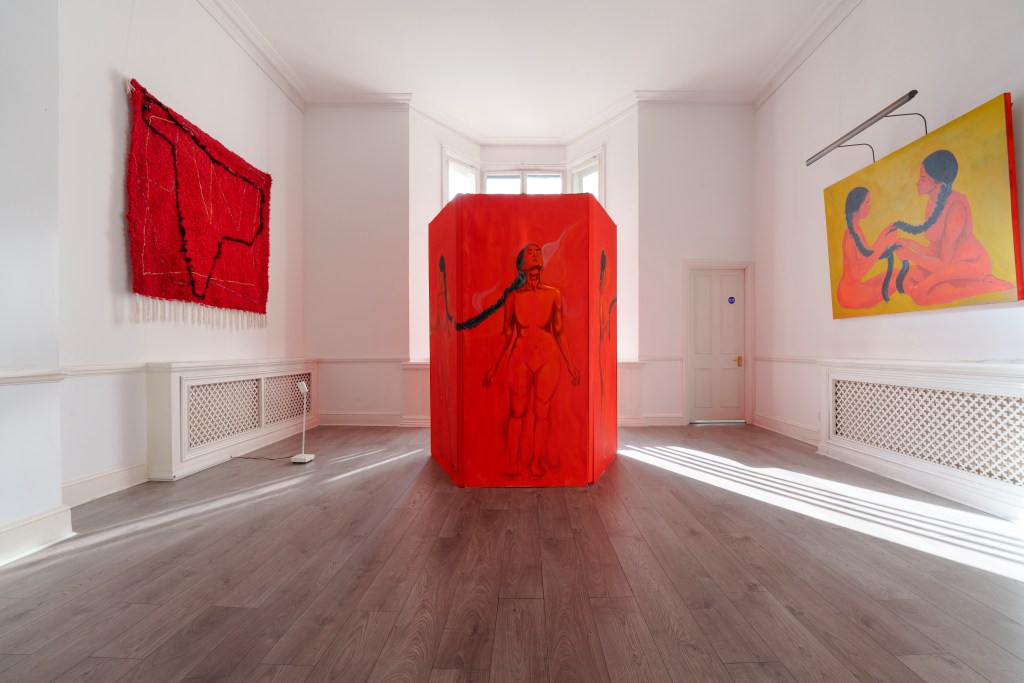
Abidi’s paintings and installations bring colour and narrative into the house. Her recurring subject is the braid, drawn as a long, dark rope that loops around, connects and encircles.
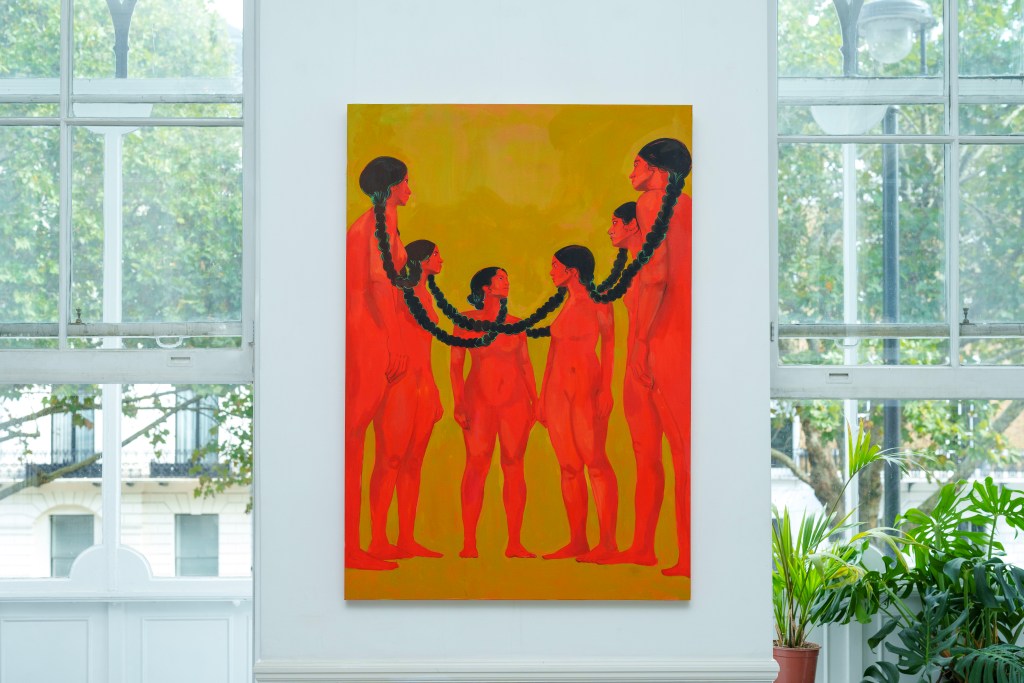
In With Us, six women stand barefoot on a mustard-gold ground, their bodies glowing a hot vermilion against it. Their braids are long enough to leave their owners and travel, sweeping in low arcs from one figure to the next until the whole group is strung along a single dark garland edged in flashes of teal. Some of the women look at one another and some gaze past the frame, and the tallest figures at either end draw the garland into a shallow bowl that seems to cradle the viewer as well.
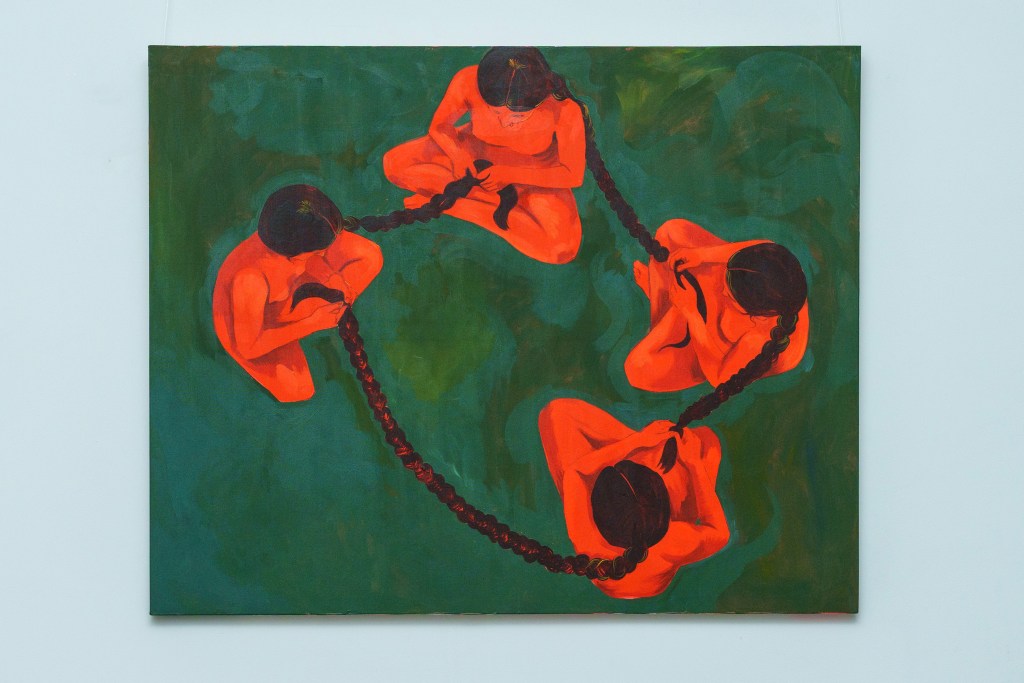
Ties looks down from above on four women seated cross-legged on a deep forest-green field, each absorbed in the work of her neighbor’s hair. Their plaits run out across the canvas and join into a loose ring that turns around an empty green centre like water around a stone. The overhead view turns a daily grooming ritual into a diagram of kinship, recalling the afternoons of oil and combs with an aunt and grandmother that Abidi names as the origin of the series.
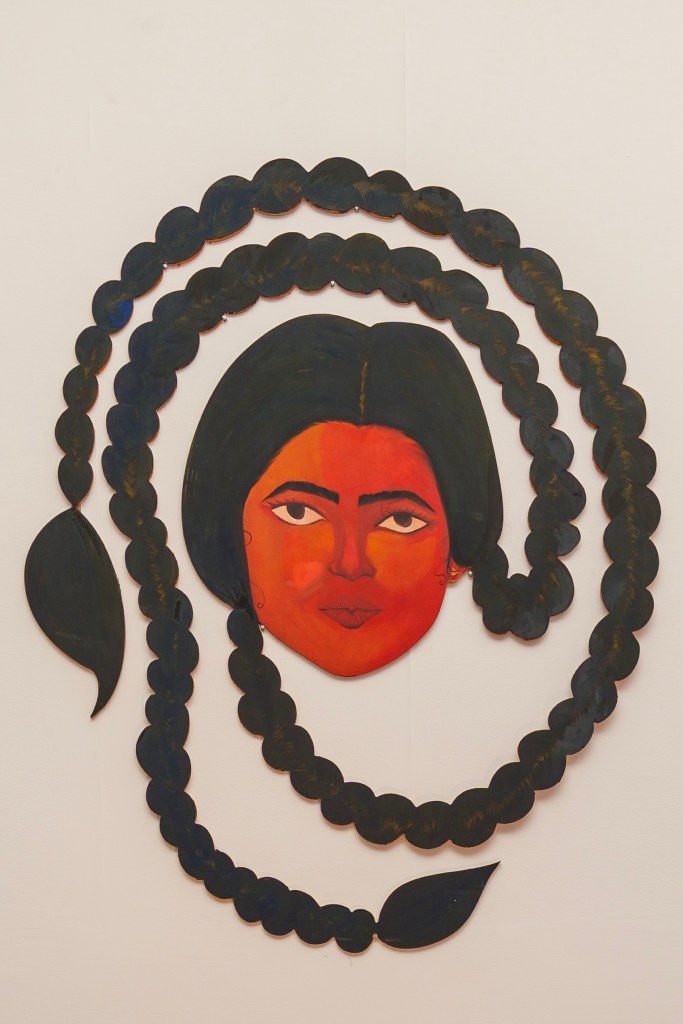
Untitled, a cutout work of plywood and oil paint, sets a calm orange face at the centre of a pair of enormous black braids that coil outward around it. Each plait has a scalloped edge and ends in a leaf-shaped tip, and the painted gaze meets the viewer’s directly from the middle of the spiral. It reads as a mandala, a portrait and a length of rope all at once.
Untitled Log is a more tender picture. Two red-skinned women face each other, hands clasped, their braids swinging out and looping together as they balance on a wooden box against a pale pink, cloud-patterned ground. It is a portrait of sisterhood as a shared act of balancing, equal parts dance and trust.
The most ambitious piece is Island, an interactive installation with audio and scent. A tall, hexagonal red structure carries a standing female figure on each face, a braid running around the surface from panel to panel. The back of the work is curtains of hair and braids inviting the viewer to step inside. Sound and fragrance extend the work beyond sight, so that the viewer is not just looking at connection but standing inside it.
Common Threads
Seen together, the three bodies of work describe connection from three directions. Navarro finds it in the labour of hands and the memory held inside a stitched room, Choi in the weight two people carry when they hold each other up and Abidi in a ritual of care handed down between women until the braid itself becomes a family tree. Their materials differ widely, yet each artist makes the tie itself the subject, and a visitor standing in the single room at Portland Place can follow one line of connection from a stitched hanging to a clay embrace to a plait of painted hair, leaving with the sense of having traced the length of a single long braid.
“Bound” at Secteur Privé closed on 4 November, but for more info and to make an appointment for future viewings, visit https://secteurprive.co/.



What are your thoughts?