Adobe MAX 2026: Walking Into the Frame
A reinvented Firefly and Adobe’s latest research previews suggest no frame is final—angle, light and even wardrobe can be reimagined easily in post production
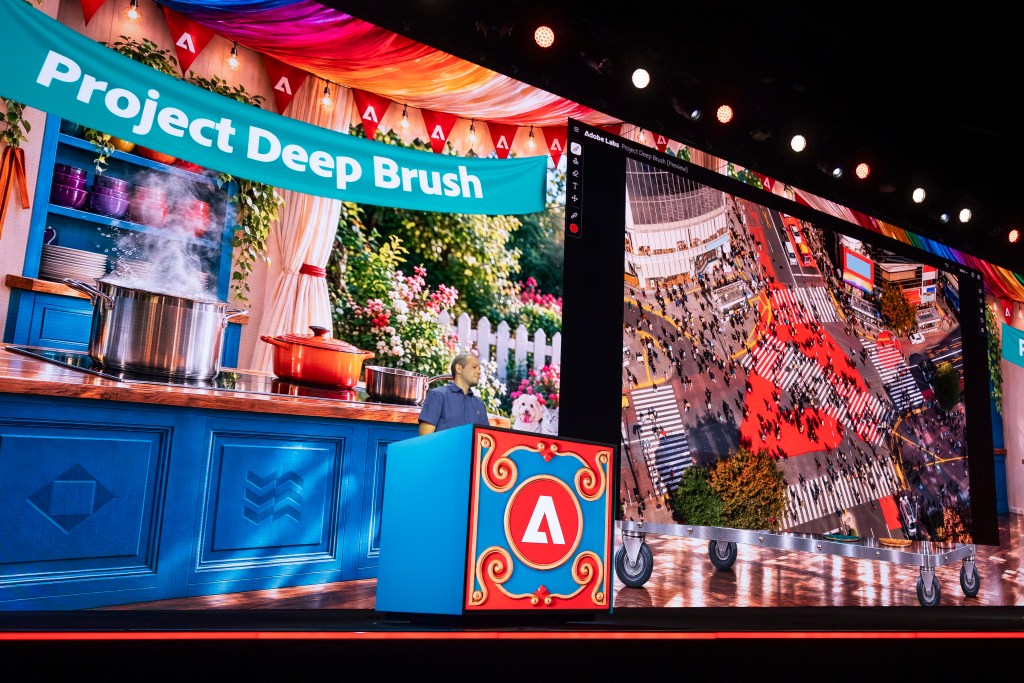
On Wednesday evening at Adobe MAX in Miami Beach, we watched a photograph of a panda lounging on a tree branch in a forest become a space a camera could move through—not just zooming in and out or adjusting the angle left or right, but fully moving above, below and even behind the subject. The demo came from Sneaks, the conference’s annual showcase of research in progress, and it was one of 10 projects shown on 11 November. Project Sight Span infers enough depth and context from one photograph to let a virtual lens wander and reframe. Another Sneak, Project Deep Brush, paints color and light onto the geometry it detects beneath the pixels of a static image. And Project Scene Sweep brings a similar comprehension of form to video, enabling wardrobe and hair changes for actors in motion and across multiple scenes. Another project, Hands On, trades the text prompt for handles that steer AI edits to objects in an image, and, along with Deep Brush, it is already open to the public through Adobe Labs. Form, details, light and perspective are becoming decisions that can be revisited in post-production with seemingly flawless effect. Those glimpses arrived a day after Adobe recast Firefly as its AI-first hub, a place where agents assemble entire campaigns, models from rival labs share a single subscription and a character or product holds its likeness from one shot to the next.
Tuesday morning’s opening keynote laid out a strategy that approaches AI from several directions. Inside familiar applications like Photoshop, Premiere or Illustrator, chat-driven agents and generative tools now sit beside the precision controls, and Adobe stressed that every AI feature is opt-in, a nod to the tensions felt across the creative community. Firefly has pivoted from a simple image generator into an AI-first creative studio, gathering models from Adobe, Topaz Labs and partners such as Google and Kling under one subscription while absorbing capabilities from the established apps. Unburdened by decades of muscle memory, it can look and behave differently, and its new Firefly Design space, still in beta, puts illustration, image editing, animation, 3D and print on a single canvas.
Elise Swopes, a surrealist artist who serves as Adobe’s senior evangelist and community relationship manager, showed how Firefly handles a brand job. For a fragrance client, she dragged her approved pitch into the agent along with several reference assets and asked it to make Elements—reusable stand-ins for a character, object or setting—of herself and the perfume bottle. The agent returned her likeness with added views of expressions and poses, then built stills and sound-laced video clips in the pitch’s lemon courtyard, giant flower garden and towering sky. Those extra angles are, in her words, “great for character consistency because I want me to look like me in all these scenes.” When a red outfit stopped popping, she dropped in four photos of herself in blue, and the software revised the Element and every shot that used it, a change she said “would have required a whole new reshoot.”
Their third AI front faces outward. Adobe is bringing native support for the Model Context Protocol (MCP) to its desktop creative tools. The emerging standard lets AI assistants operate external apps, so someone who would rather start in Claude or ChatGPT can call on Adobe’s tools and skills from within that conversation. Adobe named Anthropic, Google, OpenAI and Slack as partners, with Microsoft Copilot to follow.
Sneaks trades the shipping roadmap for the lab bench, and the engineers and designers behind each tool present it themselves. Yiwei Hu, the Adobe researcher who leads Sight Span, began with the panda. He wanted a tighter frame on its face and noted that “getting too close to a wild animal just to take a new picture might not be a good idea.” The software produced what Hu called a 3D preview, a coarse model in which he could reposition and aim the camera freely, and Adobe puts its generation at roughly 10 to 20 seconds. Once Hu chose a composition, an upscale step rebuilt the new view from the original file, recovering the texture of the tree bark behind the animal. “And also remember, everything just started from a single JPEG image. Nothing else,” he said.
A portrait followed. Hu swung around the subject’s head to reveal both profiles and the buildings behind him, and the upscaled result kept even the tattoo on the man’s arm. For the finale he loaded a photo of Vermeer’s The Milkmaid and viewed the scene from a broad range of angles. “Well, in general, we cannot really physically step into a painting,” Hu said, before doing more or less that. Once a view was settled, the upscale, he added, “not only restore all the details from the photograph, but it also preserves the original style of the painting.” Adobe’s Labs write-up says Sight Span “grew out of earlier work rotating objects in an image.” Extending that control from one object to an entire environment forces the software to invent whatever the original frame never recorded.
Scene Sweep moved the demos from stills to footage. Hyeonho Jeong, who co-leads it with Yuqian Zhou, showed how it watches a multi-shot sequence and works out where the cuts fall, who is in each shot and which rooms they pass through. The demo followed a woman from an entrance hall through a corridor and gallery to a terrace, then dressed her in a plum blazer that held across all seven of her shots, with lighting that gave its leather more sheen than the black turtleneck she had worn. A second character’s curly hair became a new blond crew cut wherever he appeared, and a painting on the wall turned into artwork featuring Terry Crews, one of the evening’s hosts. “Understand the whole thing and edit in one go,” Jeong said. Crews, a veteran of television sets, saw the stakes at once: “In filmmaking, television continuity is a problem.” Adobe pitches the tool for recasting characters, relocating stories and swapping wardrobe without a reshoot; like Sight Span, it offers only a sign-up for notice.
Iliyan Georgiev, who leads Deep Brush, opened a parkour shoot in Photoshop to show where a conventional tool falls short. “A regular brush doesn’t know what’s a wall,” he said. “All it sees is pixels.” His version “sees the geometry in the scene, the intrinsic color, the lighting,” separating a surface’s own hue from the shadow and highlight falling across it into what Adobe Labs calls physically decomposed layers. On stage Georgiev painted a concrete wall while its original shading held, confined strokes with smart masks and used a warp mode to wrap color around a curved form. He then inked a tattoo onto a photo of himself, a painless test for a man who, by his own account, hates needles. His closing move echoed Sight Span’s preoccupation with space and light: “we can paint not only color, we can paint light too,” he said, washing a glow across the new ink.
Hands On, the night’s final demo, tackled a different bottleneck. Co-host Kelsey Slay introduced it with a question: “Have you ever tried to describe exactly what you want? Sneak number 10 skips that part.” Led by Adobe researcher Celso Gomes, the project identifies the objects in a photograph, proposes suitable properties for each and lays draggable control points across them, so an outline can be pulled into a diamond, a couch lengthened or a model’s arm repositioned without typing a word. “So you don’t have to type text anymore,” Gomes said. “You can come here and just drag the control points.” The live preview is approximate; pressing apply hands that geometry to the image models for a finished render. Gomes stacked edits on a photo of his cousin, filling the beer glass, enlarging the burger and turning the head on a quick 3D mesh, then sent them in one pass. Adobe traces the project to a property-suggestion feature now in Firefly’s Edit object tool and calls it a possible step from text-based editing toward more fully graphical interfaces.
Sneaks have made the jump to shipping software before. Slay said Relight “was shown as a sneak last year, and it got so much love and attention that it’s made its way into Photoshop.” The feature, which adds and adjusts light sources, became generally available on 10 November, and in the keynote it warmed a dim house with an added source. Slay was candid about this year’s crop, warning that what the audience would see “is not necessarily guaranteed to launch or become a real thing” and that public enthusiasm helps decide which ideas graduate.
That enthusiasm now has somewhere to go. For the first time, Adobe opened two Sneaks to the public the night they debuted: Deep Brush and Hands On can both be tried through Adobe Labs. Sight Span’s page offers only a sign-up for notice should it become an experiment. Adobe Labs states that its technologies “are subject to change” and that the company makes no commitment to release them commercially.
Photographer Lindsay Adler, a member of the Adobe Creative Collective of practitioners who advise the company, described her fashion photography to us the day before Sneaks as “clean, bold, graphic, precise lighting, saturated color, all of that, maybe we’ll touch on for AI because it’s also somewhat easily replicable.” A day later, software that reads form and light in a photograph and repaints it on command turned that self-assessment into a forecast. Her counterweight is that with her commissions the human hand is the product—a campaign built around a makeup artist’s craft, she astutely said, “it matters that it’s real.” As synthetic image generation grows more accessible and more convincing, evidence of a person’s touch—the blended lid, the chosen moment, the deliberate imperfection—becomes the scarcer and more valuable currency. Hu’s Milkmaid demo made Adler’s case from the other side. He steered toward the table, pressed upscale and returned with a view Vermeer never painted that still reads as his, a convincing likeness missing only the painter.







What are your thoughts?