Seattle’s Populus is a Revolutionary Idea: Art Gallery As Hotel
The new Seattle-based hotel incorporates a variety of local art in its lobby, restaurant and guest rooms, all available for purchase

Art in hotels, as a rule, often stinks. Despite the opportunity—hotels generally have beautiful public spaces that, especially at the premium end, are some of our favorite places to hang out and meet friends—property owners and managers simply haven’t had the correct eye for attracting new, exciting work. Let alone thinking of their rooms, hallways and restaurants the way you think of your own home. That is, as a place for curation, theming and self-expression. In recent years art-forward hotels have begun to emerge, largely driven by mega collectors who need more space to exhibit the works they own.
The two-hotel “chain” of Populus hotels, in Seattle and Denver, are bringing a new perspective to the art hotel concept. (They are part of the Aparium group of properties, which is well-known for transforming existing properties in up-and-coming neighborhoods nationwide.) Guests are staying in a gallery, not a museum, as all the works are available for purchase.

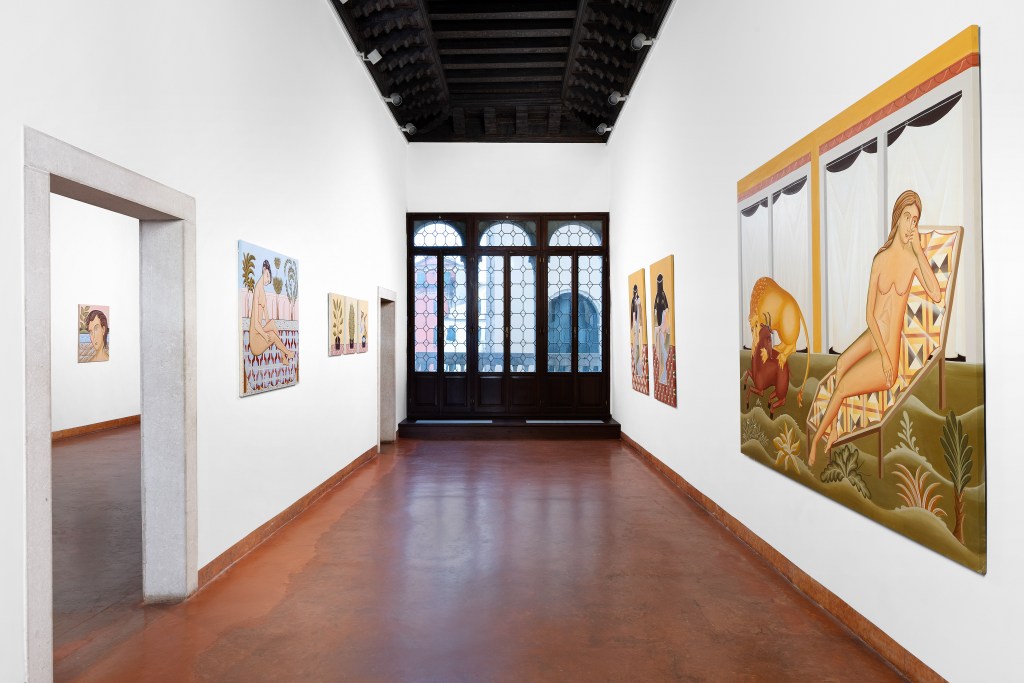
But Populus Seattle, is going much farther than most properties to transform itself into a kind of living gallery, with soaring canvases bracketing a multistory lobby, and pulling your eye upward as you ascend the front staircase into the confines of the hotel’s signature restaurant, Salt Harvest.
The brains behind Populus’s artistic effort is Dominic Nieri. He’s the director of creative strategy at the developer, Urban Villages, and also the director of ARTXIV, a Northwest-based art production house that harnesses local—and international—artists’ talent matched to a property’s intended use case and neighborhood.

In the case of Populus Seattle, which opened in June 2025, the building is part of a greater transformation of Pioneer Square. Until recently, this section of Seattle was fairly rough and ready, yet the warehouse bones were tremendous, dating to the early 1900s. For decades, graffiti artists have been transforming its brick walls and alleyways into their own informal “gallery” space.
Through ARTXIV, and Nieri’s leadership over four years, Urban Villages first gutted and reclaimed three buildings that are part of the Railspur neighborhood. These warehouses were originally linked by a train line that cut through each structure, storing shipped goods from Puget Sound until they’d then travel north or south along the Pacific Coast Railroad line.

With massive Douglas fir beams and flooring and tremendous elevation to each floor, often 20-feet-plus, Nieri saw the opportunity to bring the informal artwork that was already happening outside into the interior. “We would hold exhibitions and festivals and all kinds of experimental retail, just playing with the empty space. We’ve driven close to 50,000 people through these spaces,” Nieri says.
He added that this created a kind of community spirit that also drove a revitalization of the neighborhood adjacent to Seattle’s historic Chinatown, drawing in area artists and arts organizations in a grassroots effort.

“So when the hotel project finally came into the equation, I was just thinking about what we had been doing here already, and how important the community was in that,” he says.
That led Nieri to the idea that they should use one of the still-empty buildings—adjacent to where Populus now stands—as a 10,000-square-foot production studio. Then, through word of mouth and an application process, Nieri brought in 50 local, regional and international artists to take up residences and draw inspiration from the area for artworks that would then live within the confines of the hotel. “We’d walk around, ride the ferries, go on forest hikes and then we would come back to the studio and respond to it.”
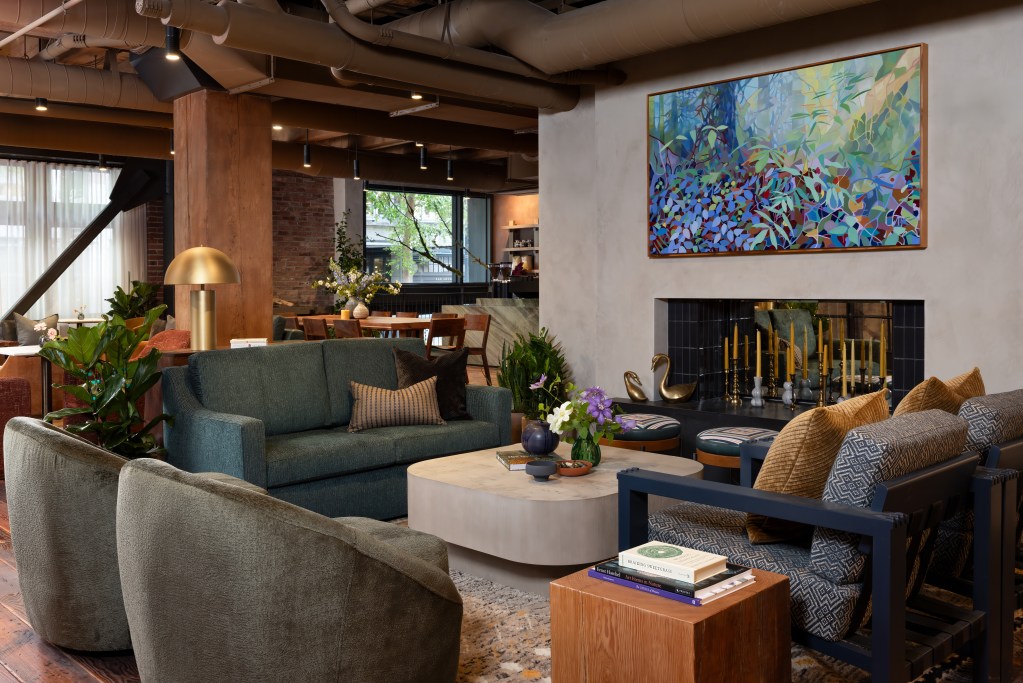
Populus’s manager, Juriana Spierenburg, adds that there’s another twist to the more than 300 pieces of art at Populus. “Hotels are actually the best galleries, because, of course, many people are coming through all the time.” But typically, she says, even if they’ve commissioned the works for, say, their lobby, “the hotels own these canvases for the rest of the life of the property.” At Populus, the artwork is for sale, and each year will be renewed. Nieri is creating an artist-in-residence program to foster that, so that there’s a constant flow of new work going into Populus as the extant pieces are purchased. He points to a gorgeous, intricate, six-by-six-foot painting of flowers by the artist Baso Fibonacci that hangs adjacent to Populus’s coffee bar and notes that there’s currently a bidding war to own it.
Even beyond the works themselves, the entire experience of Populus has a thoughtfulness that’s exceptionally rare and, for lack of a better term, home-y. The hotel room numbers are a homage to the hand-lettering tradition of the early 1900s, says Spierenburg. She cites the ghostly advertising still visible on the sides of brick buildings in Pioneer Square as an inspiration.

Populus has a carbon-positive footprint thanks to its reimagining of an existing structure, plant-filled interior spaces and the green roof used for beekeeping. Even the screen-printed door numbers feature botanical illustrations that align with the building’s earth-friendly theme.
Thoughtful touches are found within each room, not only because each has its own artwork, but the physical spaces are also unique, preserving the underlying warehouse rawness wherever feasible. That means a giant pillar might cut through a suite with tree trunk-sized beams supporting the ceiling. Guest rooms also feature handmade pottery and coffee bags from local outfit Monorail Espresso were crafted via a co-lab artistic project.

Nieri says that the Populus project felt daunting since filling 120 rooms and all the common spaces was no small task. “You have a restaurant and a rooftop bar and a cafe; it’s a lot!”
But he also knew this was a unique chance to overcome the “negative connotations around hotel art. We were able to break that barrier.” He said that it came down to trust between the artist community over several years, and the managers understanding they were building something more than a hotel. “Now Populus is a living illustration of what art can do and how much it can change.”




Latest Comment