Anselm Kiefer’s The Women Alchemists in Milan
At his exhibit in Palazzo Reale’s Sala delle Cariatidi, Kiefer honors pre-scientific revolution female alchemists with 42 large-scale paintings
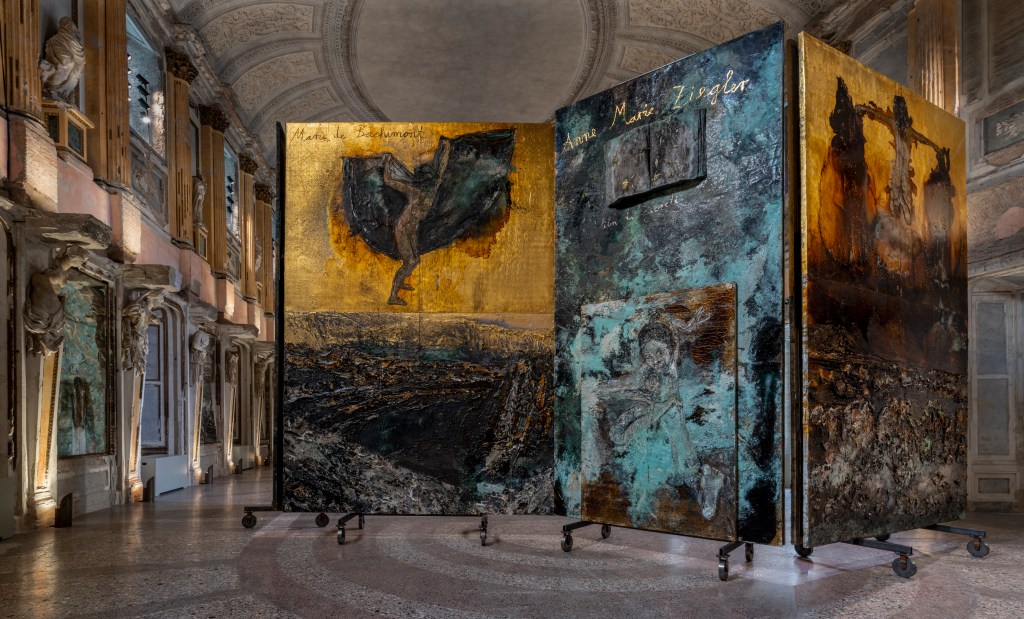
Alchemy has always been considered an obscure practice. Women alchemists are an even more obscure chapter of human history. The new exhibit by iconic artist Anselm Kiefer at Milan’s Palazzo Reale is a journey from darkness to light, both for alchemy and female historical figures—a celebration of women who practiced it and significantly contributed through experimentation and studies.
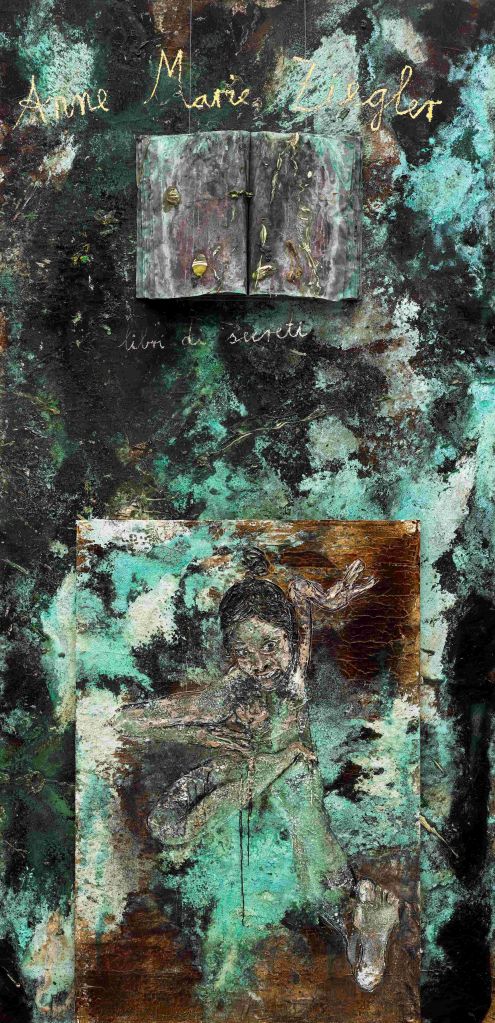
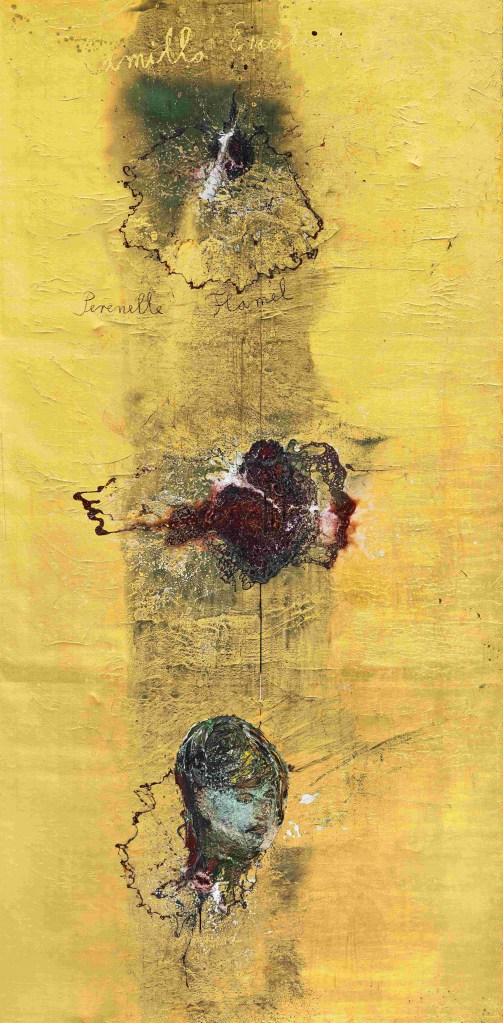
The Women Alchemists displays 42 imposing paintings—each is over 16 feet tall and nearly 10 feet wide—dedicated to women who practiced alchemy before the 18th-century scientific revolution. These women were subaltern to men and were not allowed to assert themselves publicly. They worked silently and tirelessly, making a strong impact on research aimed at improving quality of life in their time. The presentation is compelling for its abstract language of myth and history, destruction and regeneration. It’s also grounded in meticulous historical research, documented through scientific citations finely presented in the catalog published by Marsilio Editore.
The installation is site-specific. Invited by the City of Milan two years ago, Kiefer visited Palazzo Reale’s Sala delle Cariatidi and fell in love with it. Formerly a royal ballroom, it was heavily bombed during World War II. Postwar restorations were minimal, specifically intended to preserve testimony to war’s brutality. Today, the room reads as a wonderful yet decadent space, with the remains of 40 statues of female figures known as Cariatidi. It has impressed visitors for the past 80 years, including Pablo Picasso—who repeatedly refused permission to send Guernica abroad, but in the mid-fifties made an exception after visiting the Sala delle Cariatidi. He organized a special installation there, one still remembered to this day.
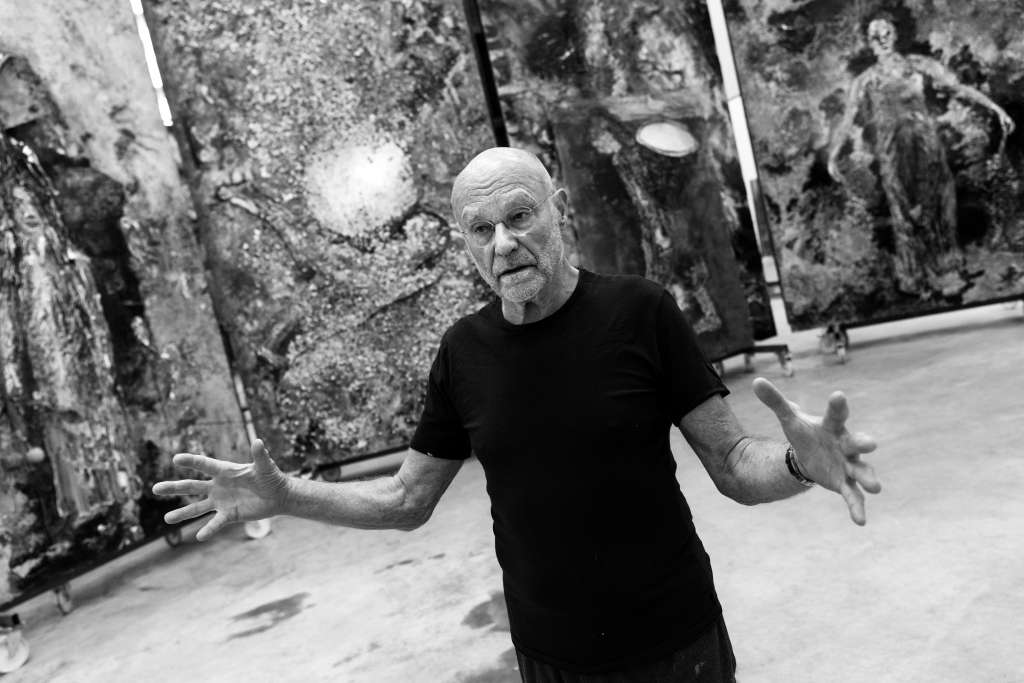
At Kiefer’s inaugural event, Palazzo Reale’s general manager, Domenico Piraina, said he anticipates the exhibit leaving a strong mark in Milan’s artistic history, just as Picasso did with Guernica. Kiefer himself expressed a sense of awe: “The room is charming in its devastation. It speaks in an abstract way, which is possibly even more charming than how it was before the bombing. It immediately inspired me to celebrate unsung female heroes, like the Cariatidi statues. This inspirational shock motivated me to bring out and revisit my fascination with women alchemists, people who have been denied historical relevance and have been removed from collective memory.”
The artist was quick to dismiss the label of a feminist statement: “It’s rather an act of justice and recognition for the battles of women, their rights and their role in society. I consider myself half a woman, so I can properly say it’s not a feminist exhibit.” For someone known for investigating the horrors of war, the Holocaust, German history and mythology through monumental—and sometimes intimidating—works, Kiefer comes across here with a surprisingly fresh sense of humor, even as he deflects curator Gabriella Belli’s admiration. Belli, the former director of Venice’s civic museums, described him as “an artist who works less on the tale narrative, and more on empathy. He is an alchemist himself. He is extremely close to those women; there is no distance between him and them. There is total solidarity and affinity.”
Citing Karl Marx’s dialectical materialism, Kiefer explained that, while painting, he recreated the Sala delle Cariatidi in his gigantic atelier in France, including the statues and the large mirrors, so he could study how they would reflect the paintings. “I like to work on the persuasive power of art. Once I was told I could not hang my works, I decided to display them in a series of paravents”—a French word for folding screens—“that partially reveal and partially shield, with a front and a back side, too. A parade of canvases, offering the visitor a chance to have a very direct rapport with painting, seeing them up close.”
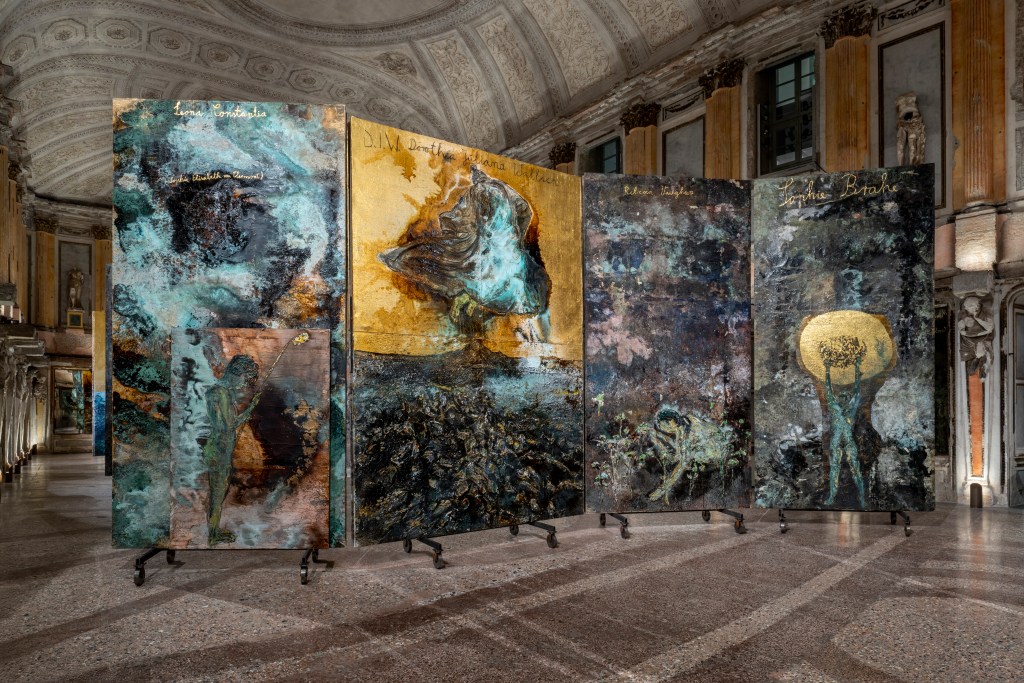
The striking paintings seem like an act of alchemy themselves. The main language is the process of transforming materials and colors. As Kiefer put it, “a true alchemist is not into material things, rather into the transformation from material to spiritual,” and his approach lends something deeply mystical to these women. The room fills with an atmosphere of sacrifice and devotion.
Across the canvases, Kiefer uses oil, acrylic and shellac varnish, alongside clay, charcoal, dried flowers and plants, and even sawdust glued onto the surface. Above all, the works shine with gold—the element, and its transformations, that for centuries connected artists and alchemists through shared fascination.
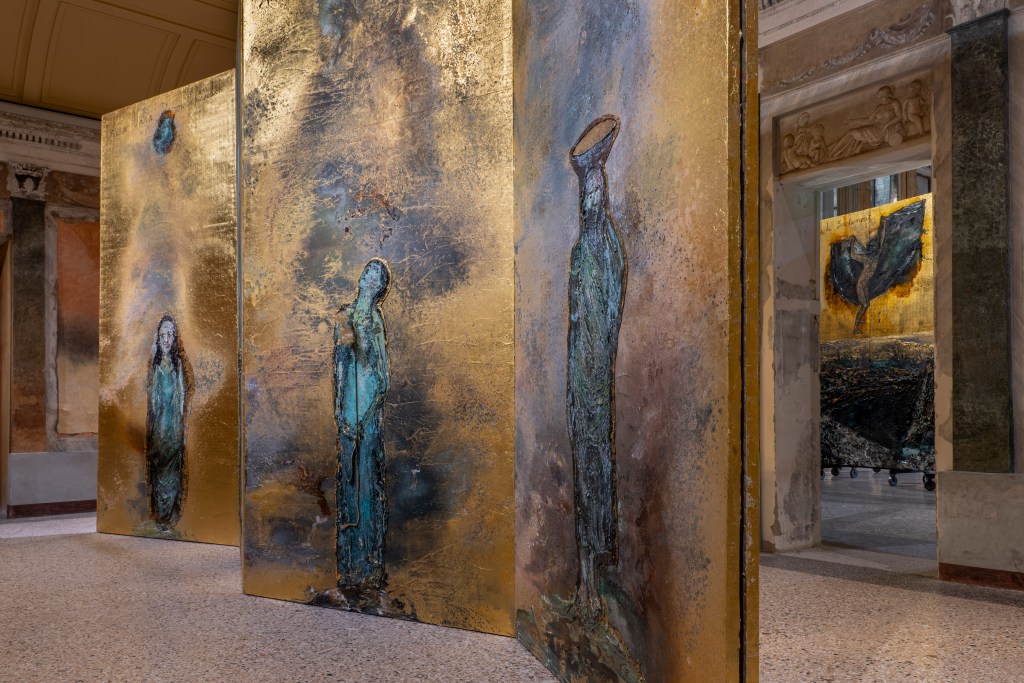
Milan’s City Councilor for Culture, Tommaso Sacchi, called the exhibition “monumental, tough and necessary for the themes that society needs to face these days. It is an invitation to recognize the female figure not only as an iconographical motif, but as a dynamic principle that runs through history: spirituality as a form of resistance, knowledge as an act of emancipation, memory as an instrument of regeneration.”
One of the women honored here connects directly to Milan’s story: Caterina Sforza, daughter of the city’s duke in the 15th century. A proto-scientist, she wrote an essay containing over 400 medications and alchemical recipes.
Kiefer’s exhibition launched alongside the opening of Milano Cortina’s Winter Olympic Games, positioned as a leading offering of Milan’s large-scale Cultural Olympiad program. These initiatives—together with the Olympic and Paralympic Games—are attracting new crowds and broadening perceptions of the city beyond its already high reputation as Italy’s capital of design and fashion.
The Women Alchemists is open through the end of September 2026 at Palazzo Reale.







What are your thoughts?