Crafting the Cosmos: The Design Behind Apple Vision Pro’s Environments
We sit down with Yuri Imoto and Matt Dessero on process, purpose and the art of building worlds
There is a particular quality of stillness that descends when you put on an Apple Vision Pro and find yourself at the edge of a mountain lake—not in a room anymore, but not quite elsewhere either. The immersed experience occupies a strange threshold, one that Apple’s design teams have labored intensely to make feel inevitable rather than engineered. Every rock placement, every shadow, every shift in ambient light is the product of deliberate, disciplined craft.
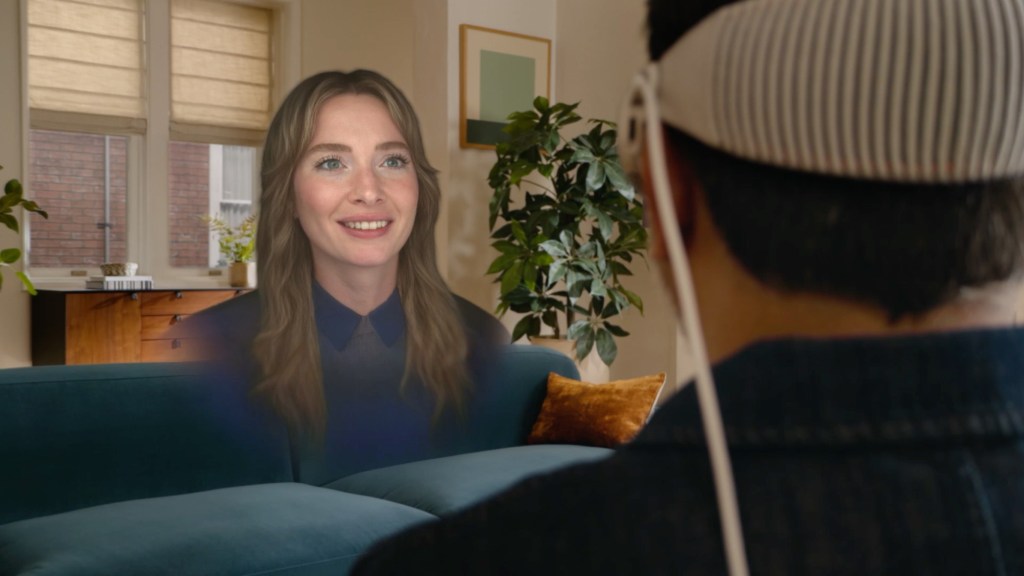
That sense of presence announced itself immediately during the interview itself, which was conducted entirely over FaceTime within Vision Pro. Sitting across from Apple’s team in a shared virtual space, the spatial Personas were striking—not as approximations of people, but as genuinely emotive representations, detailed enough to sustain the social rhythms of the conversation. The feeling of occupying the same room, of reading a slight shift in expression or the weight of a pause, was less a novelty than a quiet confirmation that something meaningful has changed in how we understand shared virtual space.
Yuri Imoto, from Apple’s visionOS Product Marketing team, and Matt Dessero, a Human Interface Designer leading a team of visual effects artists, shared how these environments are conceived and constructed—particularly the newly introduced Jupiter environment, which represents a meaningful evolution in both interactivity and spatial design.
Nature is our base
Matt Dessero, Human Interface Designer
Environments are not merely scenic backdrops, they are calibrated emotional instruments. “Nature is our base,” Dessero explains. “We ask ourselves what mood these environments are going to create for our users. Will it evoke a sense of calmness? Will it give focus? A sense of wonder?” This level of design thinking and the subsequent follow-through in its delivery is what sets Apple’s user experiences apart from others.
For Earth-bound environments, like Mount Hood or Yosemite, this begins with extensive physical fieldwork. Teams scout and capture locations on site through 360-degree panoramic photography and video shot from morning to night, establishing precise lighting references. High-resolution texture capture of rock faces and tree bark is paired with LiDAR scans to construct a unified 3D geometry mesh. The result is not a photograph but a time-space reconstruction.
We really want to make sure the environment feels alive
Yuri Imoto, vision OS Product Marketing
What elevates these environments beyond visual fidelity is the attention paid to audio. Custom acoustic meshes model how sound behaves within each virtual topography—faint echoes off Yosemite’s granite walls or the soft baffling of a forest floor. “We really pay attention to these details and soundscape,” says Imoto, “because we really want to make sure the environment feels alive and it doesn’t feel like this static scene that you’re just sitting in”.
The team also exercises deliberate editorial enhancement. In the Mount Hood environment, for example, a road visible at the actual location was removed entirely, restoring the scene to something closer to its pre-industrial state. This isn’t so much about altering reality as it is world-building in the service of psychological effect.
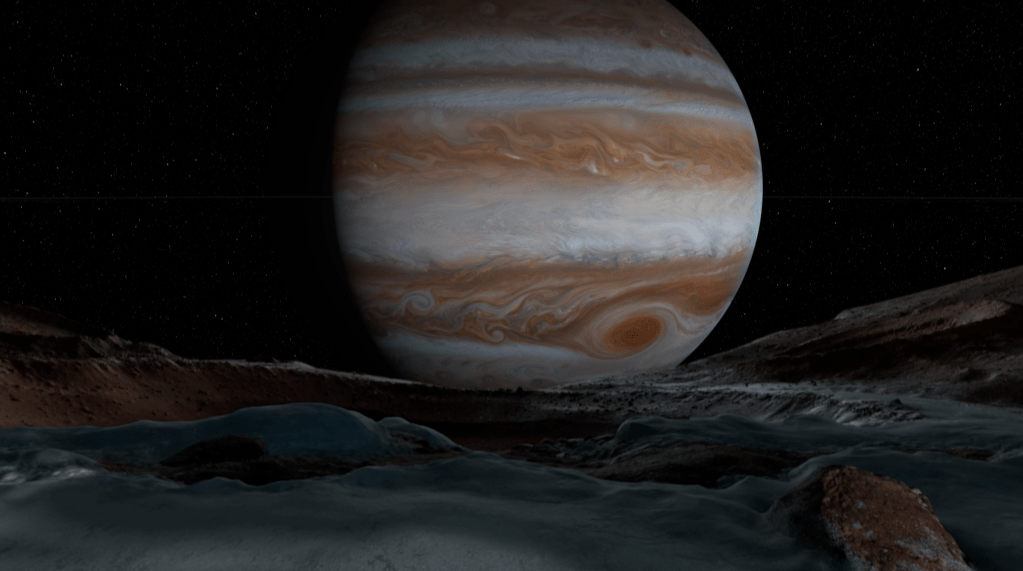
Designing for outer space presents a fundamentally different problem. There is no weather window to wait out, no fog delay, no permit to secure—but there is also limited to no ground truth. The moon environment was built from limited imagery captured during the 1972 landing. And for the Jupiter environment, the team had to construct a plausible world from almost nothing.
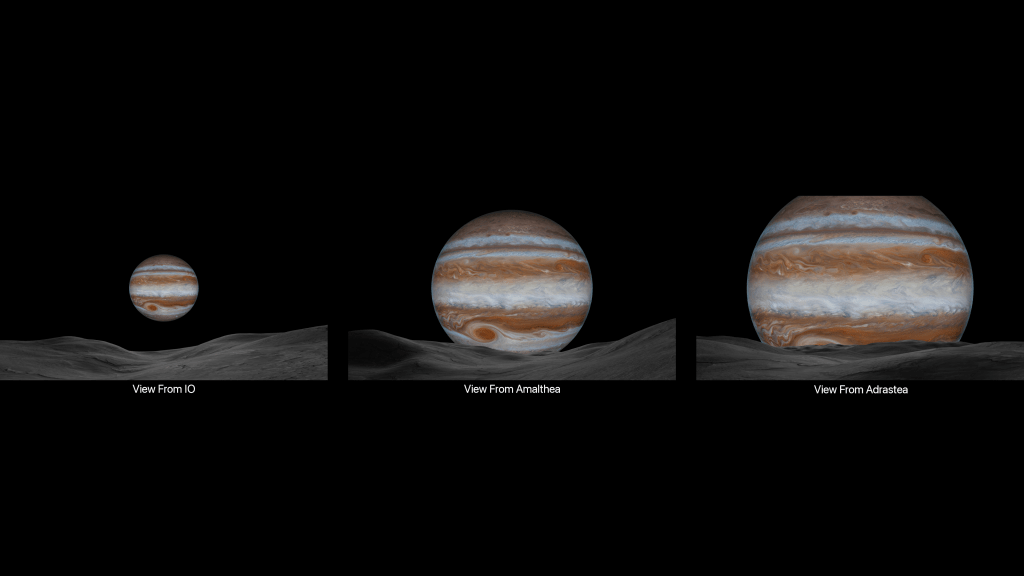
The choice to situate the viewer on Amalthea—Jupiter’s third moon, roughly 90 miles across—was itself a compositional decision. Jupiter needed to dominate the scene without consuming it, inspiring awe without triggering a sense of existential diminishment. Amalthea’s scale and orbital position provided exactly the right visual relationship between viewer and subject.
Because Amalthea has rarely been photographed at high resolution, surface texture and terrain had to be theorized. Apple’s team turned to scientists at NASA’s Jet Propulsion Laboratory for guidance. The collaboration proved transformative. “What we found out from JPL was that this moon is actually created from rocks pulled together by Jupiter’s gravity and held together by ice. So they theorize that there’s a lot of ice on this moon… that’s what we tried to represent here,” Dessero notes.
JPL’s review of the design also prompted the addition of Jupiter’s faint orbital rings and a refinement of subsurface light scattering through the moon’s ice shelves—a detail that would be invisible to most users consciously but would register as an unnamed sense of physical correctness.
Perhaps the most conceptually interesting aspect of the Jupiter environment is how it was made. Because conventional monitors cannot convey the scale relationships that define a spatial experience, Dessero and his team built the environment with collaborators inside the Vision Pro itself.
“The composition of what you’re seeing here was all done through me guiding an artist while inside headset,” Dessero explains. “It’s critical for layout. I mean, I can’t even tell you how critical it is down to the rocks, where all these pieces are in the foreground.” While artists and developers can closely approximate how objects will render and feel, it’s imperative to see them in real time in Vision Pro to properly critique and adjust.
Recursively using the medium to design the medium speaks to something essential about spatial computing. Form cannot be separated from experience when the experience is the form. The traditional pipeline of designing on a flat screen then testing in a headset introduces a representational gap that distorts compositional judgment. Monitoring and building in-situ eliminates that gap.
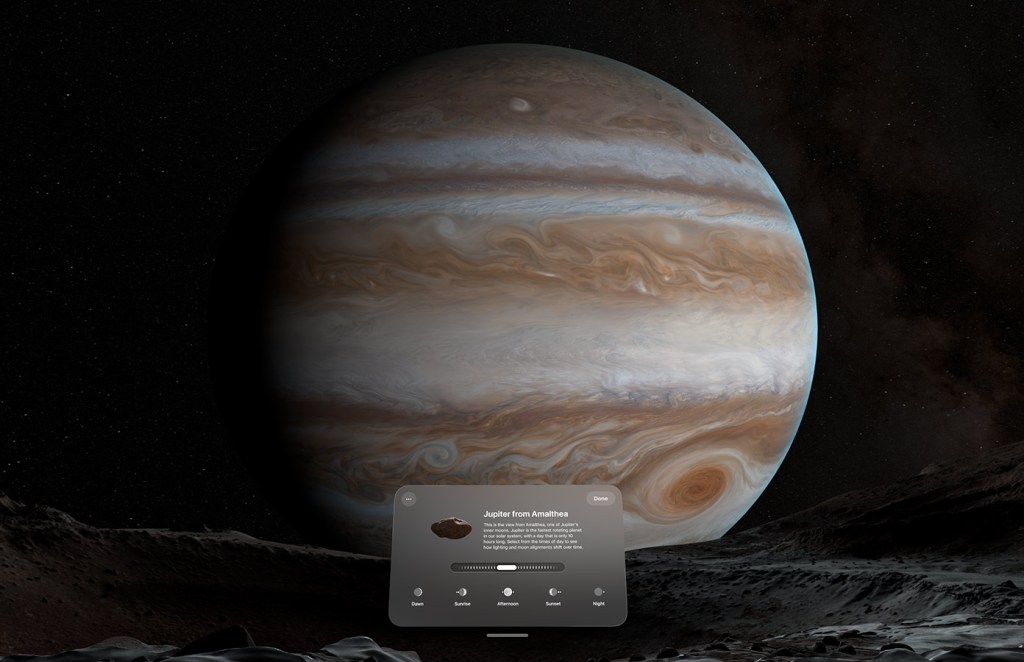
Jupiter is also the first environment to introduce meaningful real-time interactivity. Users can scrub through the time of day, watching shadows migrate across icy craters as Jovian storms churn in the background and neighboring moons trace slow arcs across the horizon.
What emerges from both the earthbound and extraterrestrial environments is a coherent design philosophy: emotional intent precedes technical execution, and no detail is too small to warrant scrutiny. The road removed from Mount Hood and the subsurface ice scattering on Amalthea operate at entirely different scales but reflect the same underlying discipline—a refusal to accept “good enough” when the goal is a sense of genuine presence.
Dessero reflects on the Jupiter project: “It’s a great example of designers, artists and engineers coming together here at Apple, problem solving, innovating and just finding ways to make this come to life, which is, really is a testament to a lot of love of the craft.”
That love of craft is ultimately what separates these environments from spectacle. They are not demonstrations of technical capability—they are spaces designed to be inhabited quietly, unhurriedly and with the kind of attention that makes a user forget, however briefly, that any of it was made at all.





What are your thoughts?