How Toyota’s 2014 FT-1 Concept Became the 2020 GR Supra
We speak with Kevin Hunter, president of Toyota’s North American design studio, about making the car a reality
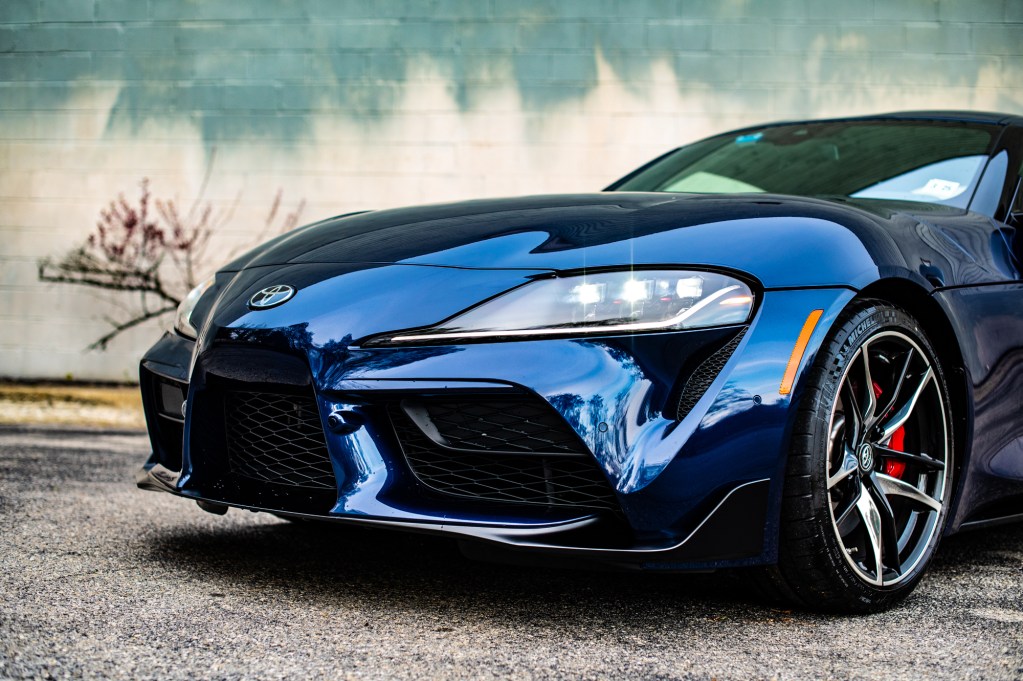
It’s been six years since Toyota‘s FT-1 concept car debuted in Detroit, and not many fully understand its relationship to the 2020 GR Supra (co-developed with BMW) that’s available now, nor just how novel the car was in the first place. When Kevin Hunter—president of Toyota’s North American design studio, Calty Design Research—was working on the FT-1, there was no plan to return the Supra to production and no existing rear-wheel-drive parts bin for Toyota to draw upon—despite the carmaker’s lack of presence in the sports car market at the time.
For two decades—from the early 1980s to 2002—the Supra had represented a kind of dominance of spirit at Toyota. While the 2000GT from the late 1960s (with its long hood, accommodating a straight-six engine) was Toyota planting a flag on a hill, very few were actually sold. Some 15 years after the 2000 GT, the Supra proved Toyota could compete with the world’s best sports car brands at massive volume. After four generations—it went away.
Hunter and his team saw the FT-1 as the opportunity to show that a Supra could come back, if Toyota wanted it to. We spoke to him about designing the massive concept, and then reworking it for reality.
You were designing something pretty blue sky with the FT-1, right?
Yeah. And it’s a big car, actually. I guess one of our hopes was we knew the Lexus LC500 was under development, but there was no package for this car. No way to make it work. We knew nothing. We’re just a bunch of designers. But we thought the FT-1 would fit around the LC500 package thinking this could be Toyota’s version.
Would you say there’s also a muscularity to both concept and production cars that carries through?
The primary movement is the cabin architecture—it’s as efficient and as tight as we could make it, balanced at the center of these super powerful wheel arches. The car has rear-drive, so we want it to look that way, to provide this incredibly muscular rear quarter area that flare all the way around. And then there’s an outlet for air-management there. One of my favorite views of Supra is the rear three-quarter, just because it really does set the tone for the entire car.
Going back to the subject of size, the FT-1 was quite a bit larger than the production Supra, which is more like three-quarters the size of the FT-1. Usually carmakers make a scale model and increase size, not shrink it.
To get that fit over the actual engineering package was quite a task. The design team that worked on it in Japan and in Munich coined the term “condensed extreme” to wrap their heads around trying to get this beast of a car down and condensed around this really tight package. I was really surprised at how well it scaled. And it is really cool it still has an in-line six crammed in there. And the hood itself is this big clamshell with a huge wrapping over the side, right to the door cut, which is quite unique.
Overall the entire body is so sculptural. Your eye just doesn’t rest anywhere. What’s the takeaway of this much visual expression?
We’re exaggerating every surface. It’s maximum sculpting. We want it to be a beautiful car, a really exciting vehicle that you just can’t stop looking at. You walk around it over and over and over again trying to understand it. Every time you look at it, it delights you in a new way.
Hero image by Michael Frank
COOL HUNTING always gets permission to use the images we publish; however, as an independent publication, we cannot afford to continue fighting unfair claims of copyright infringement, so the images have been removed from this post.