Es Devlin’s Other Worlds at London’s Design Museum
The artist and stage designer’s first European retrospective opens like a performance and closes inside a rotating library
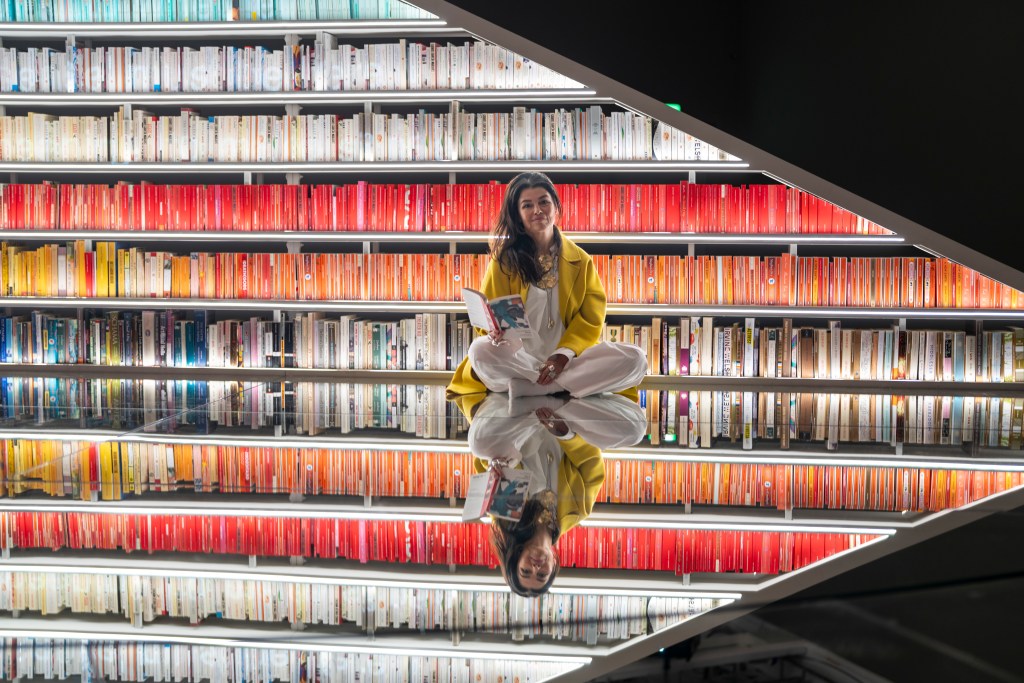
Books usually stay still until someone picks them up and brings them to life by reading. Not in Es Devlin’s world, where books keep moving, as the new exhibition Es Devlin: Other Worlds at London’s Design Museum shows.
We have met these installations of light, sound and motion before, with revolving bookcases of different shapes turning in front of us or around us: Library of Light at the Pinacoteca di Brera during Milan Design Week 2025, Library of Us on Faena Beach for Miami Art Week the same year, Library of the Four Winds at Castle Howard this summer. For her first European retrospective, Devlin unveils Infinite Library, a giant triangle holding 2,000 books that rotates and reflects in a vast circular mirror.
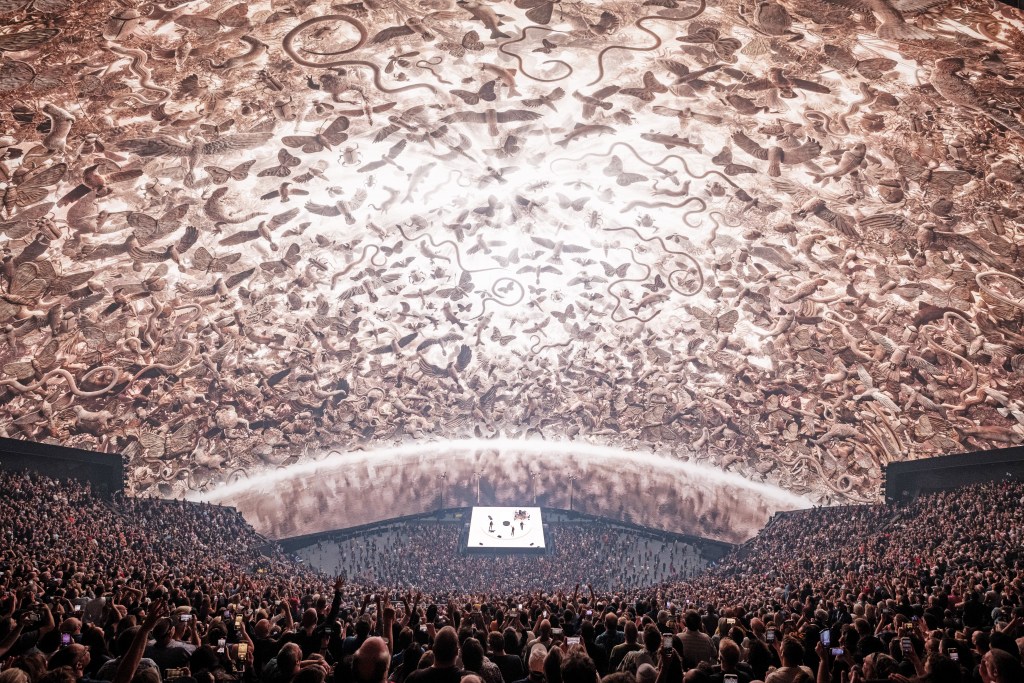
Stage designer from theaters to stadiums, artist, painter, sculptor: no single word captures her practice. She has collaborated with Kanye West, Lady Gaga, Billie Eilish, U2, Beyoncé and Mika; designed stages for the Metropolitan Opera in New York, the National Theatre in London and the Bregenzer Festspiele in Austria; created installations for the V&A and Tate Modern; worked on the inaugural show at The Sphere in Las Vegas; designed show sets for Louis Vuitton; and became the subject of An Atlas of Es Devlin at Cooper Hewitt, Smithsonian Design Museum in New York. Most recently, she served as artistic director of Homo Faber, the craft biennial we visited in Venice.
As Tim Marlow, director of the Design Museum, put it at the press preview we attended, “Es is such a multi-hyphenate. There’s so many things that Es does and is, but ultimately she’s Es Devlin.” Does it make sense to put her in a category at all? Devlin’s own answer leaves little doubt: “Having just also worked on an exhibition of artisanal objects in Venice, what came up there is these distinctions between genres become ever less urgent as we start now to distinguish between works made by human hand and works made by collective artificial intelligence, frankly. So I think there’s going to be less and less emphasis on different ways that humans make things, and more emphasis on the fact that a human hand and embodied consciousness made it.”
After years spent on theater, dance and live music, over the last decade she has turned her focus to art installations. “I’ve made 37 in the last 10 years,” Devlin says. “The focus for me now is museums, art installations. But what I bring to them is the terms of engagement that I’ve learned in a performance environment. So for me it’s critical that when you arrive, I take care of those first moments. I take care of how you gather and I offer you the experience of being a small audience.”
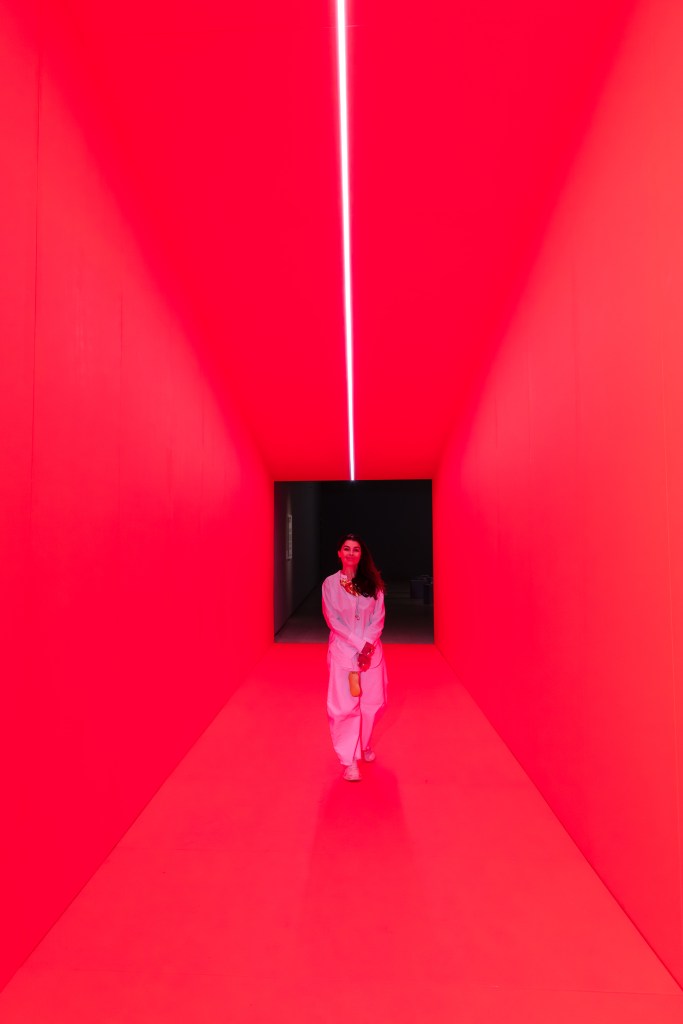
That’s exactly what happens here in London. Visitors gather in groups of 50 in a dramatic red room, then step into an almost perfect reproduction of Devlin’s studio. For a few minutes they roam and take pictures, then the magic begins: sound, light effects and a moving video about the artist’s life, building to a scenographic twist we won’t spoil. From there, the visit continues in a more traditional museum setting. Devlin stresses the weight of those opening moments: “You do what you want as you would normally in a gallery exhibition experience, but I’m bringing those terms of engagement, of performance, of audience, of temporary community to those first five minutes, and it’s critical to me that they are at the beginning of the work, because then that’s the lens through which you see the rest of the show.”
“There are forms that recur throughout all of the 5,000 objects that you’re going to see here,” says Devlin. “And they are forms like a line of light, a revolving cube, a circle, forms that recurred long before I was born and that will recur long after I’m no longer here.” Even though everything starts from her own work, she aims to build worlds open to anyone, experiences that can include every visitor: “I think what the installation really expresses is the sense in which anybody’s practice, this happens to be mine, is infused with the worlds of others. Other times, other experiences and I hope that’s what you’ll experience as you go through it.”
At the heart of the exhibition, a vast display of drawings, sketches and models spans hundreds of projects. Curator Johanna Agerman Ross, together with Danielle Thom and Margherita Dosi Delfini, spent days browsing thousands of artifacts, selecting 5,000 and arranging them with the help of Devlin’s studio staff. The archive itself survived almost by chance, as Devlin explains: “When I was 28 years old, I had been in a very long relationship, and I left the house and the relationship with one suitcase. Then about three years later, my ex-boyfriend who I was still on very good terms with said, ’Oh, I’m selling the house and I found these eight bin bags in the attic.’ And I swear to you, most of the stuff that’s on the wall in the early years of the archive, they were in those bin bags in the attic. So I wasn’t consciously keeping the stuff. I put it away. But then when I returned to it, I recognised the value.”
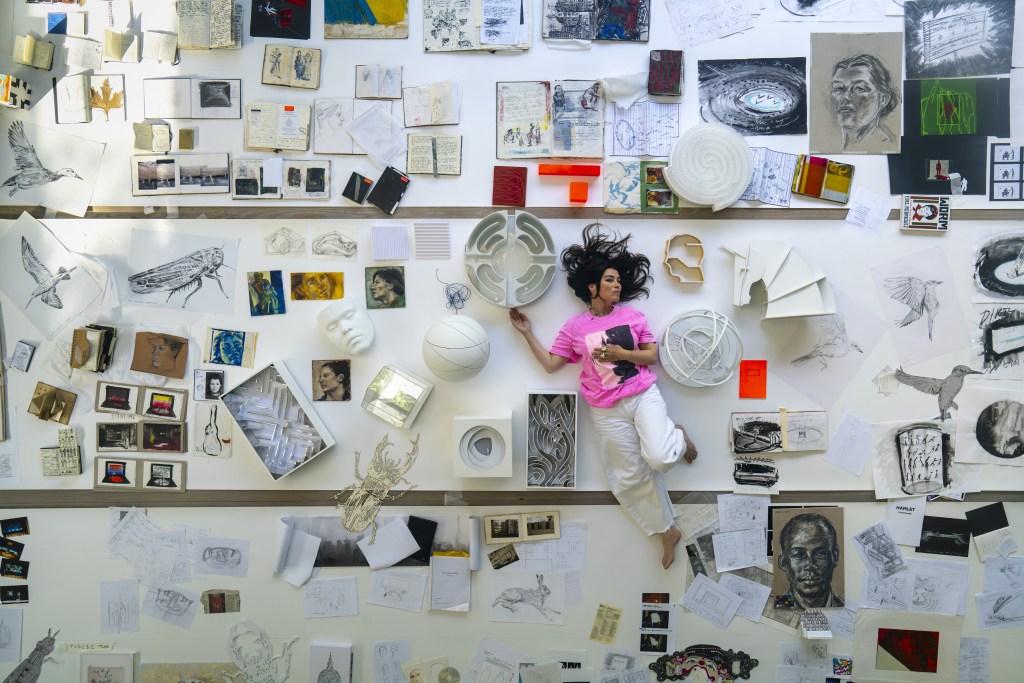
The studio team played a central role in shaping the exhibition, but according to Devlin their contribution reaches much further: “In my studio we work as a team of eight designers, and the design team at my studio has been immensely involved in everything you see here. It’s absolutely not a one-person show at all; eight immensely talented women and one guy who work with me, they keep everything. I do a drawing, I hand it to them, they take it forward in technical drawings, a lot of the recent models are made by them, so just as a process they file everything. So that’s also why we have such an archive since 1996.”
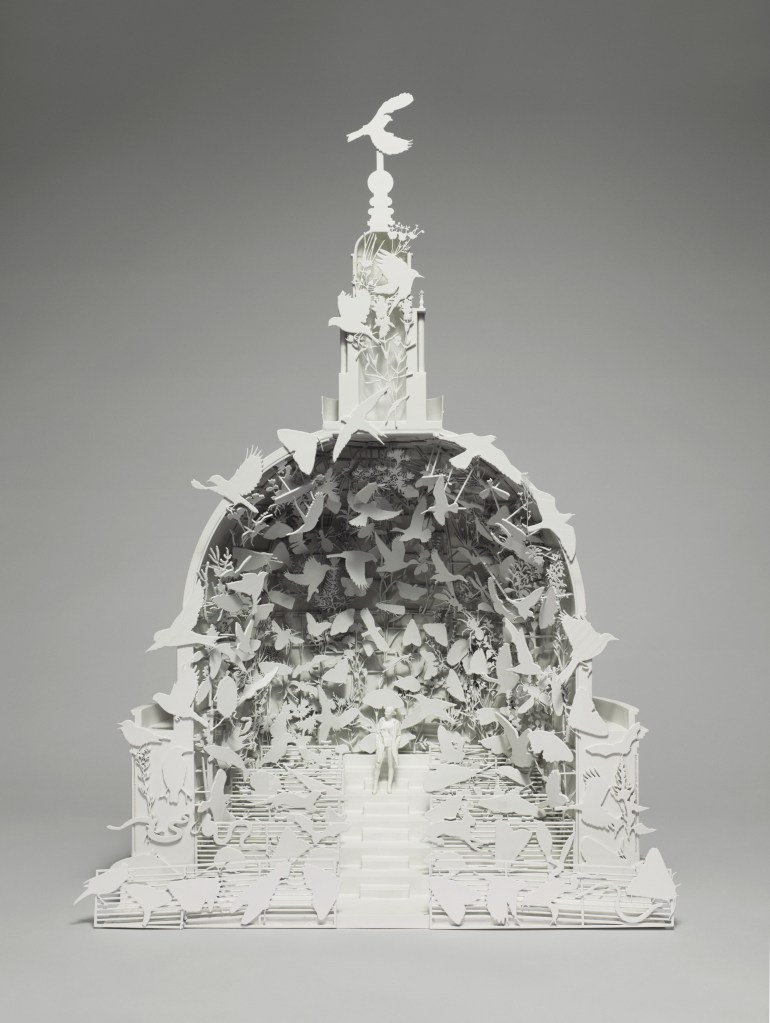
Several Devlin projects are underway around the world right now, and together they offer a snapshot of her approach to design and art, as well as of where she plans to go next: “I made a work at the V&A East Storehouse, which is still on until 18 October, called The Everythingists. I’ve adopted that word now to describe my practice. It was coined by Natalia Goncharova, because her practice was in stage design, performance, fashion, portraiture, painting. And she just said, ‘just call me an everythingist.’ And I think it’s something that was much more usual. It’s rather a recent thing that we’ve chosen to limit what’s possible to specialism. I think this renaissance approach to being able to express through multiple modes of inquiry is something I’ll continue, but I will say it probably took me until 10 years ago to really figure out what I wanted to make in my own voice. So I will for sure be focusing on museum art installations and smaller works as well. There’ll be an exhibition of works at Soho House in November, which will be small scale. And yet, Olivia Rodrigo’s tour opened a few days ago, which we did in collaboration with Hussein Chalayan. Also, Don Giovanni’s on at the Opera House. So, yes, I relish what each of these modes of practice brings.”

The final room reveals the giant rotating library; its 2,000 books, all provided by Penguin Random House UK, arranged to form a rainbow. Here, visitors can sit and read a selection of the titles that shaped Devlin’s ethos and vision, among them James Gleick’s Chaos, David Abram’s The Spell of the Sensuous, Toni Morrison’s Beloved and Margaret Atwood’s Oryx and Crake. Those books opened the portals through which Devlin entered other worlds, the same “other worlds” she now builds with her own work.
Es Devlin: Other Worlds runs 2 October, 2026 through 4 April, 2027 at the Design Museum in London.





What are your thoughts?