Hi-Snaps and the End of the Imitation Drink
Allison Parc and Sam Lim Achatz skip the beverage entirely with a pocket-sized THC + CBD snap that disappears into whatever you’re already drinking
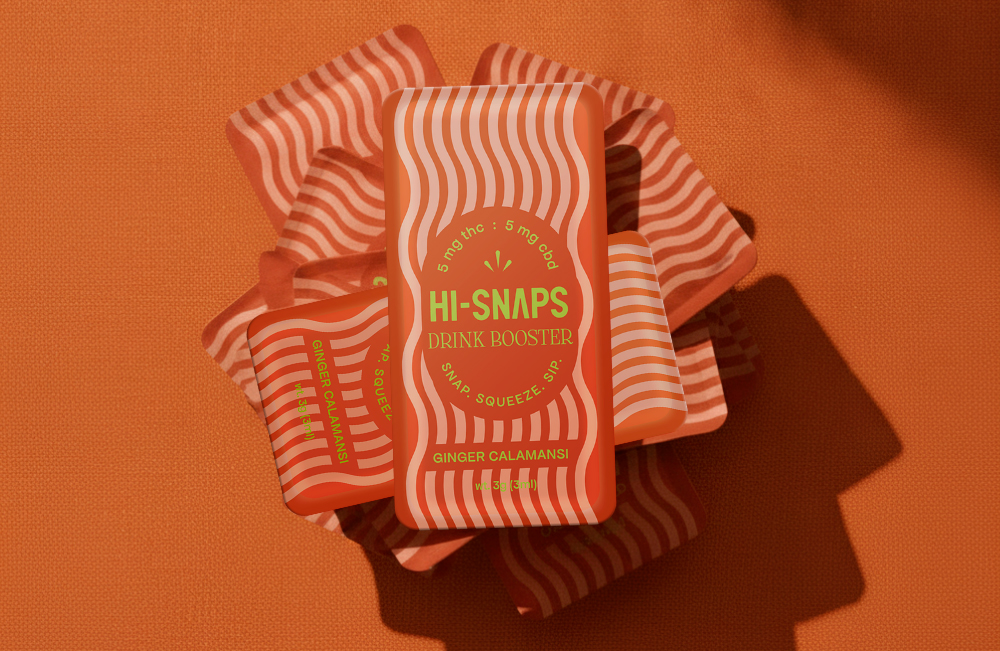
The alcohol alternative has spent the last several years perfecting its impression of the real thing. Zero-proof spirits engineered to burn like gin. Adaptogenic aperitifs in wine-shaped bottles. Cans styled to pass for beer at arm’s length. All of it assumes the way past drinking is a convincing imitation of it. Hi-Snaps is built on a different premise entirely: the drink was never the point.
Founded by co-founders Sam Lim Achatz and Allison Parc, Hi-Snaps is not a beverage at all. It’s a snap—a pocket-sized packet holding 5mg of THC and 5mg of CBD that breaks with a small crack and squeezes into whatever is already in your glass. Lim spent years as a fashion editor and creative director before turning to cannabis, and her path there was less a conversion than a slow incompatibility. “The chemistry of alcohol and my body just stopped being compatible, even though I still loved the ritual of drinking,” she tells us. “I had developed some pretty severe eczema from head to toe and one of the biggest inflammation markers was alcohol.” What she gave up was the substance, not the ceremony. “I still loved dinner parties. I still loved celebrating. I still loved sitting around a table until midnight talking about absolutely nothing important.”
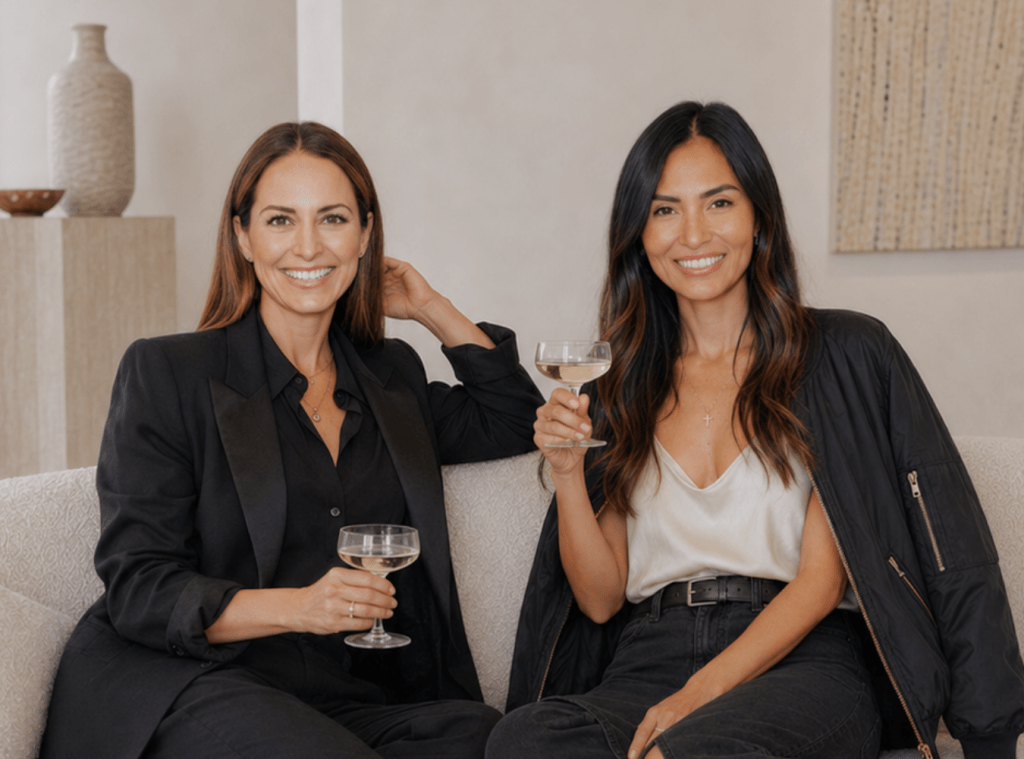
That distinction—between the drink and the ritual surrounding it—became the company’s founding argument as Lim and Parc developed the business, though not immediately. They began exactly where the category told them to: with a canned beverage. Designs were finished. Flavors were developed in collaboration with chef Grant Achatz of The Alinea Group (who is also Lim’s husband), while the two continued refining the broader product concept. Then the premise collapsed under its own logic. “One day we realized…wait. We don’t actually need another drink. We already have drinks we really like—sparkling water, matchas, Diet Coke. Why do we need to replace the drink when what we are actually changing is the feeling that drinking brings?” Lim says. For Parc, who previously founded and later sold the award-winning French single malt brand Brenne Whisky, refusing imitation was also strategy. “If you copy, then you’re already racing to try to catch up. If you create, you get to lead with creativity, innovation and create new paths forward,” she says. “It’s harder to educate consumers but once they get it, they fall in love.”
Imitating others in beverage assumes the drink is the point, but I don’t think it is. The point is the conversation. The laughter. The music. The people you’re with. The drink is just the vehicle.
Sam LIm, Hi-Snaps co-founder
The two founders disagree by design. Lim describes herself as starting with feeling first—the story, the reason a thing deserves to exist—while Parc pushes those ideas into manufacturable, scalable products. “I think I’m always trying to make things more delightful. Allison’s always trying to make them more dependable. Those sound like opposite goals, but they’re actually the same goal. Because delight disappears pretty quickly if the product doesn’t work, and a perfectly engineered product doesn’t matter much if nobody falls in love with it,” Lim says. “Neither of us is precious about being right. We’re both precious about getting to the best idea. Every single day we are grateful to have each other because neither of us would build this company on our own. We’d each end up with half a business.”
The product’s aesthetic reflects Lim’s years in fashion, balanced by Parc’s experience building premium spirits brands. “Fashion people are ruthless. If something is ugly, awkward or too big to fit in your bag…they’re simply not bringing it. That was actually a useful filter,” she says. “Fashion also taught me that people don’t carry things just because they’re useful. They carry things because they say something about them. So when we designed Hi-Snaps, we weren’t thinking about cannabis packaging. We were thinking about lipstick. Business cards. Beautiful matchbooks. Great hotel merch. I was designing one of those little objects people become oddly attached to,” Lim says. The packets trace back to the makeup and skincare samples once bound into fashion magazines—she tracked down the manufacturer herself—and the refillable 10-snap tins nod to Victorian snuff boxes and the familiar heft of an Altoids tin, topped with sleeves designed for future collaborations—“like little outfits for the snaps.”
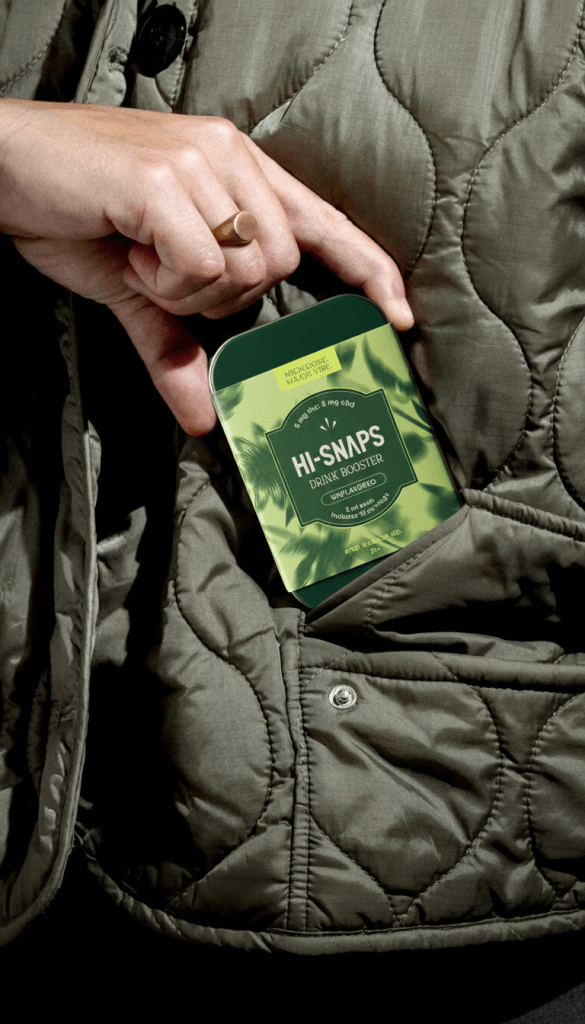
Neither founder looked at other cannabis brands for cues. “I don’t think cannabis has had enough people from outside of cannabis designing it,” Lim says of the team’s approach “We looked at the kinds of things we already loved having in our lives—beautiful pantry items, boutique hotels, great skincare, restaurants with incredible branding.” The test was simple: “We kept asking ourselves, ‘Would we be excited to pull this out at a dinner party?’ If the answer was no, it didn’t make the cut.” Parc puts the result plainly: “Hi-Snaps are intentionally discreet and fun—pocket-sized, travel-ready, with a carrying tin that feels nostalgic and effortless at the same time.”
Then there’s the gesture the brand is named for: crack, squeeze, pour. “Good design invites participation, and a Hi-Snap is just that,” Lim says. “We love the snap-and-squeeze action—it lasts for 2 seconds but people talk about it all night. Someone inevitably says, ‘Can I try one?’ and then everyone wants to see. It’s become this tiny little party trick that somehow turns into a conversation about why you’re using it in the first place.” The product demos itself.
The most fought-for detail is the one nobody notices. Using advanced cannabinoid delivery technology, the formulation vanishes into a drink without announcing itself—no weedy undertone, no sugar masking. “If someone says, ‘Wait…did you already put it in?’ that’s my favorite compliment,” Lim says. Parc is pointed about the flood of hemp drinks cramming milligrams into lower-quality formulas and hiding them under sugar and basic flavors; the Hi-Snaps answer was patience. “We also took nearly a year to develop our first flavor. We were really intentional about it, and we’re so incredibly proud of what we’ve created,” she says. That flavor, Ginger Calamansi, is a citrusy, gently spicy blend developed with Achatz that has already collected a Platinum High Spirits Award—and like the unflavored original, the hemp-derived formulation is kosher, vegan and gluten free, with zero sugar and zero calories. The starting brief to their scientist wasn’t a spec sheet either. “We kept saying if we could give our best friends anything, it would be more laughter and better sleep.”
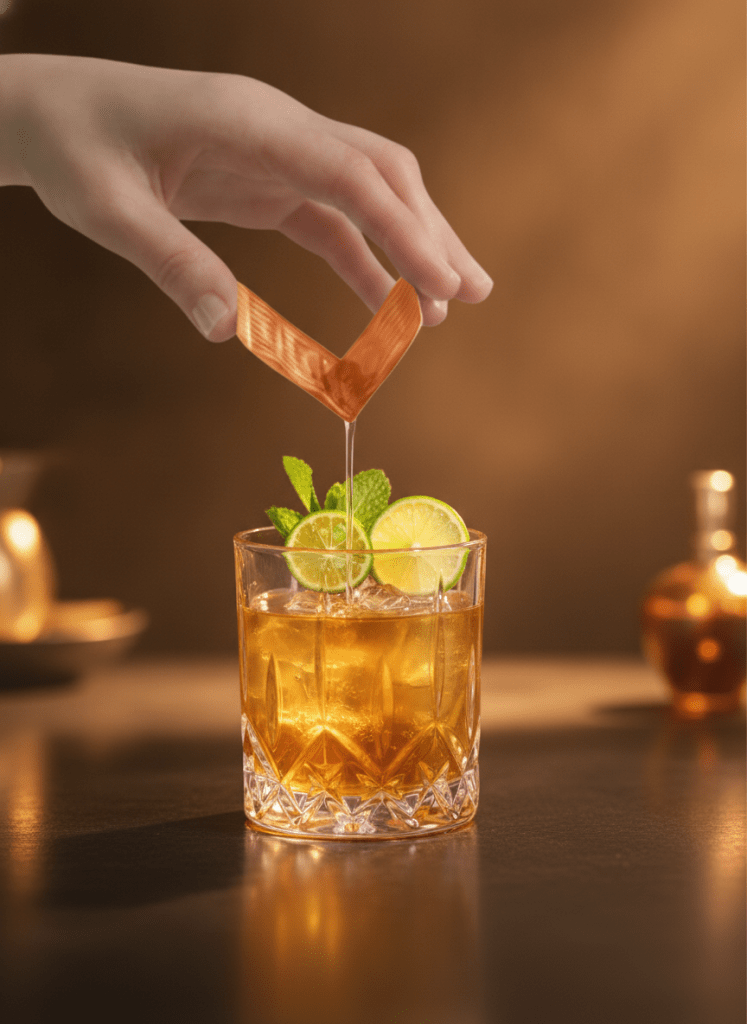
That feeling is calibrated as carefully as the object. Every snap delivers the same 5-mg dose and every batch is tested. Ask Parc what that took and the answer is quick: “An amazing scientist and team of dedicated professionals who are as maniacal about quality and consistency as we are!” For Lim, the obsession is aimed squarely at the category’s real barrier. “Most people don’t tell me they’re afraid of cannabis. They tell me they’re afraid of not knowing what’s going to happen,” she says. “Every decision we made came back to one question: Would I feel comfortable handing this to my mom? My best friend? If the answer wasn’t yes, we weren’t done. We’re not selling intensity, we’re selling confidence.” In a market that often equates potency with value, Hi-Snaps treats predictability as the luxury.
The audience is drawn just as precisely. “Our audience is High Functioning: professionals, parents, creatives, people doing big things who do not find value in being hungover. But they’re still fun,” Lim says. “I think we’re in the business of protecting tomorrow without sacrificing tonight.” She has little patience for the all-or-nothing terms the culture has set. “The culture has acted like your choices are either ‘don’t drink’ or ‘go to the moon.’ Most people are looking for something way less dramatic. They’re just trying to have a really nice evening,” she says. “Just because we aren’t drinking alcohol doesn’t mean we are all of a sudden boring and want to miss out on all the fun. Non-drinkers deserve to have just as much of a special experience as those partaking.”
Parc frames that audience with the specificity of someone describing her own address book. “We realized no one in cannabis was talking to people like us—people who like going to nice restaurants and events, host dinner parties, museums, attend a concert or the ballet, have pool parties and host their mom-friends,” she says.
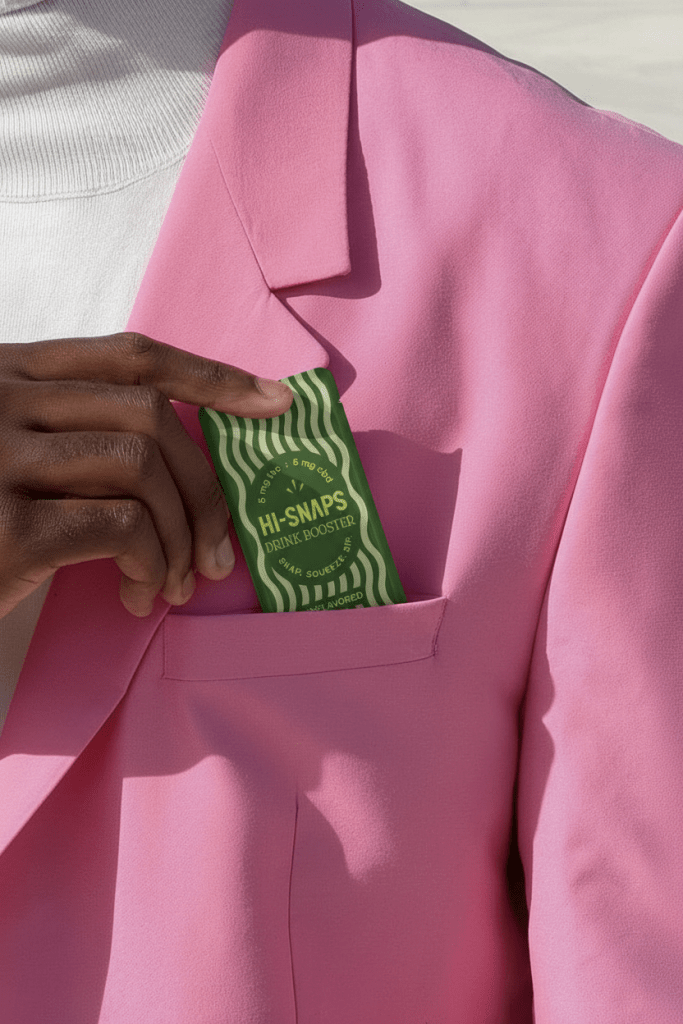
The shift is already visible at the table. “It used to be, ‘Red or white?’ Now it’s… ‘Do you want wine?’ ‘Want something non-alcoholic?’ ‘I have Hi-Snaps.’ Nobody makes it a thing anymore and that is really beautiful,” Lim says. “Because good hospitality has never been about serving the perfect drink. It’s about making someone feel considered and thought about.” Restaurants are following the hosts. Parc points out that a snap asks nothing of a beverage program—no refrigeration, no cans to store, no prescribed flavor, sugar or volume before the full 5mg lands. “The restaurant can keep their creative mocktails on the cocktail list and now offer Hi-Snaps as an add-on,” she says. “Some places like to offer Hi-Snaps in tall drinks with lots of ice to slow down the effect, others like to offer it almost as a shot for the effect to happen more quickly.” The guest, not the glass, stays in control.
Asked what the dinner party looks like in five years if the snap becomes as common as a wine key, Parc doesn’t hesitate: “A very good time and quite chic. Can you imagine? Instead of people ingesting bottles of wine and getting a little sloppy by the end of the night, everyone instead is snapping and laughing, increasing the quality of their time together in community versus getting more numb.”
Lim’s own ambition runs in the opposite direction of most founders’. “Right now we are the new cool kid on the block, we have a fun new function, we’re a new exciting alternative to drinking alcohol and I love that energy,” she says. But the endgame is invisibility. “Honestly, I hope we get to a point where nobody talks about Hi-Snaps. I hope it’s as unremarkable as asking someone if they’d like still or sparkling water. Someone opens a beautiful bottle of wine. Someone else snaps Hi-Snaps into iced tea. Somebody has a martini. Nobody has to explain themselves,” Lim says. “Not less celebration, just less pressure that celebration has to look exactly the same for everyone.”
The rest of the category keeps chasing a more convincing stand-in for the glass. Hi-Snaps ultimately designed its way around the category altogether—and the most persuasive alcohol alternative may be the one that never asks you to replace the drink you already love.
To shop Hi-Snaps, visit hisnaps.com.


What are your thoughts?