People’s Clock by Maarten Baas at Schiphol Airport
The Dutch artist and designer bends our sense of time with a monumental, participatory clock
If you’re among the tens of millions of passengers who pass through Amsterdam Schiphol each year, you’ve likely walked through Lounge 2. And if you did so any time after 2016, you probably stopped in front of a very strange clock conceived by Dutch artist and designer Maarten Baas. In fact, it ran as video: a lone figure painting and deleting the hands, yet keeping real time all the same.
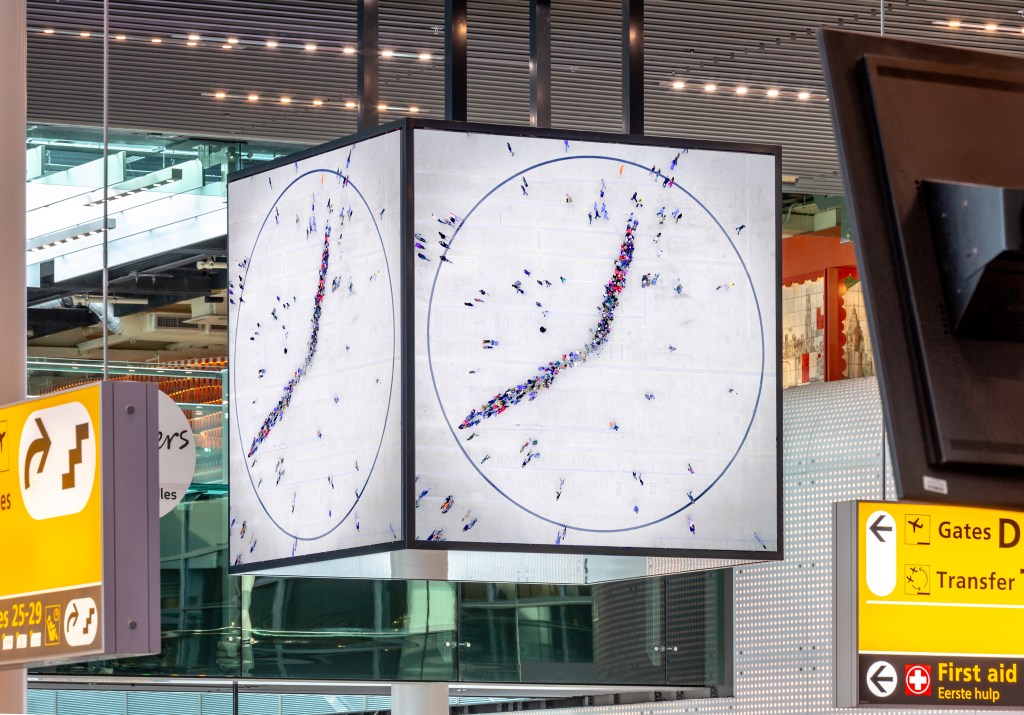
Head through Lounge 1 now—for European/Schengen flights and transfers—and you’ll meet People’s Clock, the ambitious new functional work by Baas. A giant cube measuring 2.5 meters per side, it shows the time cleanly across four faces, once again a perfectly working clock in the form of video. Only this time, Baas trades one person for an entire village.
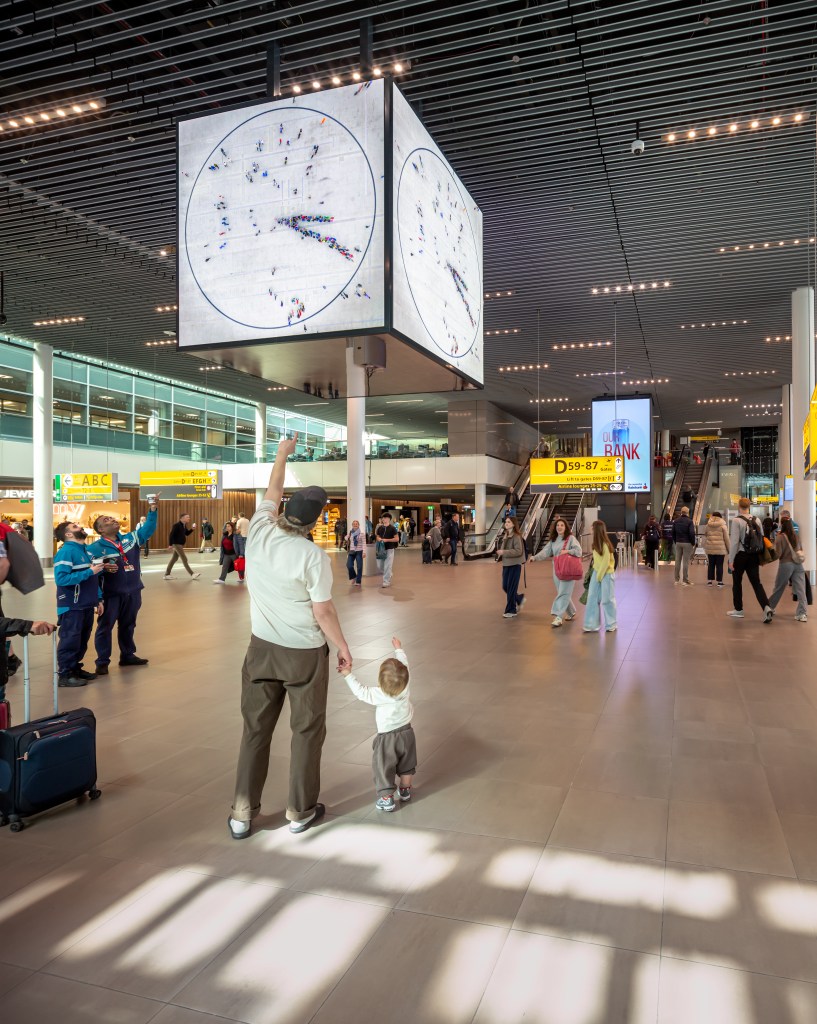
To build it, he enlisted 1,000 people, airport workers and other volunteers, for a 12-hour aerial film shoot in which every participant became part of a genuine performance. A single camera positioned directly overhead captured the choreography from above. Bodies moving in unison form the hour and minute hands, while the second hand falls to a single person running around the perimeter. Most of them work at the airport: baggage handlers, security, cleaning staff and others participated. For Baas, it reads as a tribute to the countless people who keep a machine as delicate and complex as an airport running, every bit as intricate and sophisticated as a clock.
He shot it all in a single day and, fittingly, inside one of Schiphol Airport’s hangars. Baas’s playful, irreverent spirit surfaces here too. This landed less as a set and more as a full-blown cultural happening, where volunteers didn’t just feed the video but ate, practiced yoga, played, participated in a screen-printing workshop and more.
People’s Clock extends Baas’s Real Time series, which he launched in 2009 at Milan Design Week with Sweepers Clock, featuring two workers pushing debris into the shape of the hands. From there it grew into the Grandfather Clock, with a bearded figure repainting the time from inside a brass and bronze cabinet, and public commissions like the Paddington Clock in London and the Schiphol Clock that preceded this one. Seventeen years on, the passion holds: that measured time, for all its precision, comes down to people, moving.









What are your thoughts?