Static and Signal: Prada Mode Tunes in at the Hotel Chelsea
For its 14th iteration, Prada’s itinerant private club takes over a New York landmark with Nicolas Winding Refn and Hideo Kojima

Most brand programming asks you to stand still and look. Prada Mode asks you to move through something. For three days at the Hotel Chelsea, the company’s itinerant private club turned one of New York‘s most storied buildings into a working broadcast, a sci-fi set and an argument about what it means to make anything at all. The 14th edition is called Satellites II, and it played less like an exhibition and more like a signal—one you can tune into and walk through.
The collaborators are Danish filmmaker Nicolas Winding Refn and Japanese video game creator Hideo Kojima, two men whose friendship has become its own medium. Satellites II extends Satellites, the show they staged at Prada Aoyama Tokyo in the summer of 2025, which used their dialogue to trace the lines between love, language and creativity. The New York chapter widens that frame—across cultures, across media, across a city—and threads it through the romantic mythology of the Chelsea itself. The result is not a tribute to either artist. It is a study of the space between them.

A Club That Keeps Moving
Prada Mode began at Art Basel Miami Beach in 2018, conceived as a members’ club that refuses to stay put. Each edition lands in a different city, timed to a cultural moment like an art fair or festival, and hands its concept to a different collaborator. The first was Theaster Gates, who built a club around Black music and identity inside the fair. Since then the program has touched down in Hong Kong and London, Paris and Shanghai, Moscow and Los Angeles, Dubai, Tokyo, Seoul, and most recently across Osaka and Inujima Island in Japan. The collaborator list reads like a syllabus: Damien Hirst, Ava DuVernay, Martine Syms, Kazuyo Sejima, Kate Crawford and Trevor Paglen, Jia Zhangke.
What holds the editions together is not a look but a posture. Prada Mode treats hospitality as a form: workshops and panels by day, performances and dinners by night, a membership granted entry to all of it. New York’s edition is the first time the club has set itself inside a building with this much of its own history and Satellites II leans into that tension rather than smoothing it over.
Satellites, Continued
Refn and Kojima are an unlikely pair only on paper. One makes neon-soaked, slow-burning films, the other builds games that play like cinema you can walk inside. Both work in worlds defined by mood, dread and the long pause. Satellites took their friendship as its premise: the idea that creativity is relational, that it moves between people the way a signal moves between two points in orbit. Satellites II keeps the metaphor and lets it travel. The exhibition spans languages, cultures and spaces, built around the two artists’ ongoing exchange of images, ideas and obsessions.
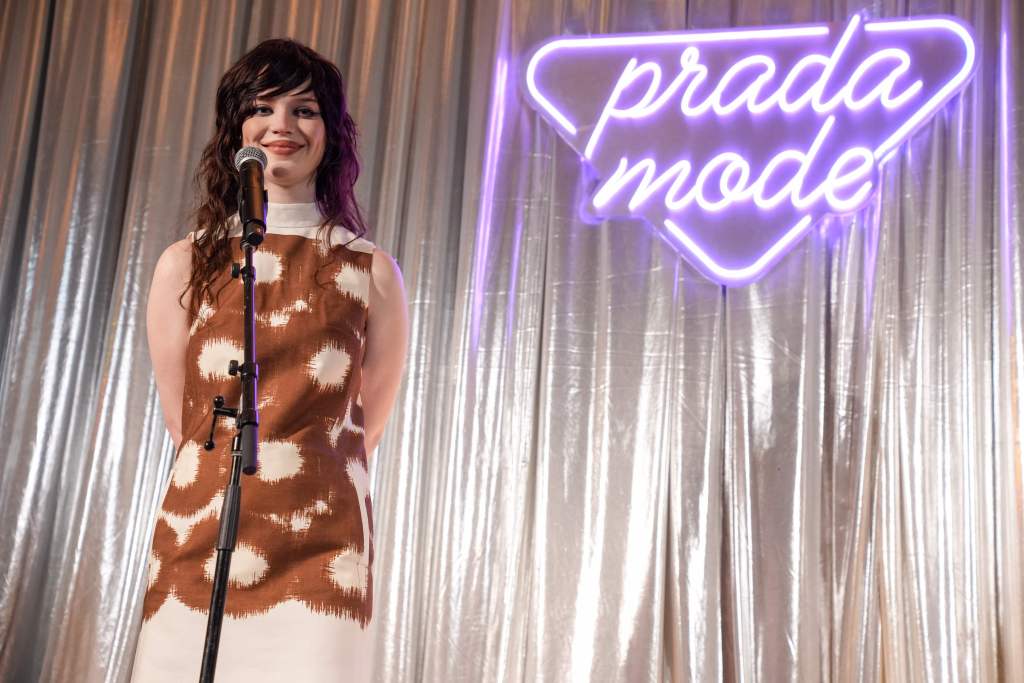
On the opening day, that exchange went public in the form of conversation. Two talks set the register: “Arrogance of Youth,” with actress and musician Sophie Thatcher joining Refn and Kojima, and “Artists We Love,” with filmmaker Abel Ferrara. The dialogues circled a single, durable idea on the need to create, and the failure built into the act of creating. Not failure as a setback, but failure as the cost of admission.
The Hotel as Instrument
The staging uses the Chelsea as more than a backdrop. Satellites II unfolds across the building’s layered architecture, moving between the lobby, corridors and guest rooms, letting the progression do the thematic work. A classical-but-progressive science-fiction aesthetic reimagines the historic setting, so the place feels at once like itself and a transmission of itself.

During the private program, select guest rooms functioned as micro television studios, staging original performances for invited participants. Later, those same rooms reopened to the public as deliberate installations, the studio becoming the artifact. The space is not a container for the art. The space is the art, caught mid-broadcast.
Tune In: The Prada Mode Channel
The Prada Mode Channel is a broadcast built in the vein of a cable station, made in collaboration with Mikael Bertelsen, and you can watch it from anywhere. It leaned hard into analogue television tropes—talk shows, horoscopes, the low-grade intimacy of programming that runs whether or not anyone is watching. It is nostalgia used as a tool, not a mood. The channel turned the exhibition into something with a frequency, a way of reaching past the velvet rope of a members’ club and into the ambient static of a screen.

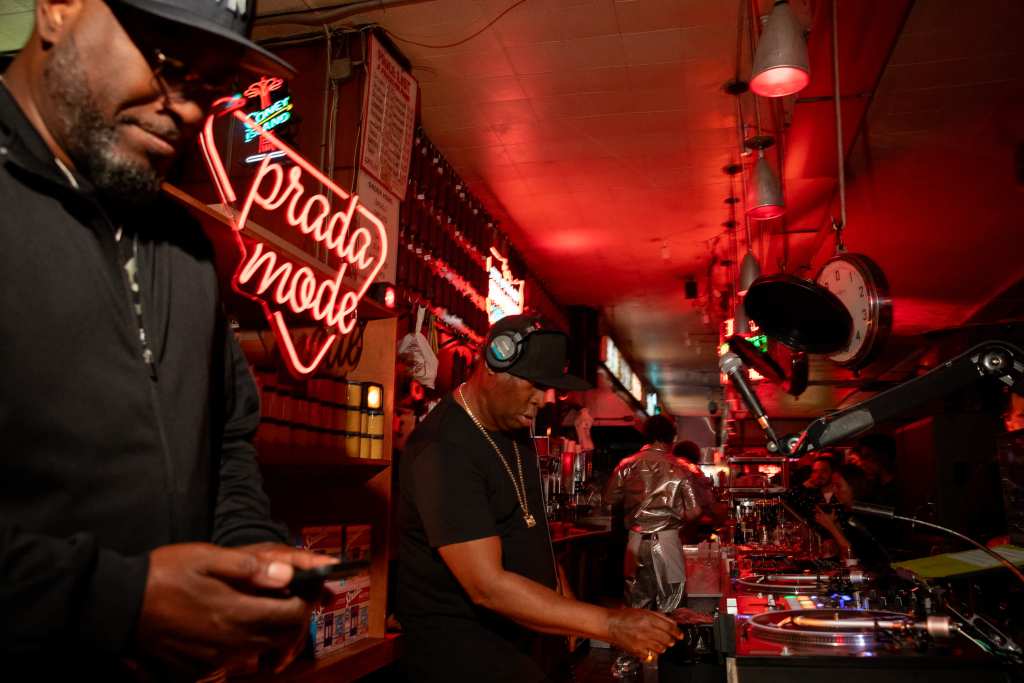
That instinct ran through the opening night and its lineup. The Velveteers played; Lydia Lunch performed as singer, poet, and writer; Precious took the stage alongside a DJ set from William Benton; KROM ran a kendama workshop and the Nordic bakery Juno ran another. The night ended downtown at Katz’s Delicatessen, where Grandmaster Flash, Justin Strauss and Papi Juice turned a hundred-year-old deli into a dance floor. The throughline is range—high and low, analogue and live, all of it treated as equal input.
When the Doors Open
Satellites II ran as a private members’ program on 3-4 June, then opened to the public from 5-7 June, 2026, at the Hotel Chelsea. The timing was deliberate, coinciding with the Tribeca Festival, planting itself in the middle of the city’s early-summer cultural rush.
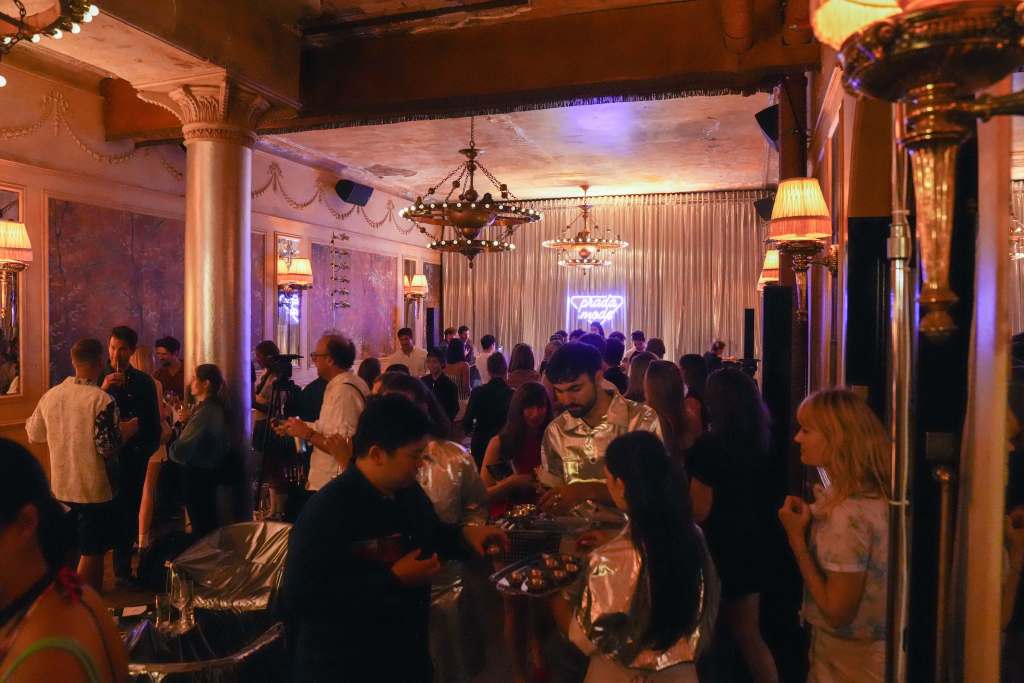
The public days did not shrink the project; they expanded it. The rooms that served as television studios reopened as installations and the footprint spread beyond the hotel into the city. Site-specific works extended downtown to the Prada Broadway Epicenter and Katz’s, and Refn and Kojima curated a Japanese anime festival screening at the Angelika Film Center. A live program of talks, concerts, screenings, performances and reinterpreted broadcast formats ran alongside the exhibition, with curated dining woven through. The members’ club became, for three days, a public one.
There’s an argument underneath all of it. Prada Mode is built on access—who gets in and when—and Satellites II spent its first two days as a closed signal before broadcasting wide. The Hotel Chelsea, a building that has always traded on the romance of the people who passed through it, is the right place to make that point. A satellite is only useful once it sends something back down. For three public days in June, this one did.





What are your thoughts?