The Open Wound: Where Beauty Refuses Resolution
Co-curated by Daria Borisova and Selcan Atilgan, the group exhibition in Venice’s Palazzo Naril Bernardo explores states of continual adaptation
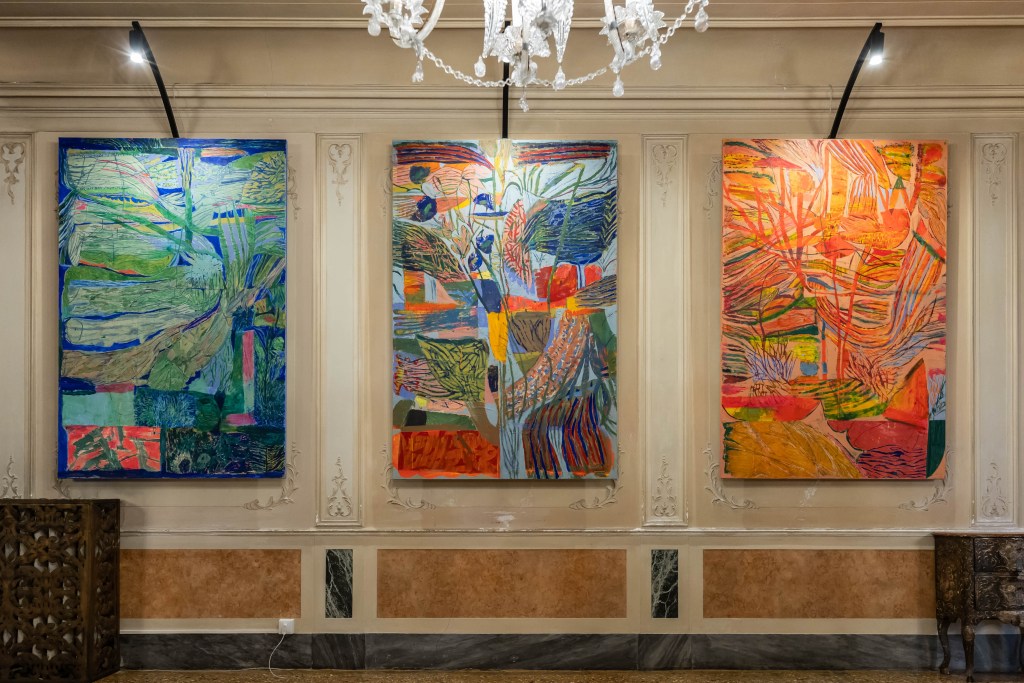
There could scarcely be a more fitting setting for The Open Wound than the storied rooms of Palazzo Nani Bernardo. Situated on Venice’s Grand Canal in the sestiere of Dorsoduro, the palazzo embodies the paradox that lies at the heart of the exhibition: permanence sustained through continual adaptation. Venice itself survives in a state of perpetual negotiation with water, history and decay—a condition that becomes the exhibition’s conceptual anchor.
Co-curated by Daria Borisova and Selcan Atilgan, The Open Wound brings together works by Von Wolfe, Boris Acket, Savannah Harris, KV Duong, Geoffroy Pithon, Ludovic Nkoth, Isabella Amram, Dennis Miranda Zamorano, Giuseppe Francalanza and Naleye Junior. Rather than imposing a singular curatorial argument, Borisova and Atilgan construct an exhibition that unfolds through resonance. The “wound” of the title is neither a metaphor for trauma alone nor an invitation to pessimism. Instead, it becomes a condition of openness—of remaining permeable to history, memory, beauty, vulnerability and transformation.
As Selcan Atilgan shares with us, “I’ve been thinking about Venice and wounds for a long time. This city survives by refusing to pretend the water isn’t rising. That felt like the right place for this show.”
That refusal to deny instability becomes the exhibition’s organising principle. Across painting, sculpture, installation and photography, the artists explore states of becoming rather than arrival, presenting works that seem less concerned with providing answers than with remaining attentive to uncertainty.
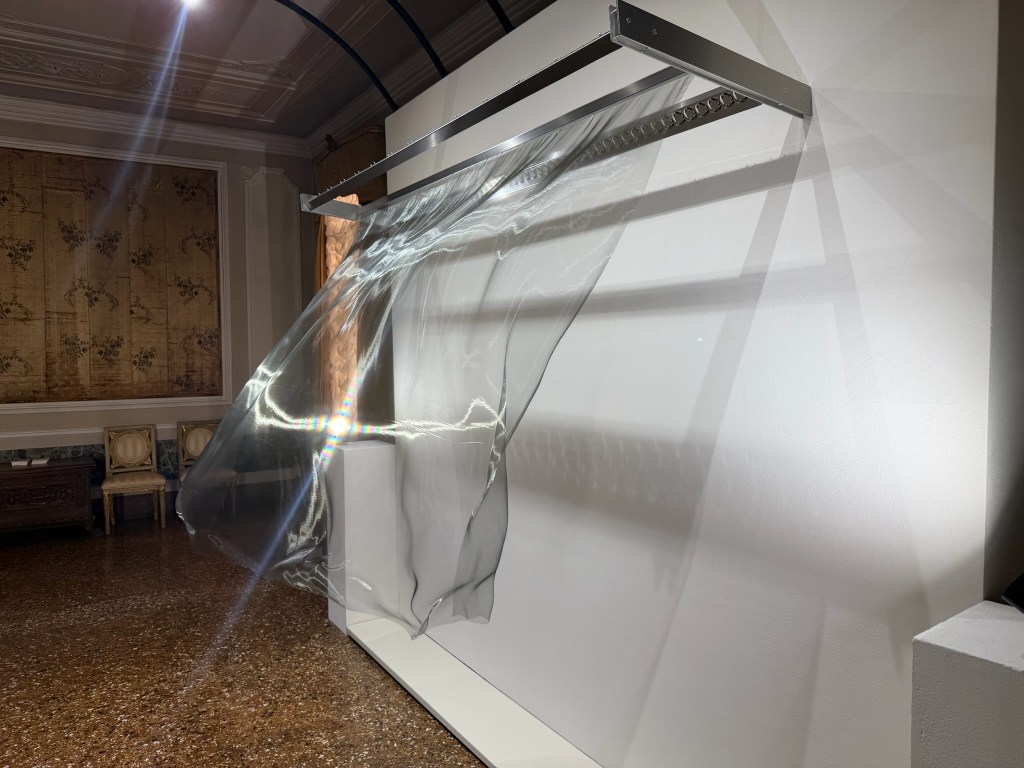
The exhibition’s most immediate embodiment of this philosophy is Boris Acket’s The Skin of a River, Framed. Occupying the palazzo with remarkable restraint, the installation transforms air currents into a choreography of moving fabric that appears almost alive. Rather than representing nature, Acket allows invisible environmental forces to become the work itself. The installation never repeats; each movement is contingent upon the atmosphere at that precise moment, making impermanence its defining material.
“This body of work really captures the studio’s ongoing research on the juxtaposition of control and surrender,” Acket says. “An immense amount of work went into creating the control systems, into controlling the fans with a gigantic amount of steps. But in the end you have to surrender to the material, to the space, and to all the turbulences and thermics that make up that exact moment. As you can never stand in the same river, this skin of a river will never ever move the exact same way even twice.”
The work quietly establishes a rhythm that reverberates throughout the exhibition: precision giving way to unpredictability, control dissolving into lived experience.
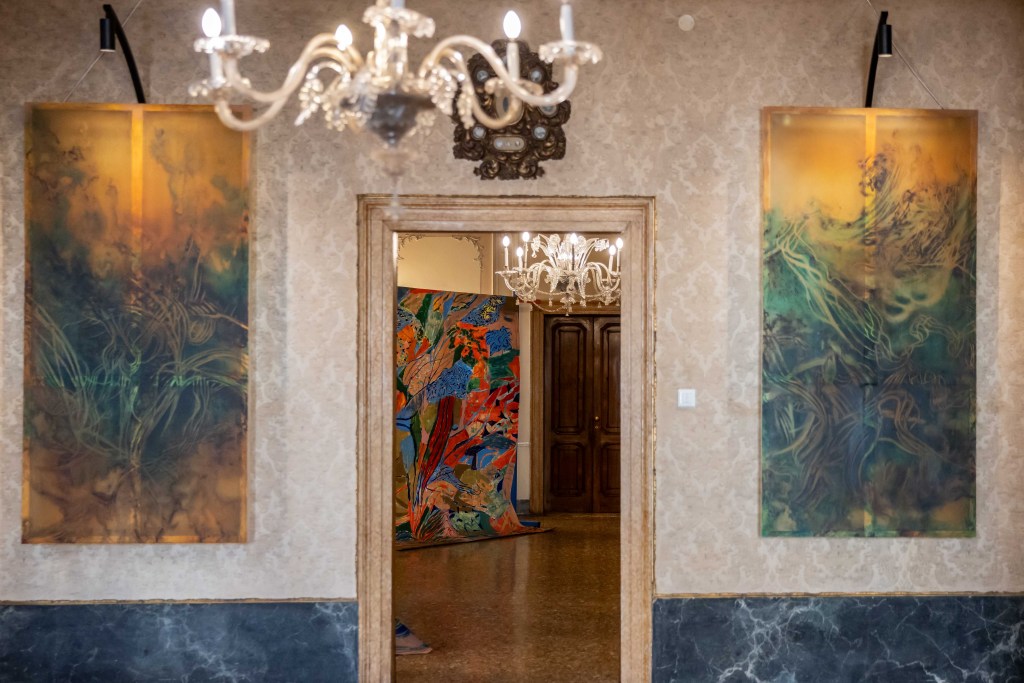
Water likewise courses through the paintings of KV Duong, though here it emerges as both personal memory and geopolitical reality. Suspended between abstraction and landscape, the works evoke rivers, tidal movements and submerged terrains without settling into literal depiction. Their layered surfaces seem to accumulate sediment, carrying histories that are simultaneously intimate and collective. “These new works reflect on water’s beauty, movement and latent power, drawing from Venice and Vietnam, where waterways shape life and reveal vulnerability,” Duong shares.
If Duong’s paintings contemplate water’s shifting character, Geoffroy Pithon transforms the palazzo itself into a living organism. His exuberant paintings and installations—Bain des îles, Vent et fleurs, Heure des branches en fête, Victoire, and Sophie—revive the decorative traditions historically associated with Venetian interiors while refusing nostalgia. Botanical forms expand across surfaces with remarkable vitality, dissolving distinctions between ornament, landscape and abstraction.
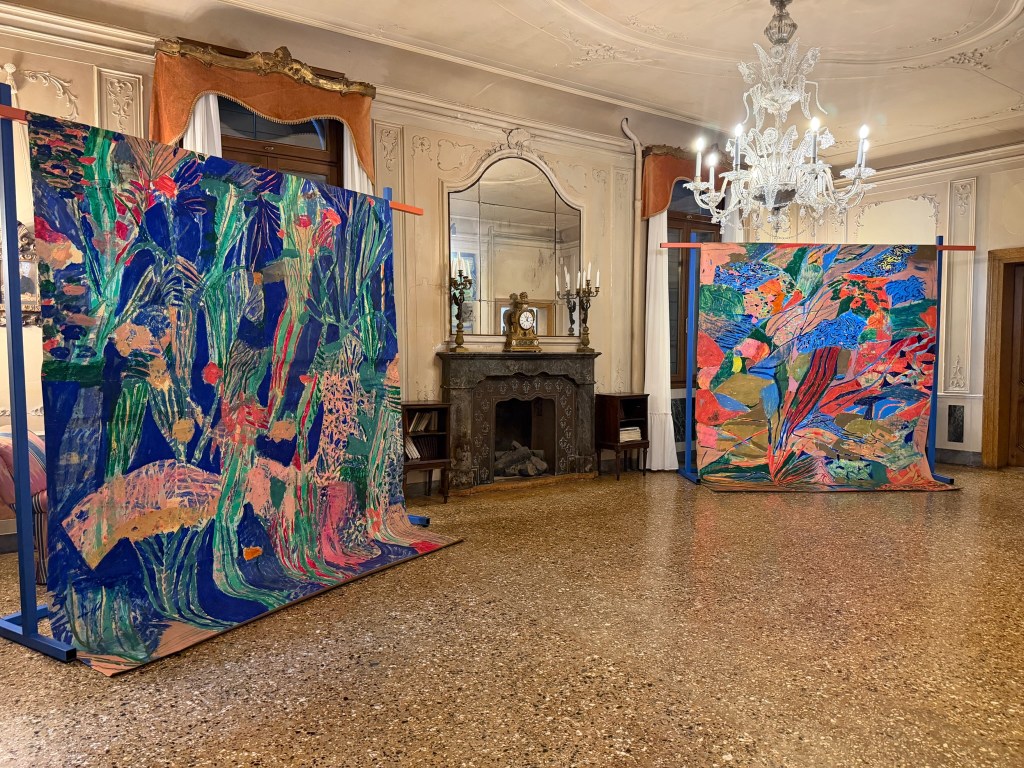
“In the rooms of this beautiful and typical Venetian palazzo, I present a series of paintings and installations conceived as living presences within the architecture,” Pithon says. “Echoing the decorative compositions that once inhabited Italian palazzi (wallpapers, large flower-filled vases, tapestries), these works seek to reactivate a sensory relationship between painting, space and immersion, without reducing ornament to a purely decorative function. Working at the threshold between abstraction and figuration, I use organic forms, moving lines and vibrant color to transform the room into a landscape charged with energy. Conceived as openings into color, the works invite viewers into a physical and intuitive experience of painting, where perception moves freely between sensation, memory and appearance.”
Rather than decorating the historic architecture, the paintings seem to reactivate it, allowing the building itself to participate in the exhibition’s unfolding dialogue.
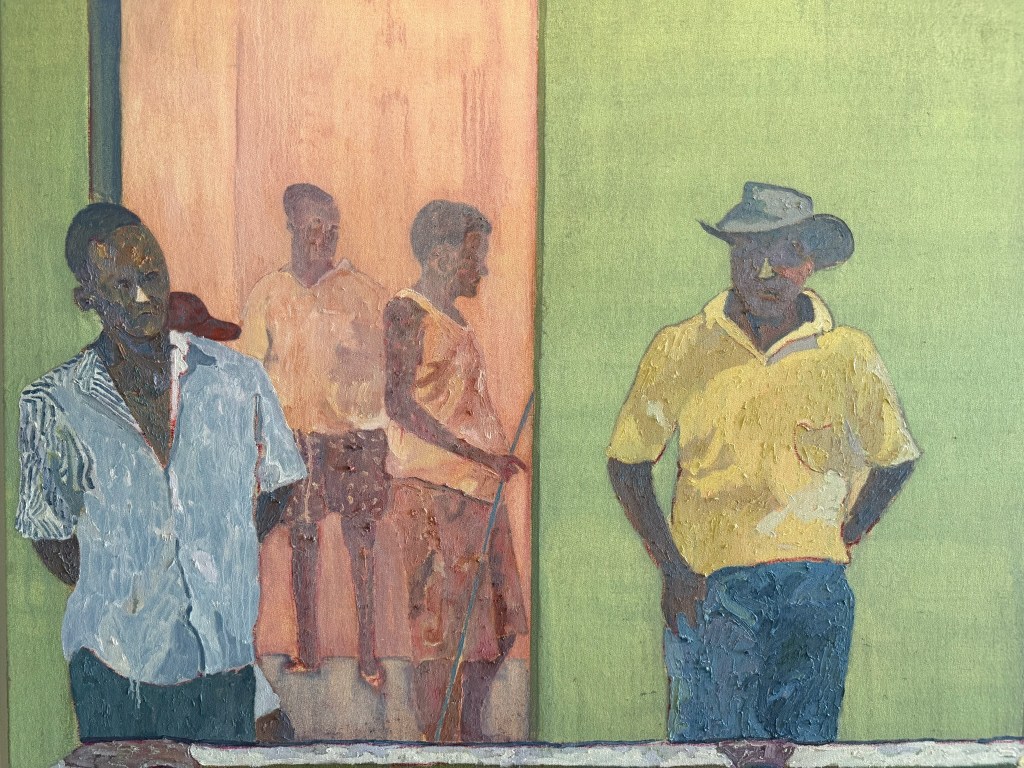
Human relationships occupy the centre of Ludovic Nkoth’s contribution. In Green Hall and Search Party, figures inhabit spaces that appear familiar yet psychologically complex. Nkoth’s compositions resist dramatic narrative, instead finding emotional depth within gestures of waiting, looking and quiet coexistence. His paintings reward sustained attention, revealing subtle negotiations between intimacy and distance.
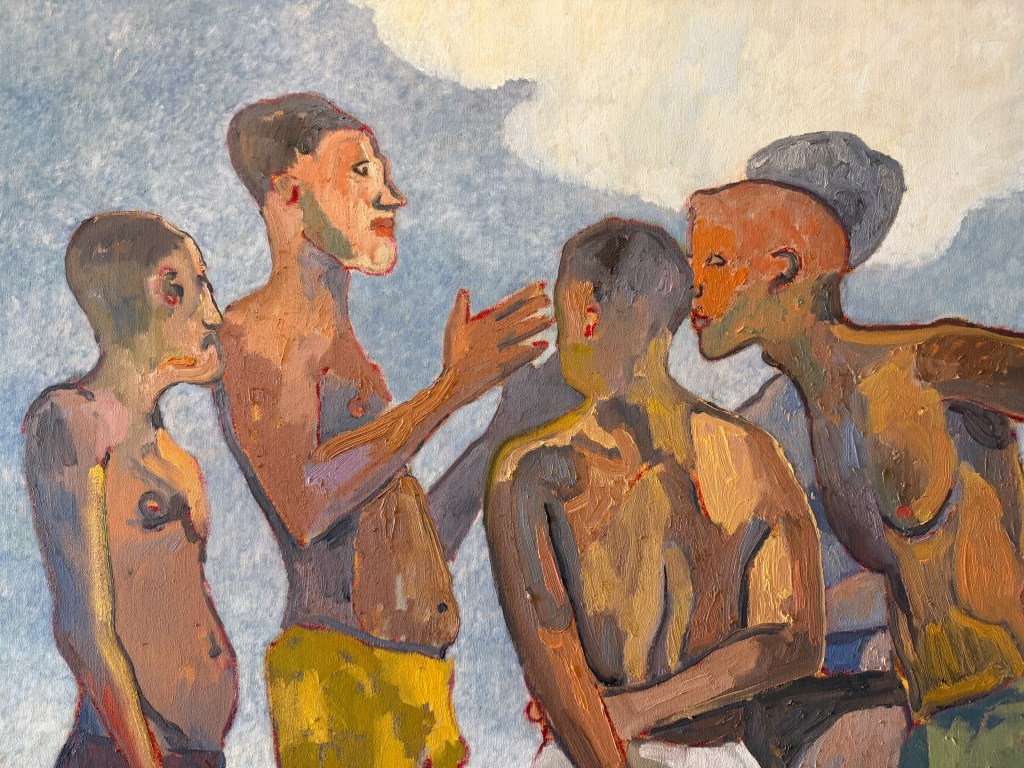
“These paintings continue my interest in how people occupy space together physically, psychologically and emotionally,” Nkoth explains. “I’m drawn to moments that feel ordinary at first, but slowly reveal tension, vulnerability, performance or intimacy. In Search Party and Green Hall, the figures exist somewhere between stillness and movement, between observation and participation. I want the paintings to feel open enough for viewers to project their own experiences into them.”
Von Wolfe’s paintings similarly investigate identity through carefully staged interiors, where theatricality and vulnerability coexist. Their figures appear suspended between historical portraiture and speculative fiction, inhabiting worlds that feel simultaneously ancient and uncannily contemporary.
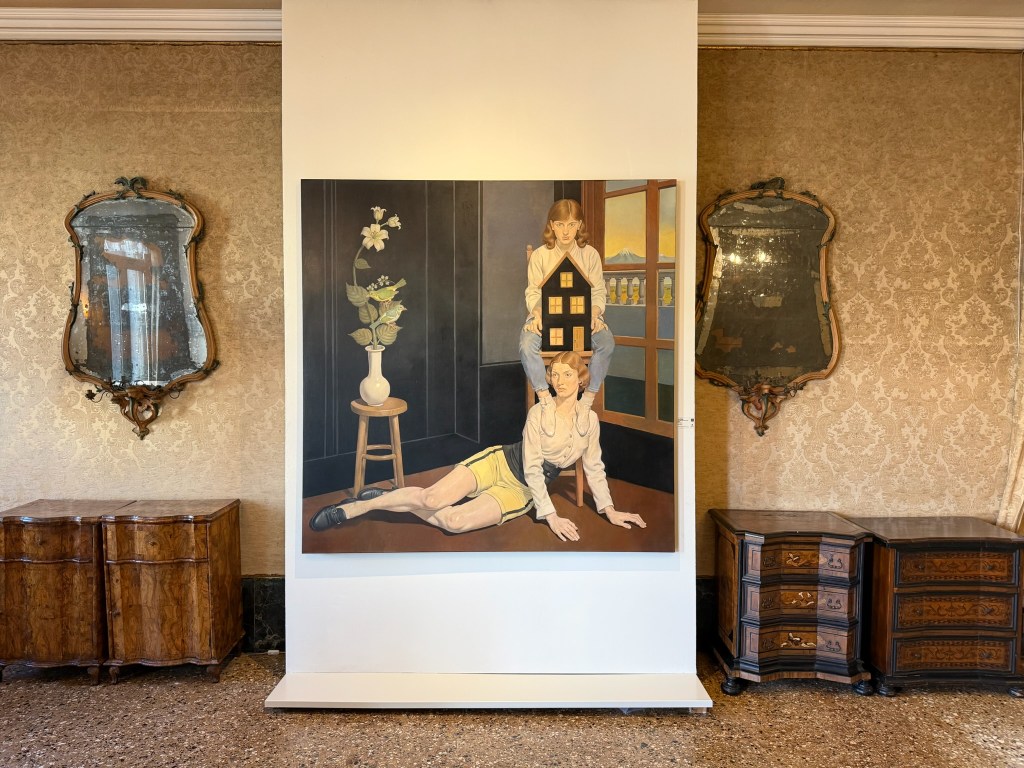
Set against the fading grandeur of Venice, Von Wolfe’s paintings seem less exhibited than summoned, poised between old-master discipline and the flicker of some future intelligence. The juxtaposition between the palazzo’s centuries-old interiors and Von Wolfe’s enigmatic figures produces one of the exhibition’s most compelling temporal dislocations.
Elsewhere, Giuseppe Francalanza turns overlooked fragments of urban infrastructure into objects of unexpected intimacy, transforming the ordinary into sites of poetic reflection, while Naleye Junior constructs intricate visual systems in which line, rhythm and interruption become expressive forms in themselves. Their works suggest that memory often resides not in monuments but in overlooked details—in the spaces between certainty and ambiguity.
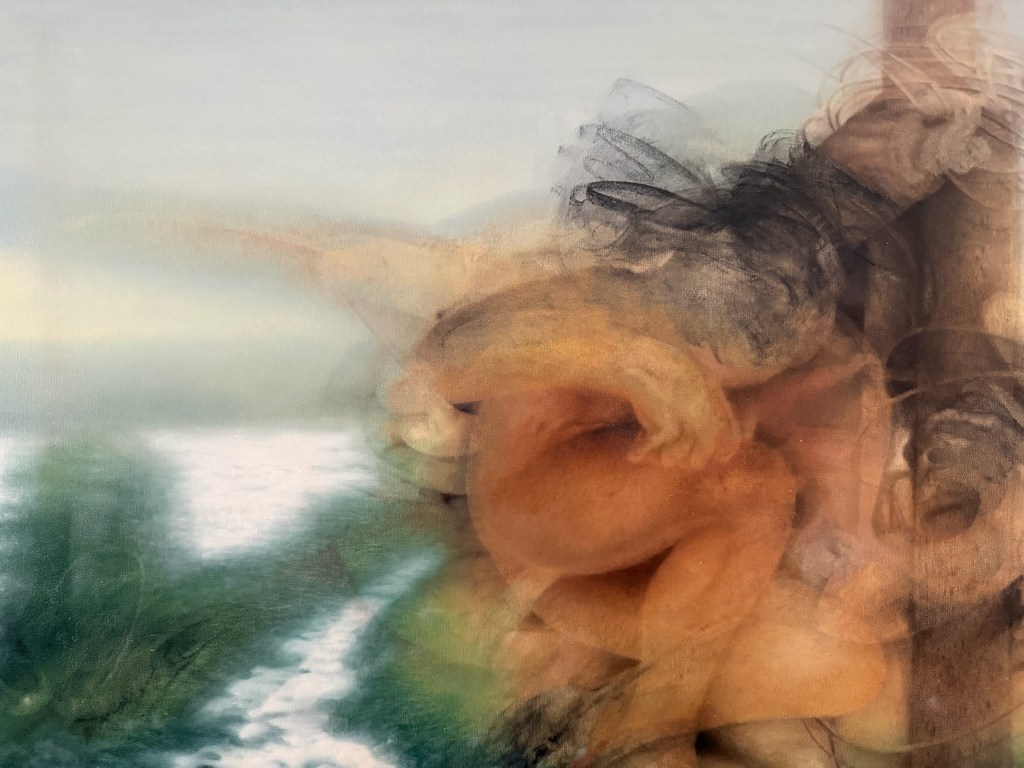
The quieter contributions of Savannah Harris, Isabella Amram, and Dennis Miranda Zamorano further enrich the exhibition’s emotional texture. Rather than competing for attention, they deepen its central proposition: that fragility need not be understood as weakness, but as a condition that allows connection, perception and change.
What ultimately distinguishesThe Open Wound is not the diversity of its media or the calibre of its participants, but the atmosphere it creates between them. As Daria Borisova reflects, “I’ve never worked with a group where the practices are so radically different and yet something pulls them together that I can only describe as necessity. These artists are not making work because they chose to; they’re making work because they have no other way of processing what it means to be alive right now. That’s what you feel when you walk through the rooms. Not a theme. A pressure.”
That pressure is indeed palpable—not as anxiety, but as attentiveness. The exhibition refuses easy synthesis, allowing each work to retain its own voice while participating in a larger conversation about uncertainty, resilience and transformation. Within Palazzo Nani Bernardo, the wound of the title remains deliberately open: not awaiting closure, but insisting that what is exposed may also become the place where new forms of seeing begin.




What are your thoughts?