Club de Tennis: Moët & Chandon Rebuilds its US Open Welcome
The Maison’s third year at the US Open brings a redesigned Suite, a postcard drawn from the archive and a champagne poured to order in a tennis ball can
Champagne has been part of tennis for about as long as the sport has had trophies to lift. Moët & Chandon has been in the picture since the 1970s, toasting champions as they shared their victories with the world, and in 2011 it became the Official Champagne of the ATP World Tour. At the 2026 US Open, in its third year as the tournament’s Official Champagne, the Maison gives that history a name and a home.
Club de Tennis runs the length of the tournament at the USTA Billie Jean King National Tennis Center from 23 August to 13 September, and this year it continues past the gates into New York City. It brings the customs of the sport and those of the Maison into one place.
“Heritage is most powerful when you continue to make it relevant for today’s fans,” says Daniela Curiel, head of Moët & Chandon. Club de Tennis is where that happens, turning five decades of association into something a guest handles. “The platform allows us to encapsulate the rituals, energy, culture of US Open and tennis intersecting with Moët, creating a space where community can come together.” Everything under the Club de Tennis banner is something a guest picks up, writes on or opens.
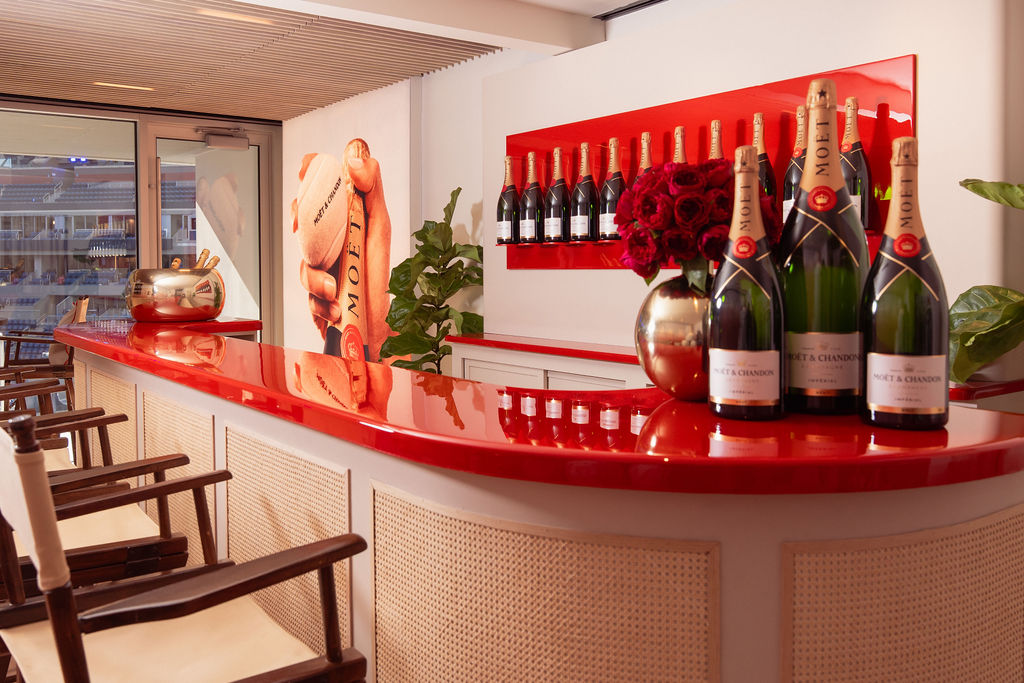
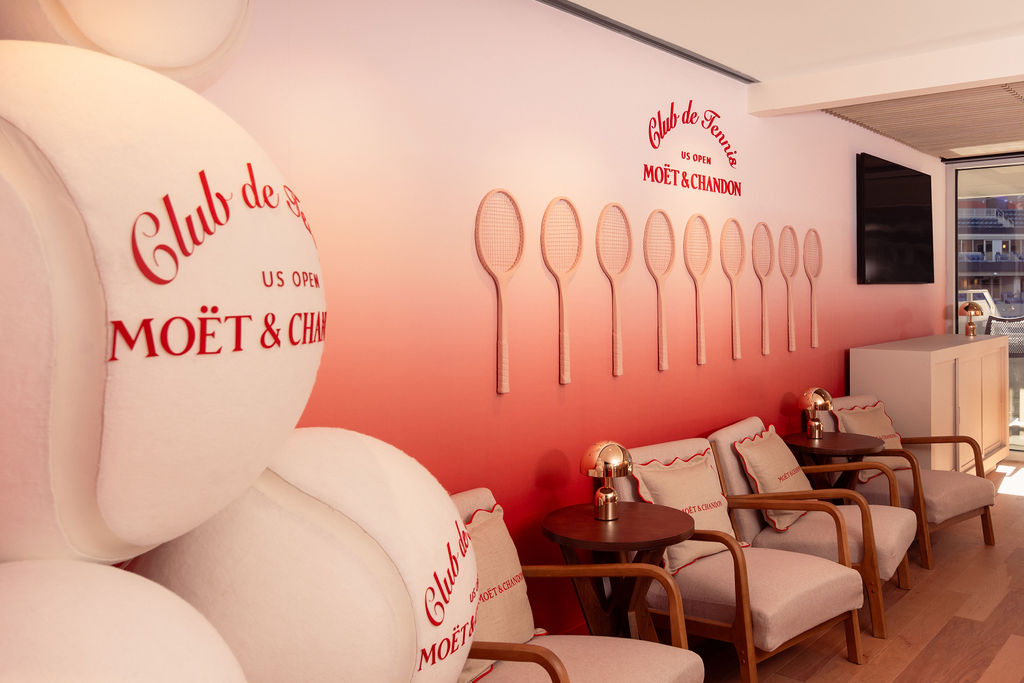
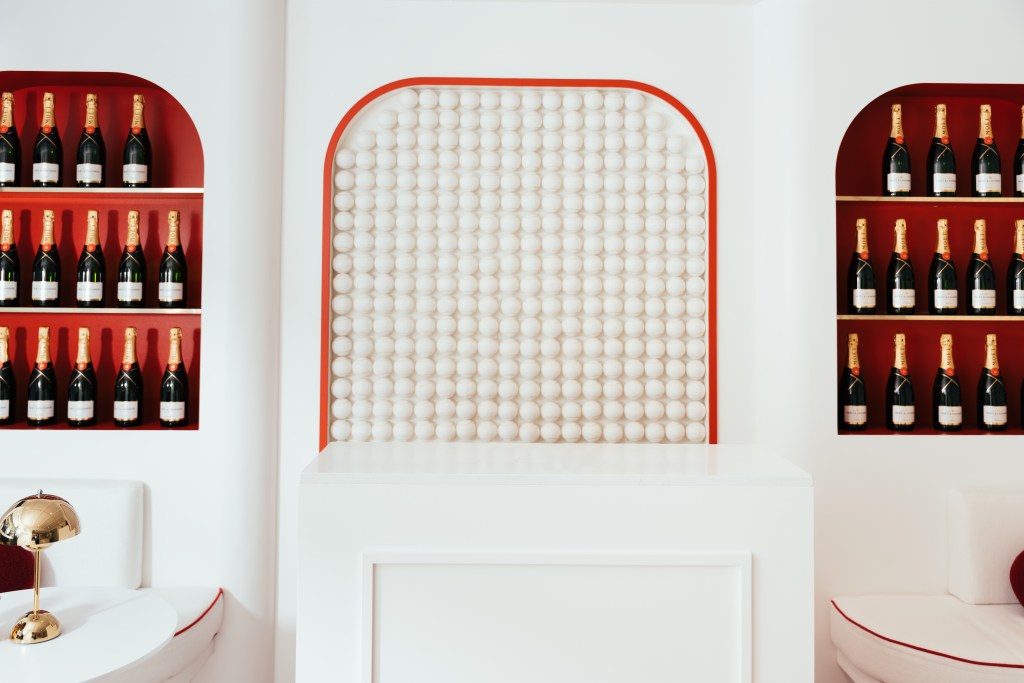
At the center is the refreshed Moët & Chandon Suite, redesigned around a question of scale. “The refreshed Moët & Chandon Suite was inspired by the desire to welcome more guests into the Moët & Chandon experience while still maintaining a warm and engaging atmosphere,” Curiel says. The brief was to hold both at once. “In tandem with simply increasing capacity, our goal was to create a setting that encouraged guests to gather, connect and celebrate the world of tennis with our beloved Moët together.”
The reference point is the tennis club rather than the stadium, a quieter register for a tournament of this size. “Tennis clubs are rooted in community, connection and the shared rituals surrounding the game,” Curiel says. She describes the Suite as “offering guests an inviting setting where they can come together and celebrate the tournament while remaining immersed in the elegance and heritage of the sport.” A stadium organizes people toward a court; a club organizes them toward each other.
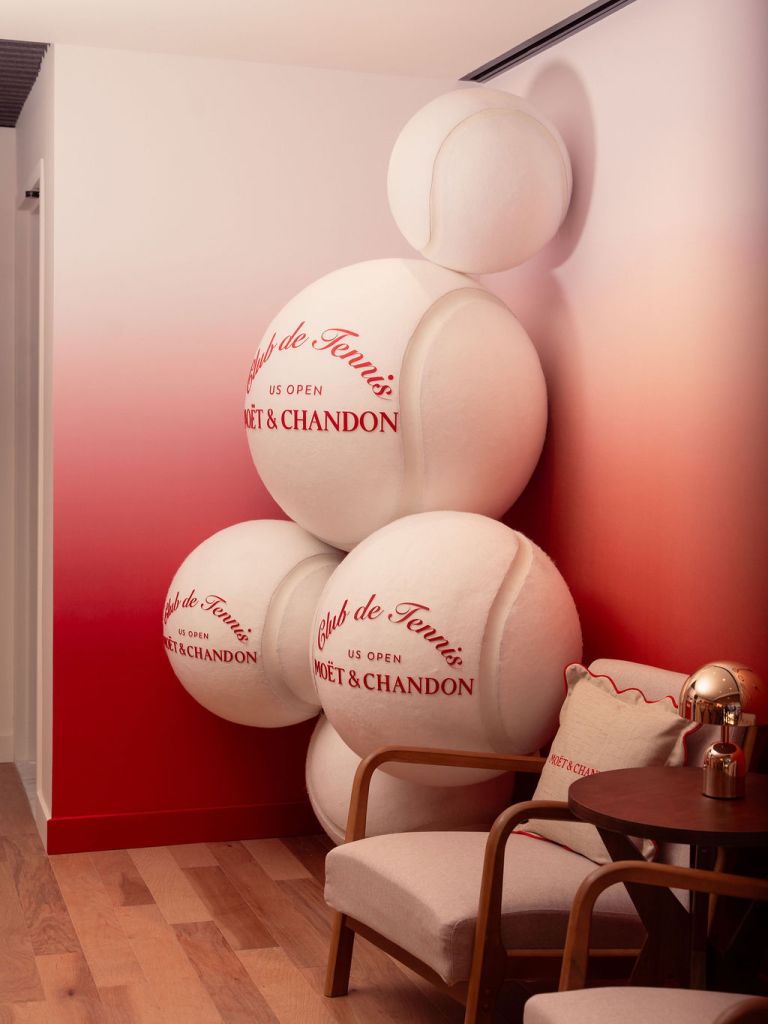
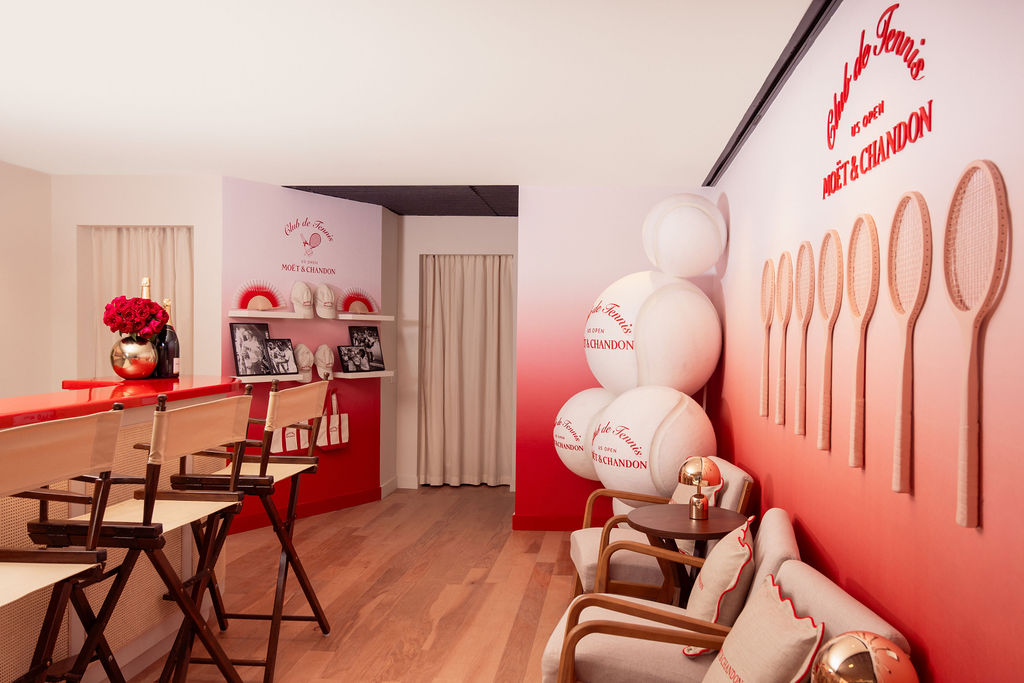
The room carries all of this lightly. A photocall is set with oversized tennis balls, high chairs recall the umpire’s perch and the walls carry rackets and tennis ephemera. “Details such as the oversized tennis balls and court-inspired high chairs introduce an element of playfulness and immediately connect the space to the sport, while the overall environment remains rooted in the Maison’s elevated point of view,” Curiel says.
We believe champagne should feel aspirational without feeling intimidating, and the US Open provides the perfect setting to show how elegance and fun can coexist.
Daniela Curiel, head of Moët & Chandon
Hung between the props are images from five decades of the Maison’s presence in the sport. “Even though the space itself is brand new, every image and piece of memorabilia on those walls is there to connect back to the champions, the legends, and the moments that made the sport what it is today,” Curiel says. “It is the same feeling you get watching a match point that becomes history.” The room is new; the material on its walls is not.
The most personal object in the room is a postcard. It reproduces a 1984 Sunday Mail sketch of Ivan Lendl holding a bottle of Moët & Chandon and is available throughout the Suite and at the Moët & Chandon bar in the Food Village. Curiel says the sketch “was such an iconic piece of the Maison’s tennis history that we wanted to bring it into the experience in an unexpected way,” Curiel says.
Handwriting is slow, and at a tournament most people experience through a screen, the slowness is the point. “The postcard invites attendees to slow down and take a moment, write to someone they care about and turn their own memory of the US Open into something that can be shared and cherished,” Curiel says, adding that “that sense of connection is central to Moët & Chandon.”
The other new ritual is a drink. The Moët Serve makes its world debut at this year’s tournament, 15 years after Ice Impérial arrived as the first champagne built to be enjoyed over ice. It is prepared live from Ice Impérial, three ice cubes and three lime wheels, then sealed into a custom can modeled on the tennis ball canister. “We looked at one of tennis’ most iconic objects, the tennis ball canister, and reimagined it through the lens of Moët & Chandon,” Curiel says.
The can does practical work, preserving effervescence and traveling well across a large site, but its real function is theater. “The result is a refreshed custom serving format that feels both familiar yet unexpected, creating a memorable experience from the moment guests see it canned fresh on-site to the moment they peel it open and enjoy their first sip,” Curiel says. The peel is the toast.
The lime is doing double duty. “The three lime wheels add a bright citrus note that enhances the wine’s fresh, vibrant character while also playfully nodding to the tennis balls found inside a traditional tennis ball canister,” Curiel says, and the made-to-order preparation exists so that with “each serve, each guest experience is refreshing.” Cellar Master Benoît Gouez frames it as an extension rather than a departure: “With The Moët Serve, we are pushing the boundaries of the Ice Impérial ritual with a spirit that is both playful and contemporary,” he says.
On the grounds, the Moët Serve is poured at bars throughout the site, including the Club de Tennis Bar in the heart of the Food Village, which also serves Brut Impérial, Nectar Impérial Rosé and the Moët Mimosa in the Maison’s gold goblet. Moët & Chandon is available at Coqodaq, the IHG Racquet Bar and the American Express Card Member and Centurion Lounges, and returns as the official toast at the USTA Foundation’s Opening Night Gala, the Final 8 Club reception and Champions of Equality.
Then it leaves Queens. “The US Open doesn’t stop in Queens, and neither does Club de Tennis—it takes over New York City,” Curiel says. The Moët Serve is being served at Dante West Village, Electric Lemon, the Hard Rock Hotel, The Gansevoort and The St. Regis New York for the duration of the tournament. “Bringing the US Open experience beyond the tournament allows more fans to enjoy and participate in the spirit of tennis, spreading the celebration city wide,” she says.
That reach is the point. The serve poured in the Food Village is the same one poured in a hotel bar downtown, and the postcard written in the Suite arrives somewhere else a week later. Fifty years of association fill the walls of the Suite. What Club de Tennis adds is a way to carry that history out of the room, in a postcard or a can that leaves Queens with you.




What are your thoughts?