Cadillac’s V-One Concept Car Marks the Evolution of a Binary Devotion to Design
The brand that has always leaned into optimistic futurism swings from the voluptuousness of the CELESTIQ sedan to the lean savagery of a race car for consumers

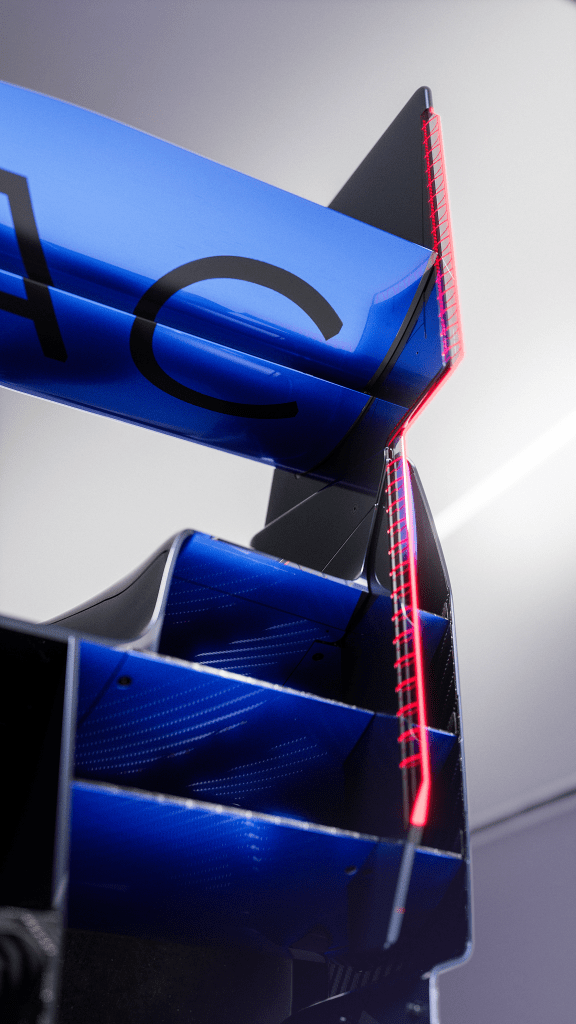
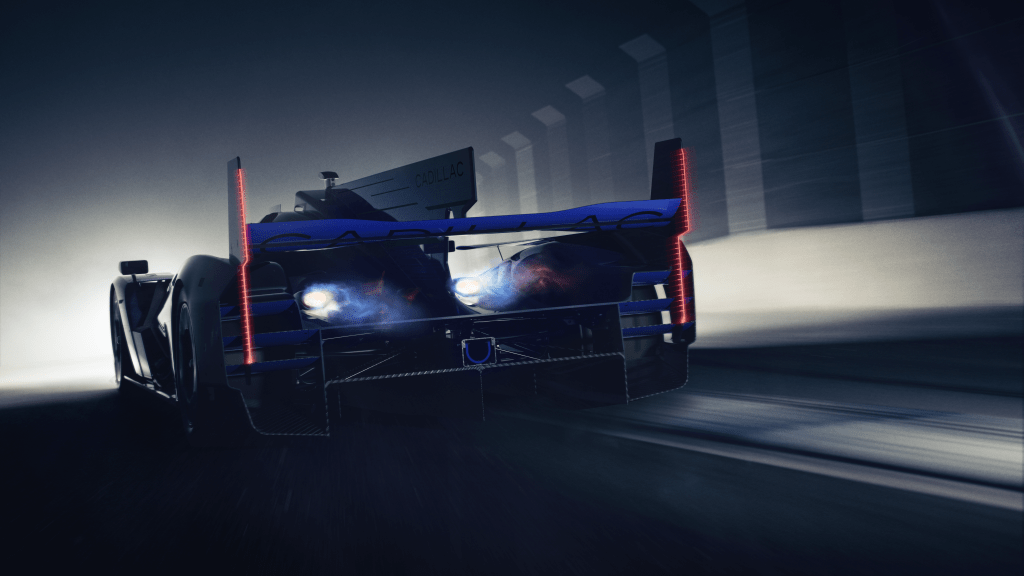
Concept cars are generally shown at places like Monterey Car Week to either point toward the direction of a brand’s future styling and design, or to show off its technical prowess. Cadillac‘s V-One does both. The lawn of The Quail, A Motorsports Gathering, is packed with the rare and fabulous, new and old. Even so, the V-One Concept is notable for its naked ambition—a design scaled down to the essence of speed and extreme handling. It looks very much like the prototype race car from which it is derived, the Cadillac V-Series.R, which runs at Le Mans, the world’s most demanding endurance race.
That’s by design, too.
The single-seat cockpit vibes like a space meant for a jet fighter pilot. A web of taut lines, vertical lighting, floating blades and aerodynamic trickery carries over directly from the race car. It carries a sexy silver-to-dark-blue paint job, a clue that it is aimed at consumers, not race-car drivers. If produced, very few savage specimens will likely be made, sold to owners who will take them to the private tracks of their choice, decked out in their personal livery. It’s definitely not street-legal.
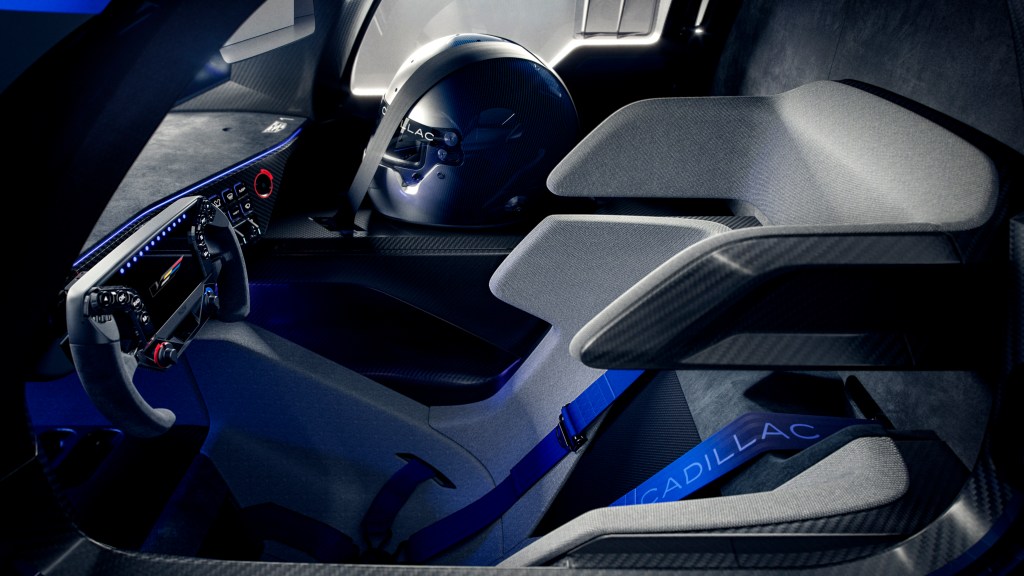
“Why do we make concept cars?” Dominic Najafi, Executive Director of Design, Global Cadillac, asked a select group of media weeks earlier rhetorically, from inside the company’s new design studio in Detroit. We were there to get a first look at the V-One.
“Concept cars are vital, especially for a company like GM, which cares about and invests in design, because we can make big, bold decisions very quickly, exploring and experimenting and pushing boundaries,” he says. “We can challenge the proportions, the architecture, the surfacing. It gives a canvas of ideas that can inspire the whole company.”

Since it shares so much with the actual race car, the V-One is less fanciful than some previous Cadillac concepts like the Elevated Velocity and Opulent Velocity. Nonetheless, Najafi says, “Our designers simply can’t stop making illustrations of it, even in their off hours. They’re obsessed.”
Of the pursuit of speed, he says, “Our concepts have to communicate a certain level of performance. Even our ultra luxury cars have an undertone of performance. That’s taken here to the extreme.”
Modern Cadillac designs have tended to be somewhat binary, leaning toward either the expansive luxury of big SUVs like the Escalade and the bespoke voluptuousness of the CELESTIQ sedan, or toward the brand’s racing aspirations and the performance goals of the V-Series range. Until now, the CT5-V Blackwing was the exemplar of the latter.
The most recent EV models offer an updated synthesis of the two. I drove from SFO to Monterey in a LYRIQ-V, a smartly-styled EV with surprising spirit and handling. Cadillac’s current designs feel both fluid and futuristic.

Cadillac has often been at the forefront of American automotive design, with each design generation led by its own team of gifted designers. Interestingly, many of the most highly regarded eras of Cadillac occurred during times of unrest and turmoil in America—the 1930s, ‘50s and ‘60s. A recurring theme from then to today is optimistic futurism.
The Great Depression gave us the 1934 Cadillac V-16 Fleetwood Aerodynamic Coupe, under Harley J. Earl, and post-WWII produced the 1948 Cadillac and its iconic tailfins, inspired by the twin tail of the Lockheed P-38 Lightning and attributed to designer Franklin Q. Hershey.
The current model lineup emerged under a generation of designers including GM’s Global Design Chief, Michael Simcoe, and Bryan Nesbitt, then Executive Director of Global Cadillac Design, Cadillac Exterior-Design Director Bob Boniface, and former Cadillac Design Chief and later, GM Executive Director of Advanced Design, Andrew Smith. Simcoe retired last year, Nesbitt took over as head of all GM design, and Boniface and Smith also recently retired.
This leaves the brand at a design inflection point, but a very healthy one. While the original Saarinen Building, home of GM Design since 1956, is still proudly in use (and is spectacularly done up in 1950s modernist-cool of funky rugs, tactile fabrics, and tasteful wood), Simcoe and team oversaw the construction of a new 360,000-square-foot Design West complex across the lawn.
The new complex houses designers from all GM brands, in a warm, bright box state-of-the-art space, with robot arms carefully milling full-scale cars and components from reddish clay—a mix of old-school design techniques dating back to Earl, given a futuristic twist. It is absolutely fascinating to watch the familiar shapes of cars unfurl from the blocks of clay.

“You can walk down the line and see what all the designers at all the brands are doing, it’s absolutely inspiring,” said Najafi, who took the reins from Nesbitt, and previously worked at Jaguar Land Rover, Bentley and GM Europe. He gestured at the V-One. “And this definitely inspires.” The V-One Concept looks fast even in its static clay form. It’s hard to imagine how many frantic hours go into getting it from this work in progress at the design center to the grounds of The Quail.
Talking to Kevin Nougarede, the design manager of Cadillac Exteriors, it was clear that it is both a passion project and a labor of love. “Working on something that is basically a race car is unique, and different from what we normally do. You can’t play with proportions or form, since they exist for performance and to protect the safety of the driver. If I change design elements, the car can completely lose control.”
He continued: “The way the emotional aspect comes into the car is how you treat the details; the gaps between the panels and how the surfaces flow together. And of course the finish, since it’s painted.”
As we talked, a junior designer next to him was sketching… yet another pencil drawing of the V-One. Nougarede looked it over and smiled. “It’s fun but a bit scary because it’s different. As designers we push to disrupt. This approach is figuring out how you enhance an object and use design to tell a new, different story.” It’s a story we’re excited to witness.





What are your thoughts?