Step Into One of London’s Newly Reimagined Old War Offices
British interior design maven Ed O’Donnell brings a contemporary aesthetic to a $20 million three-bedroom residence
When Ed O’Donnell, co-founder and creative director of London-based Angel O’Donnell, first set foot in what was to become The OWO Residences by Raffles, he understood the duality of the space. “We were walking around when this was still a construction site,” he tells COOL HUNTING. “We didn’t have any influence on the hard finishes but we knew from the beginning that restrained refinement was going to be our guiding principle.”
Built on the historic royal site of Whitehall Palace, the current building—Britain’s former War Office (OWO stands for Old War Office)—was originally completed in 1906 in the Edwardian Baroque style. “Think lots of mahogany, tall ceilings, a building designed to keep people out,” O’Donnell says. An eight-year, nearly $2 billion renovation by the Hinduja Group, with the guidance of 37 heritage consultants, transformed the space into 85 private residences and 120 hotel rooms, including 39 suites. The ample list of residential amenities include a private dining room, board room, gym and fitness studios, 16-seat cinema, games room and access to the hotel’s underground Guerlain spa, 65-foot pool and ballroom, as well as the property’s nine restaurants and three bars.
No two residences are the same in terms of layout, size or finishes. For this three-bedroom show residence, one of six OWO residences designed by Angel O’Donnell, words like feel-good, creativity and comfort guided the lead designer. “There’s a lot here,” O’Donnell says, adding, “people assume that it’s got to be big and shiny to be luxurious, but I think we’ve listened to the building. When I walk into this apartment, especially in the living and dining space it feels very grown up and grand, but it also feels very calming.”
“On this particular job about 80% of the furniture we designed and made ourselves,” he adds. “Interestingly, most of it was made within a 20-mile radius of the building itself. A lot of the manufacturers, especially the joinery and the upholstery companies that we use are very close by, which is brilliant for us, because we can go and see it all stages. Nothing gets missed.”
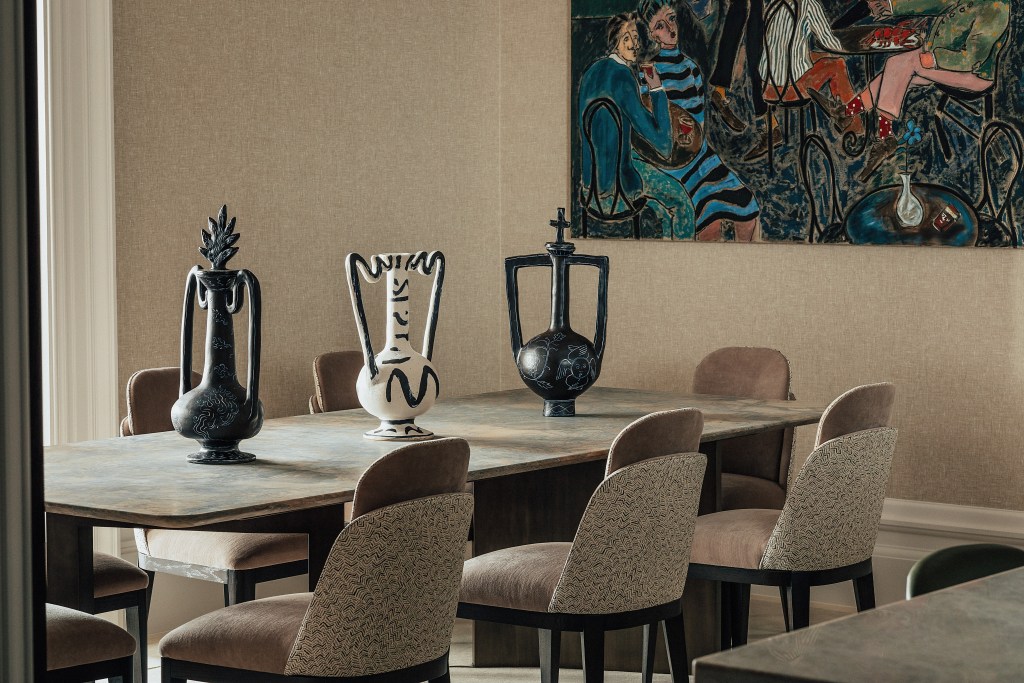
Take the dining room, an interstitial space between the kitchen and living rooms. “The client at the time had said, ‘Oh, I think because of the ceiling height, we need really tall back dining chairs.’ And I was like, ‘but that feels quite ’90s.’ So we had a think about how can we give the illusion while still having a chair that feels higher than it really is. That’s why the chairs have the double back, and why they’ve got the double fabric—plush buff velvet and geometric jacquard weave—because it’s kind of playing a little bit with your eye.”
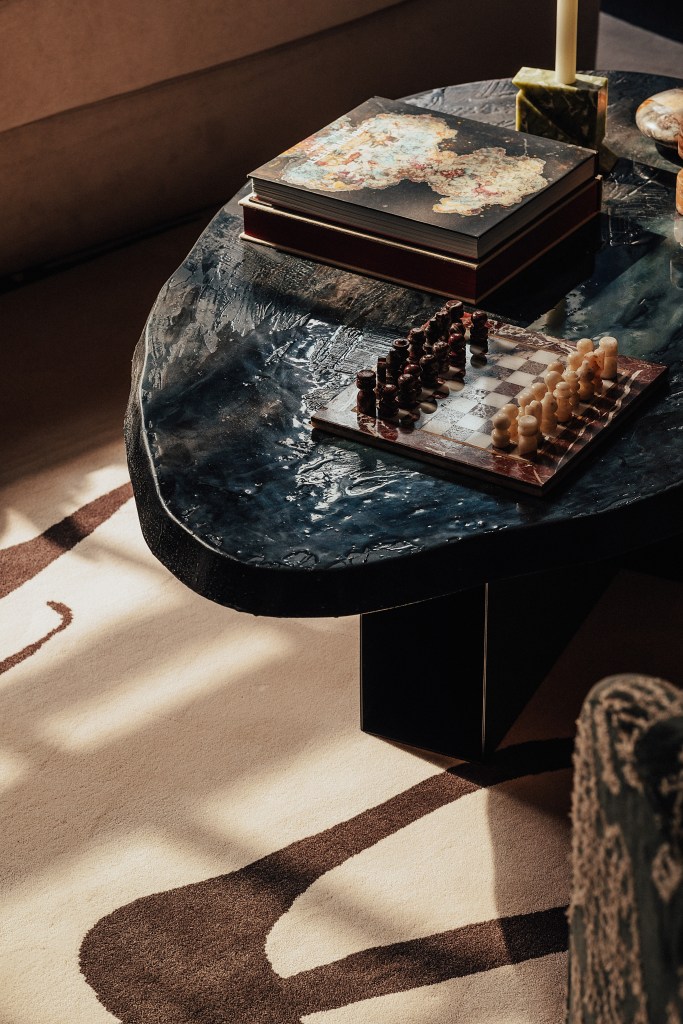
Echoed into the table, O’Donnell decided on a double base. “One is a kind of solid straight on, the other is a slightly curved line,” he says. To mimic the lines of the table, O’Donnell also designed the rug underneath, “kind of like you’re starting a sketch of what the table could look like.” The top of the table is a Caravaggio stone that’s been leathered, “so it felt soft, whereas the one in the bar felt more polished and a bit more kind of cocktail hour.”

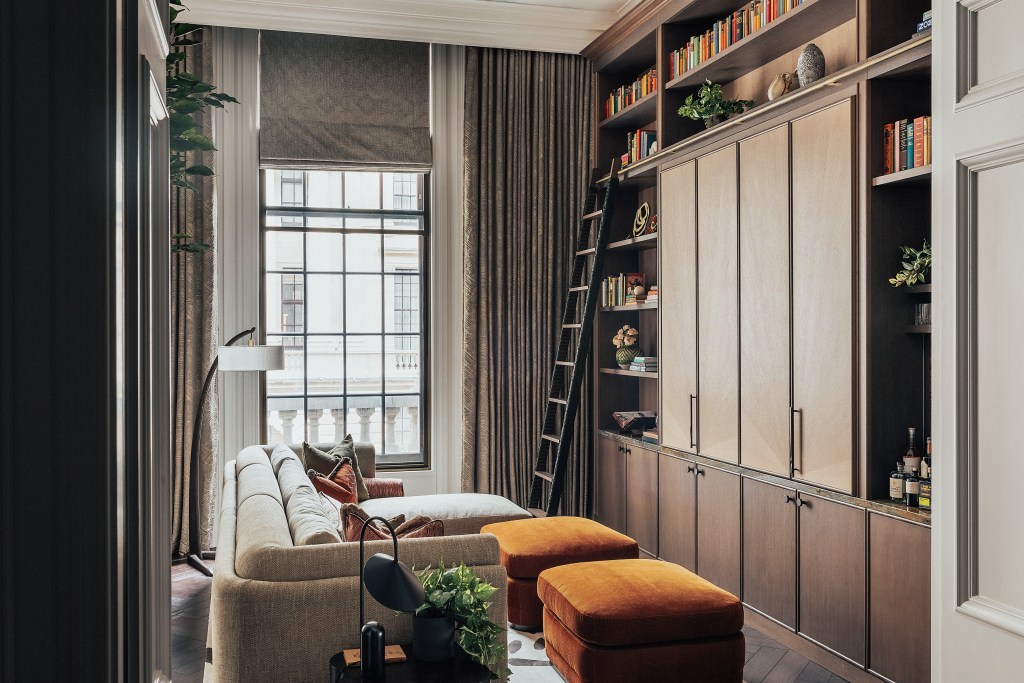
The cocktail bar is just one feature in the joinery unit—a floor to ceiling built-in that’s 14 feet tall by nearly 17 feet wide. As the main feature in the living room, it incorporates shelves, cupboards, a marble cocktail bar, a leather-wrapped library ladder and a smartly concealed TV. “We decided to back light it and use dark oak timber for everything except the veneer, which has a starburst design on it,” he says, “something interesting to look at when the doors are closed.”
On the other side of the living room is a pair of dark timber arches. “Before they were just square niches and the room just didn’t look finished. Now, when you look out the window, there are the same shapes in the neoclassical architecture of the building. It was a small touch that made a huge amount of difference in the room,” he adds.
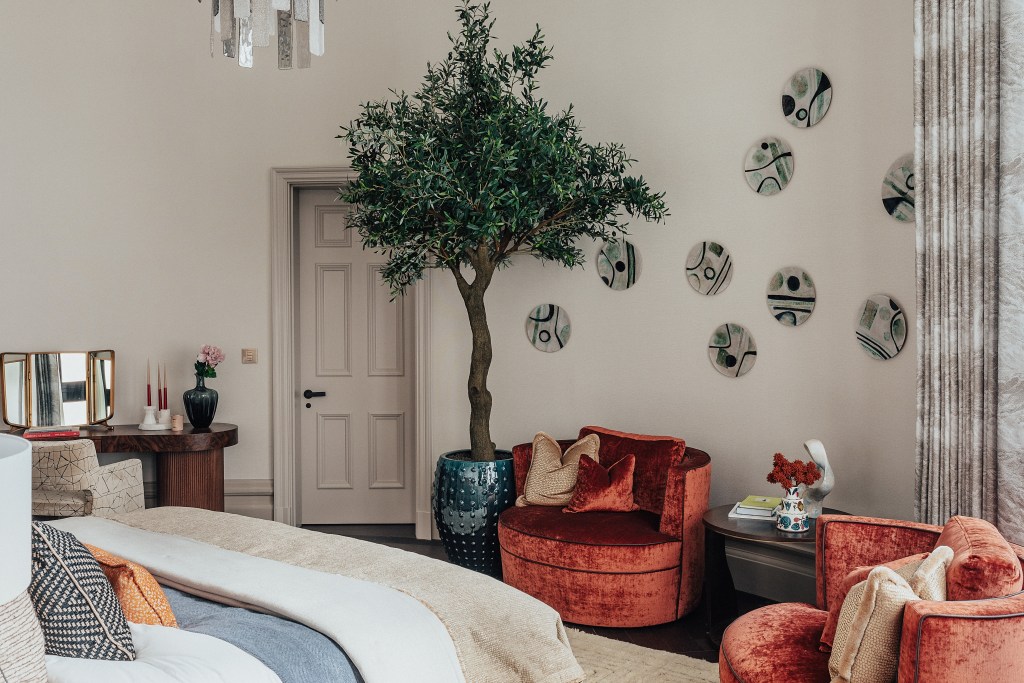
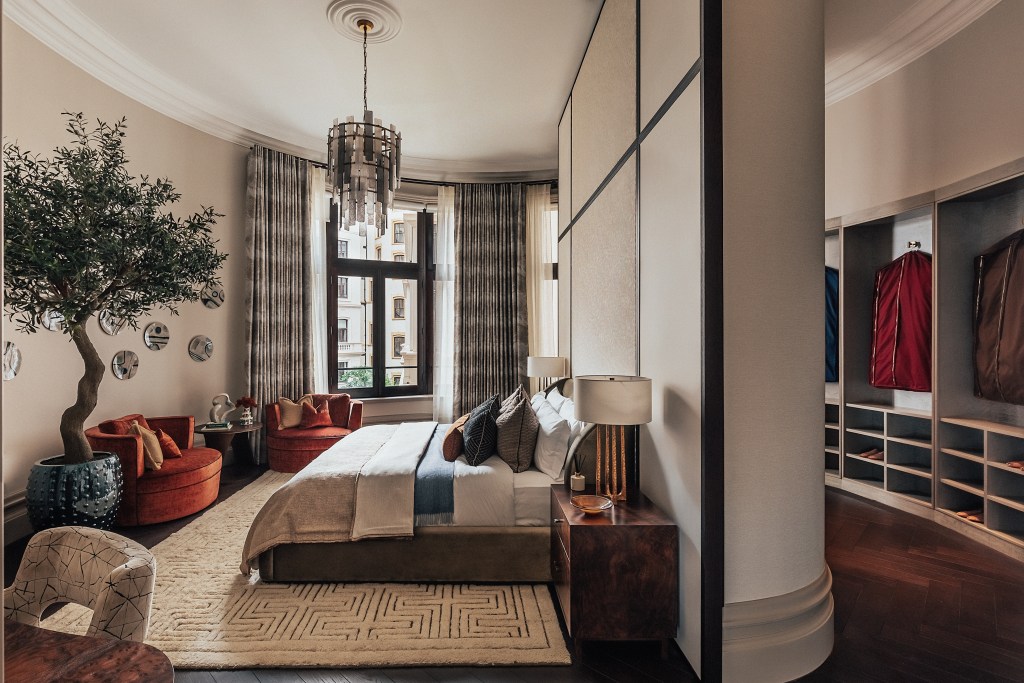
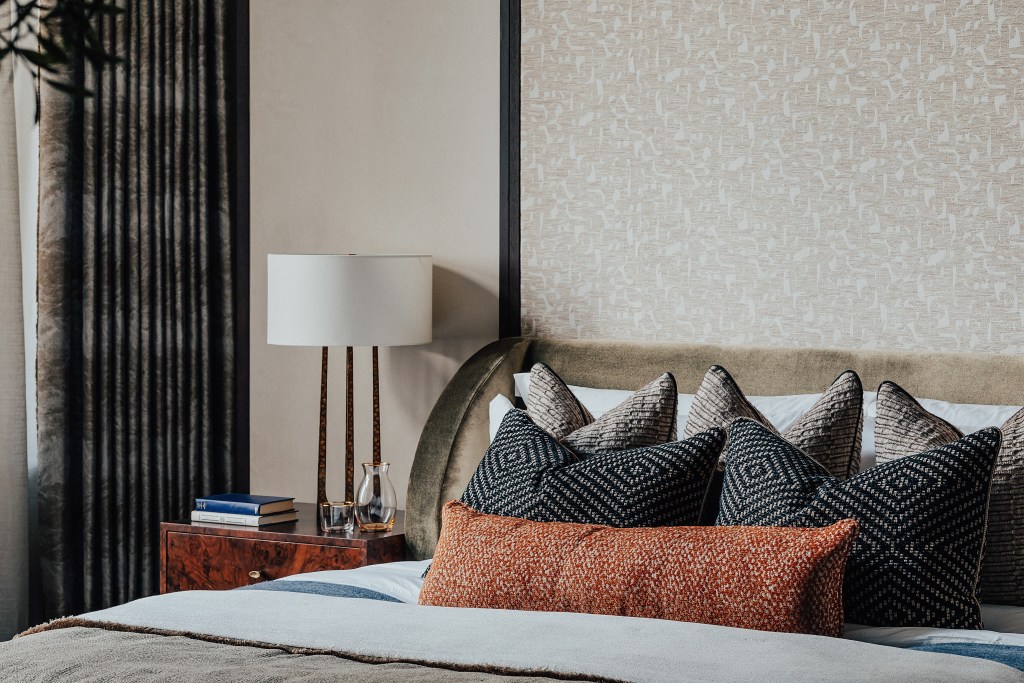
When O’Donnell walked into the primary bedroom for the first time, he was struck by its massive size and round shape. His solution was to create a wall that splits the space in two: sleeping and dressing. “We covered the wall that intersects the circular space in panels of pale suede and organically-patterned velvet.,” he says. “Then we added lots of quietly luxurious furniture—bespoke pieces we designed in-house—including a king size velvet bed, burlwood bedsides, a bean-shaped dressing table with fluted legs and two lavishly large swivel chairs covered in crushed velvet.”
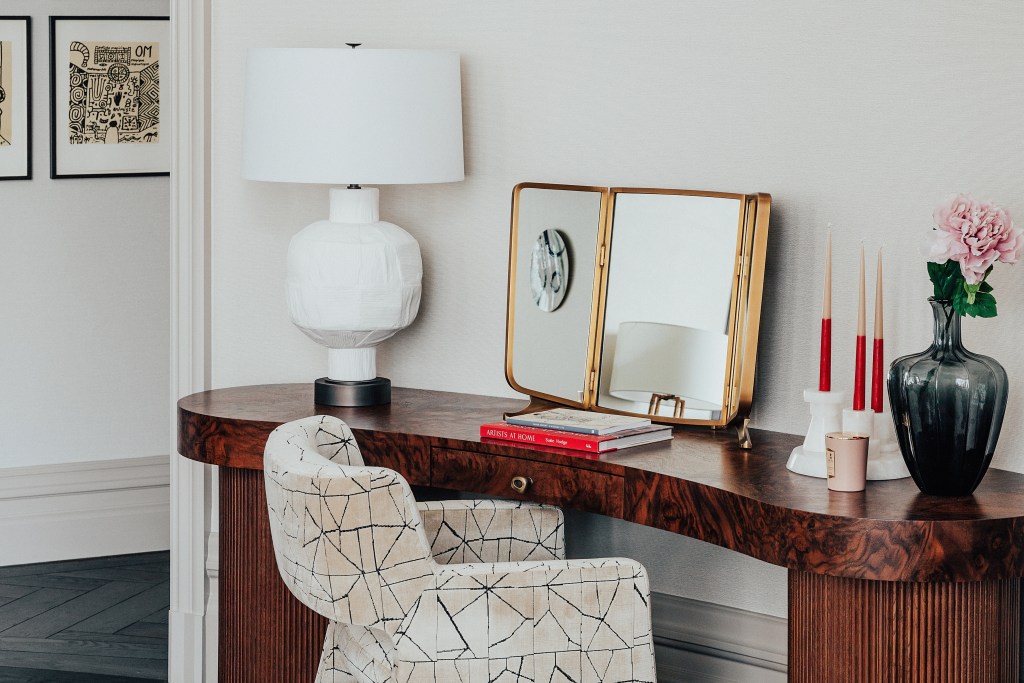
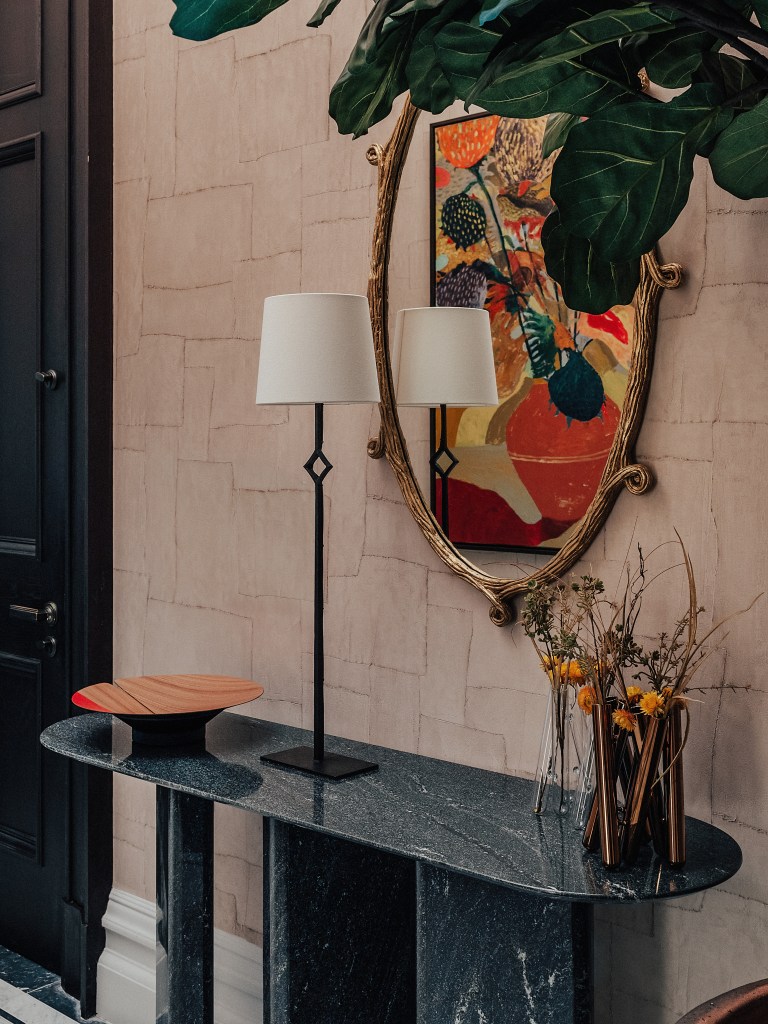
Paintings by British artists Lee Johnson and Jack Penny, ceramic plates by Alicia Corbett and lithographs by the late Scottish Expressionist painter Alan Davie are scattered throughout the space, informing the mood of each room as much as defining it. “This apartment was a study in designing restrained luxury,” says O’Donnell. “Everything feels quite harmonious. Nothing’s screaming one way or the other at you, it’s all singing in harmony. The goal was to have more of a choir than an Aria.”







What are your thoughts?