Two Digger Engines, Nine Miles of Salt and a Hydrogen Land Speed Record
JCB’s Hydromax streamliner carried Andy Green over 406 mph at Bonneville, twenty years after the same driver set the diesel mark on the same lake bed
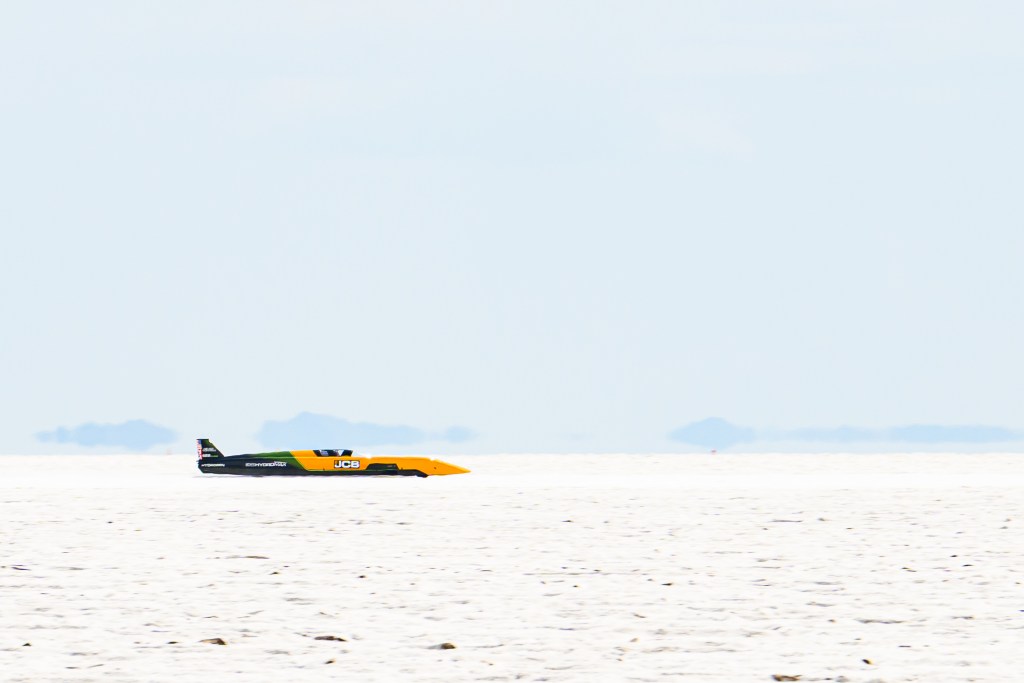
The fastest hydrogen-powered vehicle in the world is, in its essence, two excavator engines wearing a sleek and shiny superhero costume. On the Bonneville Salt Flats this morning, the JCB Hydromax—a 32-foot streamliner driven by retired RAF Wing Commander Andy Green OBE—averaged 406.320 mph across two timed runs to claim an FIA world record for hydrogen. The mark it displaces is 185.5 mph. It also clears the hydrogen fuel cell record of 303 mph and the electric vehicle record of 342 mph, and beats the 350.092 mph Green recorded on this same salt in 2006 aboard the diesel-powered JCB Dieselmax. What left the exhaust as the car crossed the timing traps was simply water vapor.
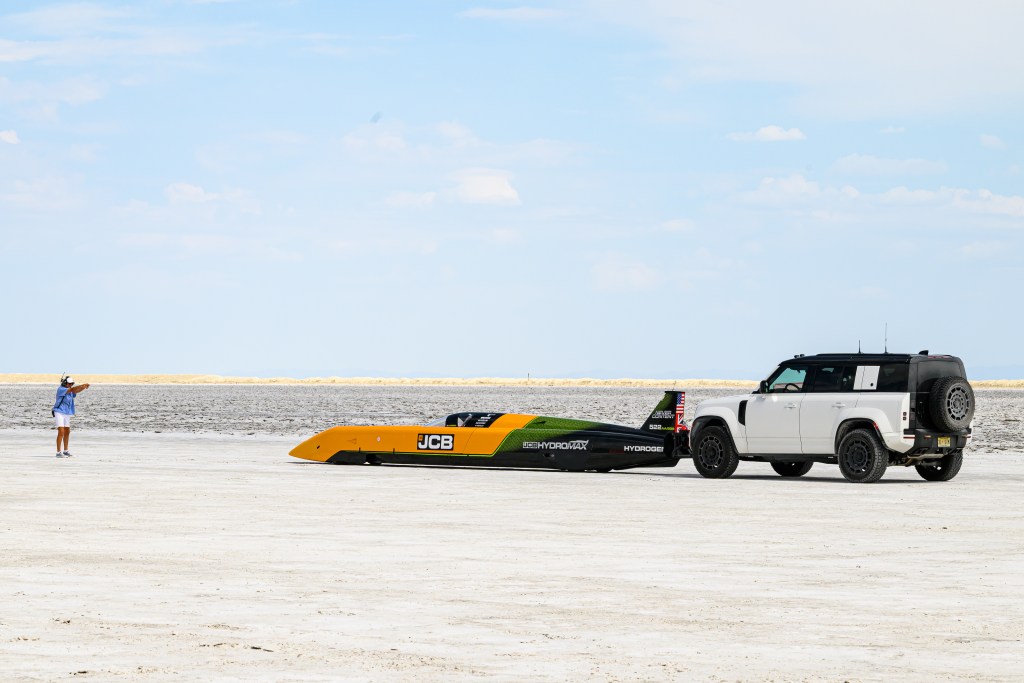
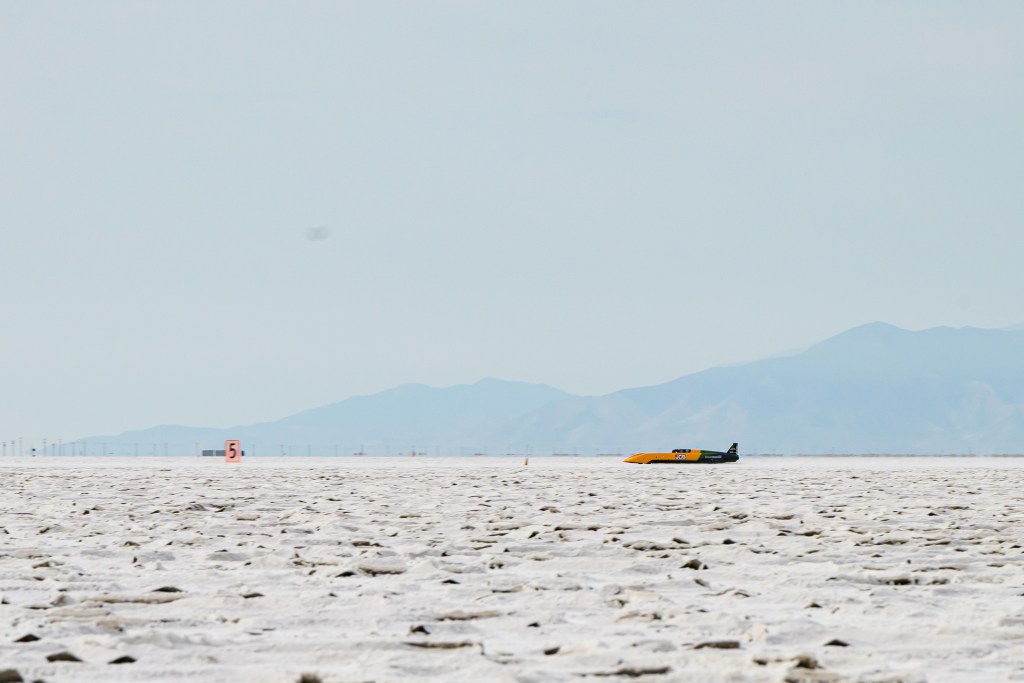
We spent the trial run day on Monday moving between a cooled hospitality tent and a few small shade structures, watching the car take the flying mile at speed on one run and, on the next, watching a white Land Rover Defender OCTA push it up to starting speed. At that distance a streamliner arrives as a flat, dry roar with none of the ragged combustion note a gasoline car leaves behind, and then it is simply gone.
Back in the tent, project director Ryan Ballard laid out the day’s logic. Over the weekend the crew had pulled both engines—the pair that carried Green to a 368.347 mph Southern California Timing Association class record on 6 August, and that by then had absorbed 44 high-speed runs—and installed two of the four spares JCB shipped to Utah, calibrated for the higher output the FIA attempt required. Rain had made the course slipperier. Monday also marked the first time the car had ever launched from the far end, toward the highway, where the grip is different and the salt is unlearned. The afternoon run was set at nine-tenths, measured in engine effort rather than speed. “That final run today will be crucial because that will allow us to make the go/no-go decision for tomorrow,” Ballard said. “It’s motorsport, not just motorsport. It’s brand new technologies and new fuel, and it’s a very, very extreme environment.”
“JCB Dieselmax was always a bit of an unusual idea—but it proved a point,” chairman Lord Anthony Bamford has said of the 2006 project. “Putting an advanced engine into a land-speed car showed the world what it could do in a way a digger never could. It’s the same thinking with hydrogen today. If you’re serious about emissions, you have to be serious about hydrogen—and a land-speed project is the perfect way to prove it.”
The engineering premise is unusually legible for a land speed programme. JCB did not build a fuel cell car. It took the hydrogen internal combustion engine it has spent more than £100 million and 50,000 hours of testing developing at its Foston, Derbyshire powertrain factory, kept the architecture of its diesel predecessor, and tuned two of them to 800 bhp apiece. The block making a combined 1,600 bhp here is a cousin of the one in a backhoe loader.
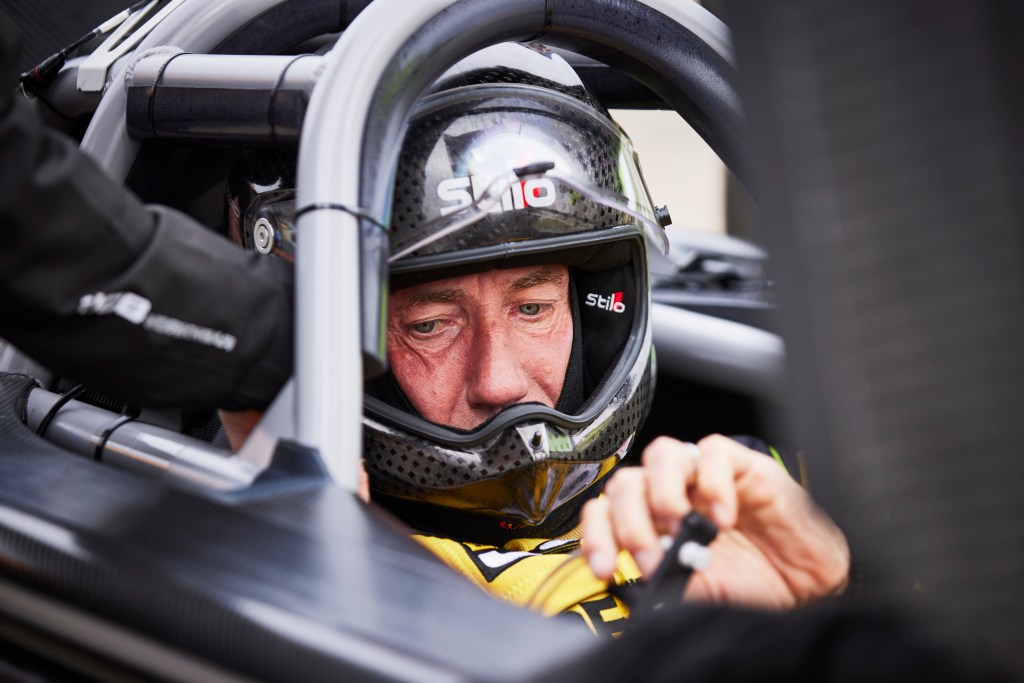
Two decades of aerodynamic study went into the body, which cuts drag ten percent against Dieselmax and squeezes the cockpit to something close to coffin dimensions. Green is six feet three inches. He sits in a carbon fiber tub built the way an F1 survival cell is built, with the fire extinguisher under his legs, and every switch, dial and parachute handle placed to satisfy a rule requiring him to climb out in fifteen seconds. Beneath him, a control system reads acceleration, yaw, GPS, axle speed, damper loads, temperatures and laser ride height one thousand times per second.
Bonneville concedes nothing. The lake bed sits 4,200 feet above sea level, where thin air strangles combustion engines of oxygen, and the usable course has contracted from eleven miles in 2006 to roughly nine—less room to build speed, considerably less to shed it. Carbon aircraft brakes work alongside two parachute systems that deploy electronically, by hand or automatically if sensors detect a tire failure. The tires are Goodyear, made to a compound and carcass belt design unique to this car, and treated as consumables. “Every time a set of tyres go more than 300 miles an hour, we swap them out,” Ballard said, noting that a fresh set goes on for each direction during the mandatory one-hour turnaround. Running the return leg concentrates the mind for a different reason: as he put it, “the next thing that stops you is the I 80.”
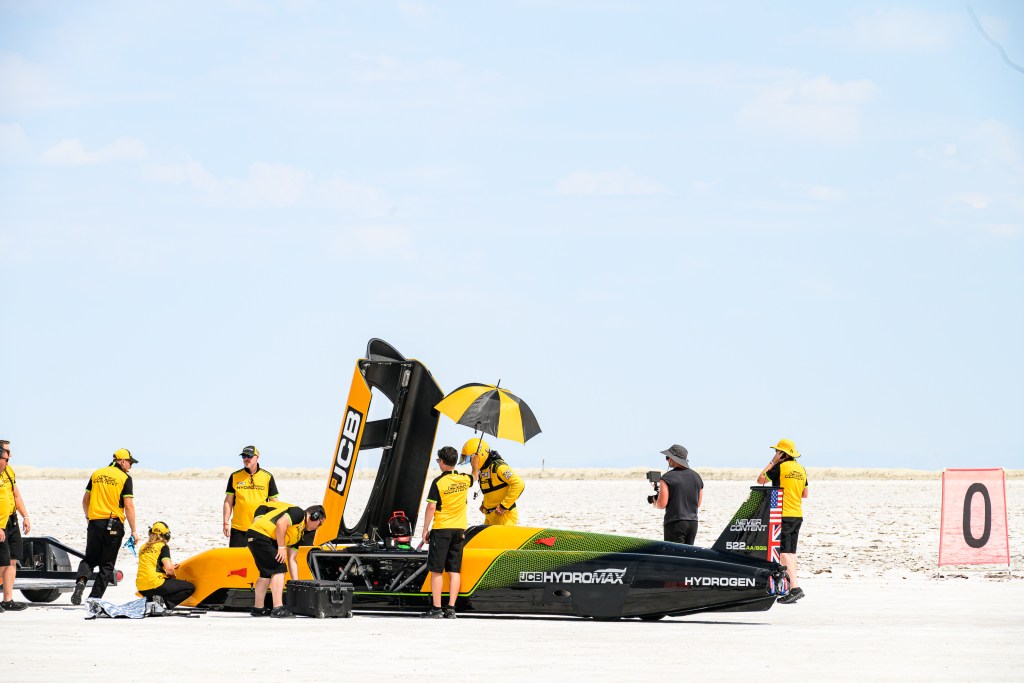
Green packs his own parachutes. Ballard offered this in the manner of a man describing something self-evident: “If you’re the guy sat in the car, who do you trust knows to pack your parachute? Yourself.” Before every run the driver, the team principal and the lead engineers convene and walk through the plan step by step. “It’s a very, very structured approach, and so far it’s worked 44 times.”
Joseph Cyril Bamford started the company in 1945 in a lock-up in Uttoxeter, building steel tipping trailers from war surplus with a prototype electric welder he bought for one pound. His motto, jamais content, survives as the corporate Never Content, which is either excellent branding or an honest account of a family firm that has now returned twice to the same salt flat to make a point about engines. The timing is deliberate: JCB opens its $500 million, one-million-square-foot plant in San Antonio this year, a 400-acre site expected to employ 1,500 people over five years, serving the largest construction equipment market on earth.
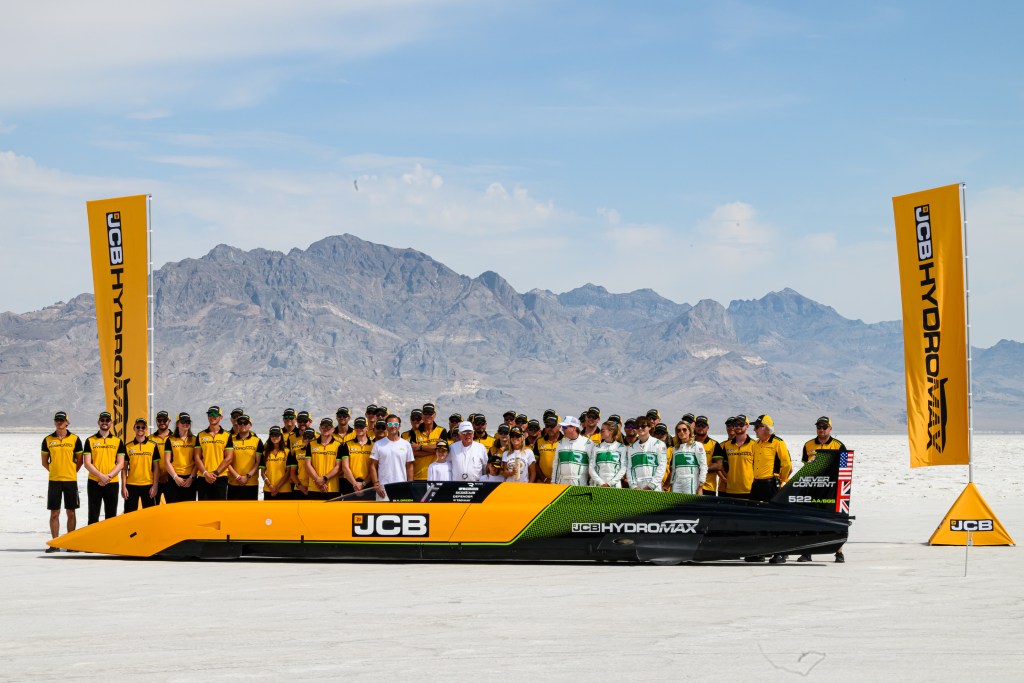
“Twenty years ago, JCB took two of its diesel engines, sprinkled some magic engineering dust on them and put them into a racing car,” Green wrote before the attempt. He got back out of the car this morning onto the same white crust he stepped onto in 2006, having done it this time on a fuel whose worst byproduct is a puddle of water.










What are your thoughts?