Interview: Dan Tepfer, the Musician Coding the Future of Concerts
With a playback piano and VR, the pianist entrances every audience he plays for
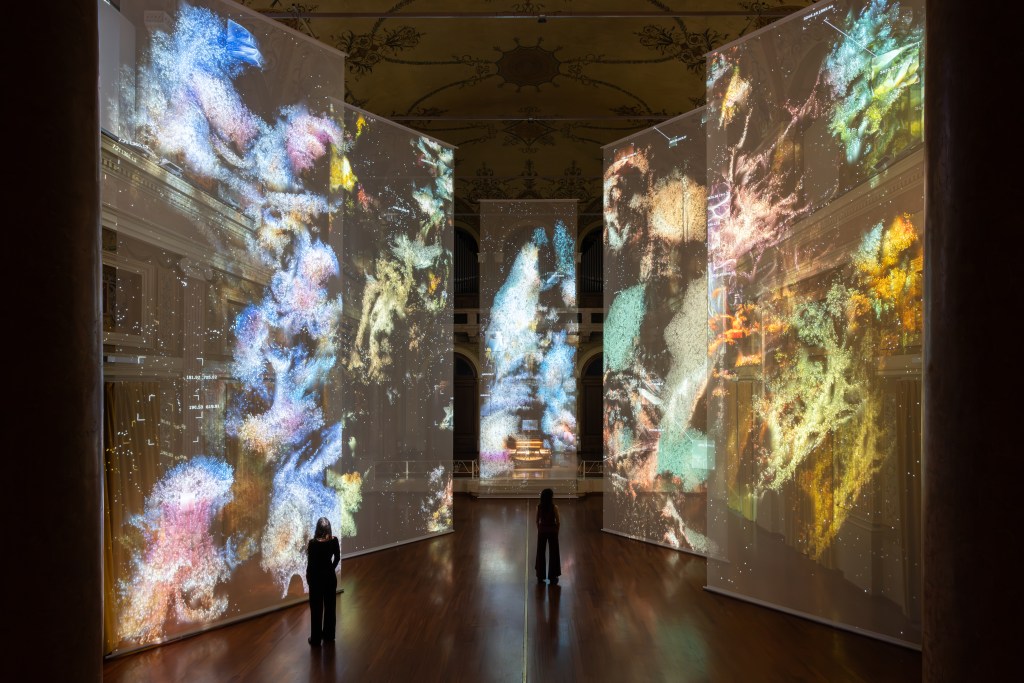
Billed as the future of concerts, Dan Tepfer‘s live show—a solo performance wherein a self-playing Yamaha Disklavier is the only instrument—entrances every attendee. From the intimate-by-choice setting and the Google-branded VR headsets to Tepfer’s winding style, the show captivates with each song and its visual accompaniment—all of which is improvisational and diverges from the original recording. There are rules in music and in coding and, while seeming to break all of them, Tepfer concurrently adheres to both centuries-old and 21st-century rules alike.
His Natural Machines show is an amalgamation of piano developments and coding advancements—Tepfer bridges the gap between technology and music on stage. Combined, Tepfer and his self-made technology form a seamless stream of creative consciousness—which is broken only by moments where he’d instruct the audience to divert their attention from him to the VR headsets they’ve been given. We were fortunate to catch him after his New York show at National Sawdust, wherein he explains the performance’s evolution from its earliest stages to now.
How and when did you get into coding?
I started getting into coding as a kid. I was born in 1982. My dad, a biologist, brought home a Macintosh Plus around 1988 or so. I started making things in HyperCard and slowly getting into the scripting environment there. It was always really fascinating to me. As a kid, it’s easy to feel relatively powerless. But with coding, you have an incredibly powerful machine that will do whatever you ask it to; it’s very empowering. As a teenager, I got into Basic and C. It was all self-taught and, in those days, there was nothing like the online resources there are now, so it was a lot of poking around and experimenting.
So you’ve thought about how your show combines something centuries-old (the piano) with something so 21st century (coding) then?
Yes, a lot. The core of the project, what really makes it work in my opinion, is that the computer plays exactly the same instrument I do—we both are playing this fully acoustic piano. That’s what makes it possible for the computer to play a truly equal part in the music, and also for the music to resonate in the way that I, as a longtime performing musician, want it to be resonating—with the complexity of acoustic sound resonating in a space. At a more abstract level, I love digging deep into the past—into the musical math of Pythagoras, into the contrapuntal rules of Palestrina, into Bach—and making contemporary art with it. So combining something old like the piano (which was considered very high-tech in its day) with something contemporary like the computer feels very natural.
How do the rules of music mingle with the modern rules of technology?
Computers are made to run algorithms, and they’re incredibly good at it—infinitely better than we are. Over the course of music history, people all over the world developed homegrown systems of rules to help them teach music to new generations. They figured out ways of codifying what sounded good to them, or at least the non-mysterious aspects of it. So in many ways, computers are perfectly suited to execute these rules. The rules were figured out by humans, but computers can take care of them in incredibly virtuosic ways. What computers still aren’t very good at, even with the rise of AI, is the emotional/intuitive/mysterious side of art, which is equally important.
One could argue that the piano is made for the intersection of music and tech. At a more general level, there’s something about music, especially instrumental music (which is, by definition, abstract) that lends itself incredibly well to developments in tech. The entire history of music shows this. Composers have had a symbiotic relationship with tech throughout music history—their music would call for further developments in instrument-making, and when those developments happened, they opened up new avenues for composition. It’s the same today. At the end of the day, we want good music, whatever that means—art being, always, in the eye of the beholder. And if a computer or a player piano can help create good music that we haven’t heard before, that’s something that I find very exciting.
Are there moments in specific songs and shows that surprise you still?
Yes, and it’s very important to me that that continues to be the case. When I go on stage, I commit to really improvising—to creating music that is uniquely of the moment, specific to this instrument, this space, this audience, this state of mind that I’m in. So hopefully, what I’m playing will already have moments of genuine surprise for me. But add what the computer does in response to this, with varying layers of complexity, and it becomes doubly surprising. And what’s best is that the surprise feeds on itself—it opens the door to further discoveries and surprises.
That’s perhaps my favorite aspect of this project. It turns the piano, this instrument that I’ve been playing most every day for the last 30 years, into a brand new instrument, an instrument that constantly yanks me away from my comfort zone and leads me to discover aspects of my musicality I didn’t know were there. I’m pretty sure that Bach used creative constraints in much the same way—to make himself a little uncomfortable, just to see how he would get out of the corner he’d painted himself into.
Tepfer is currently touring in support of Natural Machines.
COOL HUNTING always gets permission to use the images we publish; however, as an independent publication, we cannot afford to continue fighting unfair claims of copyright infringement, so the images have been removed from this post.